Why Can’t We Purify Ocean Water?
You are surrounded by water, yet dying of thirst. That is the cruel paradox of our oceans. Over 97% of Earth’s water is seawater, vast and technically purifiable. So why can we not simply turn the entire ocean into drinking water? The truth is, we can purify ocean water. Over 177 countries already use desalination to produce about 95 million cubic meters of freshwater daily. Yet less than half a percent of global human water needs are met by this process.
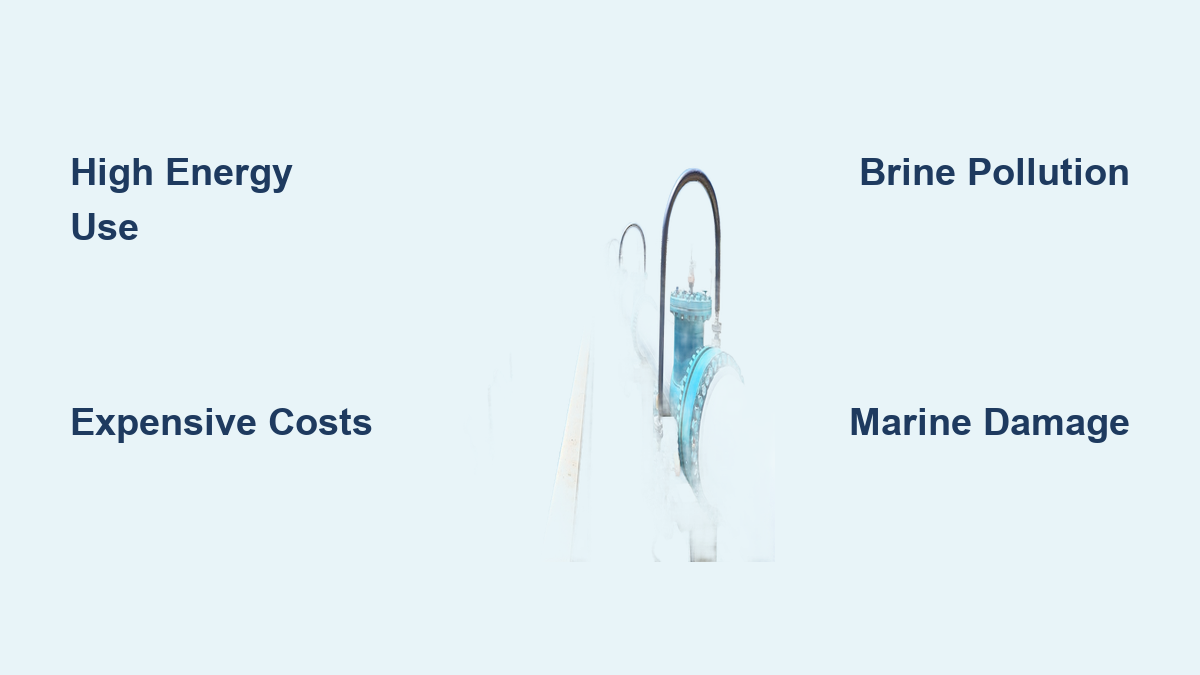
Desalination works. But scaling it to solve the world’s growing water crisis is where the real challenge begins. The barriers are not technological failure. They are a storm of energy demands, environmental damage, economic costs, and social inequity.
Core Barriers to Ocean Water Purification

High Energy Demands
Desalination is one of the most energy-intensive water treatment processes on Earth. To separate salt from water, you must overcome powerful chemical and physical forces. In reverse osmosis (RO), the most common method, seawater is forced through semi-permeable membranes at pressures up to 600 psi, requiring 1 to 2 kilowatt-hours per cubic meter of water.
Thermal distillation, which heats seawater to produce steam, uses even more energy due to the high latent heat of vaporization. A single plant in Kuwait consumes 889 gigawatt-hours annually, enough to power tens of thousands of homes. The Carlsbad plant in California uses as much electricity as 35 small towns. When energy prices spike, so does the cost of water, which is dangerous during droughts when water is most needed.
Prohibitive Costs
Even with advancing technology, desalinated water remains expensive. Producing one cubic meter (about 264 gallons) costs between $1 and $2, compared to just $0.10 to $0.20 for traditional freshwater sources. For farmers, who use 75 to 90% of global freshwater, this price difference is insurmountable.
Projects like Carlsbad cost 73% more than existing municipal supplies. While new dams or pipelines can push traditional costs up to $0.60 per cubic meter, desalination still is not cost-competitive for most regions. Building a plant also requires massive upfront spending on high-pressure pumps, corrosion-resistant materials, and complex filtration systems.
Environmental Damage
Purifying ocean water does not just take energy. It harms the ocean itself.
Brine Disposal Crisis
For every liter of freshwater produced, 1.5 liters of hyper-saline brine are discharged back into the sea. This brine is twice as salty as seawater and often contains toxic pretreatment chemicals like chlorine and copper. Because it is denser, it sinks and forms oxygen-depleted layers on the seafloor, suffocating marine life.
Globally, desalination plants dump 142 million cubic meters of brine daily. While some plants use diffusers or mix brine with wastewater to improve dilution, many lack proper mitigation, especially in developing nations.
Marine Life Destruction
Intake systems suck in billions of marine organisms annually. Small fish, plankton, larvae, and eggs get trapped against screens or destroyed inside the plant. This disrupts food chains and damages biodiversity in sensitive coastal zones.
Why Seawater Is Deadly to Drink
Osmotic Dehydration Explained
You cannot drink seawater because it triggers cellular dehydration. Human blood has a salinity of about 9 parts per thousand (ppt). Seawater averages 35 ppt, nearly four times saltier. When you ingest it, your body’s cells are exposed to a hypertonic environment. Water flows from low-salt areas (your cells) to high-salt areas (your bloodstream) via osmosis, pulling fluid out of your tissues.
Your kidneys try to excrete the excess salt, but they can only produce urine less salty than seawater. To eliminate 100 mL of salt, your body must use more than 100 mL of its own water, accelerating dehydration. The result is organ failure, neurological damage, and death.
WHO Standards for Safe Drinking Water
The World Health Organization recommends drinking water have less than 500 mg/L (0.5 ppt) of dissolved solids. Seawater’s 35,000 mg/L means desalination must remove over 98% of the salt, a massive technical challenge.
Desalination Technologies: How Purification Works
Reverse Osmosis: The Modern Standard

Reverse osmosis dominates new desalination projects due to its relative efficiency. Seawater is pushed through semi-permeable membranes with pores so small they block salt ions. These membranes require extreme pressure, about 40 times atmospheric pressure, to overcome natural osmotic pressure. Only about 40 to 50% of intake water becomes freshwater. The rest becomes brine.
Membranes are prone to fouling from minerals, microbes, or organic matter. This reduces efficiency and requires chemical pretreatment, regular cleaning cycles, and periodic membrane replacement.
Thermal Distillation: Boiling the Ocean
This older method still powers some of the world’s largest plants, especially in oil-rich Gulf states. In Multi-Stage Flash (MSF) evaporation, seawater is heated and passed through expansion valves into lower-pressure chambers, causing instant evaporation. The vapor is then condensed into freshwater.
Many thermal plants are built alongside fossil fuel power stations to use waste heat. This reduces energy costs but ties water production to carbon emissions. The world’s largest plant, Ras Al-Khair in Saudi Arabia, produces 2 billion liters daily using hybrid thermal-RO technology.
Economic and Equity Challenges
Privatization and Rate Hikes
Many desalination projects use public-private partnerships, where private companies build and operate plants in exchange for long-term water purchase agreements. While this shifts financial risk, it often leads to higher consumer costs.
In San Diego County, desalinated water contributed to a 17% rate increase between 2015 and 2018. Critics argue these partnerships prioritize profit over public good and reduce community control over water resources.
Water Inequality and Environmental Justice
Desalination plants are often sited in low-income or marginalized communities, while the benefits flow to wealthier areas. In Marina, California, a plant approved to serve affluent communities like Pebble Beach will be located where one-third of residents are low-income. They bear the noise, traffic, and pollution.
In Huntington Beach, California, a proposed plant would sit in a region already burdened by landfills and power plants, an area dubbed the “toxic triangle.” It would increase electricity demand and air pollution, disproportionately affecting high-poverty neighborhoods.
Globally, 62% of low-income households in desalination-dependent areas face unaffordable water bills.
Innovations That Could Change the Game

Solar-Powered Desalination
Renewable energy could decouple desalination from fossil fuels. Researchers at the University of Rochester developed a laser-etched black metal surface that absorbs sunlight and heats a thin water layer for distillation. It draws water across the surface and uses the “coffee ring effect” to deposit salt in passive zones, preventing scaling. No chemicals. No brine. No moving parts.
In Saudi Arabia, the futuristic Neom City plans a giant glass dome with parabolic mirrors to concentrate sunlight, evaporating seawater in a fully renewable system.
Brine-to-Resource: Mining the Waste
Instead of treating brine as waste, new tech aims to extract valuable minerals. Seawater contains lithium (50 ppm), uranium (3.3 ppm), cobalt, nickel, and magnesium. Global desalination could theoretically yield 10 million kg of lithium per day, enough for 142,000 electric vehicles. If recovery becomes economical, desalination plants could become mineral refineries, offsetting costs and reducing mining impacts.
Advanced Membranes
Graphene-based membranes can filter salt with lower pressure requirements, slashing energy use by up to 50%. They are also more resistant to fouling and chlorine damage.
Why Alternatives Are Often Better
Wastewater Recycling: Cheaper and Greener
Treating wastewater requires less energy than desalination because it is already low in salt. Cities like Singapore (NEWater) and Orange County, California already recycle wastewater at scale. It is local, sustainable, and up to 50% cheaper than ocean desalination.
Rainwater Harvesting
Collecting rainwater costs one-fifth as much as desalination. In tropical or temperate regions, rooftop systems can supply households with minimal infrastructure.
Fixing Leaks and Reducing Waste
In many cities, 30 to 50% of water is lost to leaks in aging pipes. In the U.S., water main breaks exceed 240,000 per year. Investing in infrastructure repair is often more cost-effective than building new desalination plants.
Agricultural Efficiency
Farming uses 75 to 90% of freshwater globally. Shifting to drip irrigation, drought-resistant crops, and reducing meat consumption could save more water than any desalination project.
The Future of Ocean Water Purification
Hybrid Models: Renewables + Desalination
The most promising path forward combines solar, wind, or geothermal energy with desalination. Pilot projects in Chile, Australia, and the UAE show that renewable-powered RO is technically feasible.
Policy and Governance Reforms
To avoid inequity, desalination must be governed with transparency, community input, and affordability safeguards. Long-term contracts should include brine reduction mandates, renewable energy requirements, and rate caps for low-income users.
A Tool, Not a Panacea
Desalination will remain essential for arid, coastal regions like the Middle East, California, and parts of Australia. But it is not a one-size-fits-all solution. The future lies in integrated water management, combining conservation, recycling, rainwater harvesting, and targeted desalination, to build resilient, equitable water systems.
Frequently Asked Questions About Ocean Water Purification
Can humans drink seawater if it is filtered?
No. Simple filtration cannot remove dissolved salt ions. Desalination requires specialized processes like reverse osmosis or thermal distillation to separate salt from water at the molecular level.
Why is desalination so expensive?
Desalination requires massive amounts of energy to force water through membranes or boil it. It also demands costly infrastructure, including high-pressure pumps, corrosion-resistant materials, and ongoing membrane replacement.
Does desalination harm the environment?
Yes. It produces large volumes of hyper-saline brine that can smother seafloor ecosystems. Intake systems also kill billions of marine organisms annually, and many plants rely on fossil fuel energy, contributing to carbon emissions.
What is the biggest alternative to desalination?
Wastewater recycling is often the most cost-effective alternative. It requires less energy than ocean desalination and provides a reliable local water source. Rainwater harvesting and fixing leaking pipes are also highly effective.
Could solar power make desalination affordable?
Potentially. Solar-thermal innovations like the superwicking black metal surface and projects like Neom’s hydrological sphere aim to power desalination with renewable energy, which could lower costs and eliminate carbon emissions.
Key Takeaways on Why We Cannot Purify Ocean Water at Scale
We can purify ocean water, but we cannot do it at scale without paying a steep price in energy, ecology, and equity. The ocean is not a magic faucet. It is a complex system we must treat with respect. The real solution is not just technology. It is smarter, fairer, and more sustainable water use. Start by supporting local water conservation efforts, advocating for infrastructure repair, and demanding transparency in any desalination project proposed in your region.