Different Types of Reverse Osmosis Systems
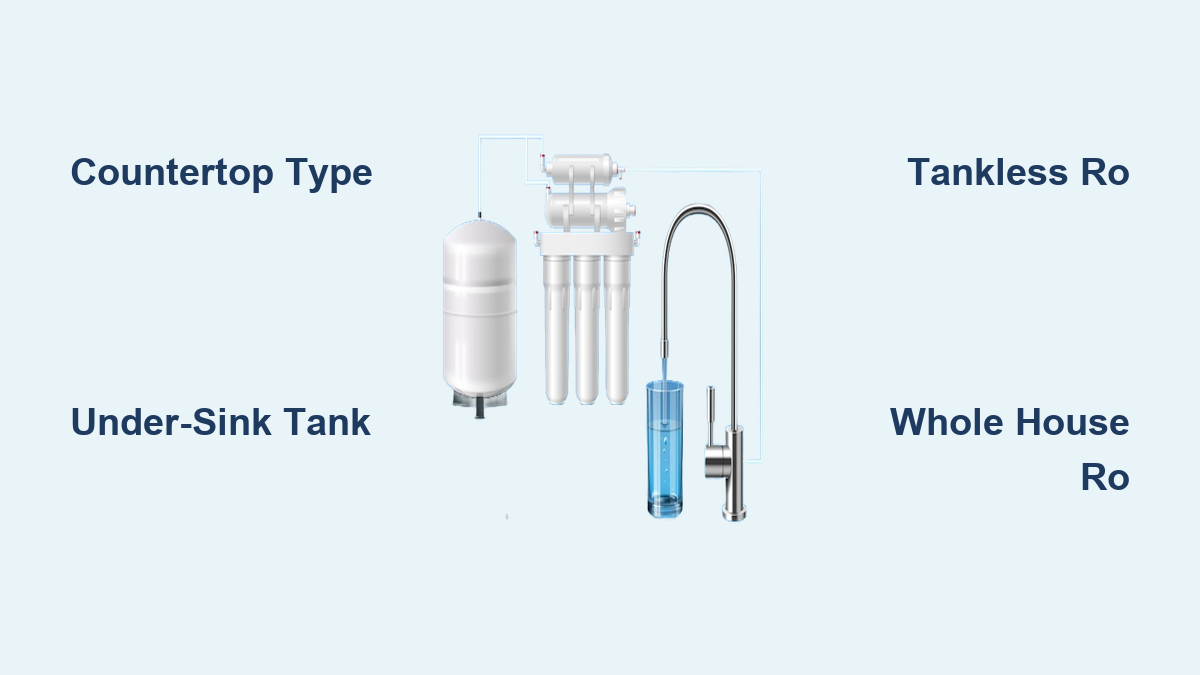
Reverse osmosis (RO) systems remove up to 99% of contaminants like lead, fluoride, arsenic, nitrates, and microplastics, making them one of the most effective ways to purify drinking water at home. But not all RO systems work the same way. The right choice depends on your space, water quality, household size, and budget. From compact countertop models perfect for renters to high-capacity under-sink and whole-house units, there is a system tailored to nearly every home.
This guide breaks down the different types of reverse osmosis systems, comparing their performance, efficiency, installation needs, and ideal use cases. You’ll learn how each type works, what it costs to operate, and which option best fits your situation.
Countertop RO Systems: Portable and Plug-and-Play
Countertop RO systems sit on your kitchen counter and connect to the faucet via a diverter valve or use a manual fill reservoir. They require no permanent plumbing, making them ideal for renters, small apartments, RVs, or anyone who wants purified water without drilling holes.
Best Overall: AquaTru Carafe
The AquaTru Carafe earned a near-perfect 9.57/10 performance score in independent testing. It holds IAPMO certification to NSF/ANSI 42, 53, 58, and 401, which means it is independently verified to remove chlorine, heavy metals, pesticides, pharmaceuticals, and fluoride. Testing showed it eliminates 100% of detected health-impacting contaminants in tap water, including uranium, chloroform, and total THMs.
Key specifications include:
- Efficiency: 4:1 pure-to-waste ratio (best in its class)
- Filtration Speed: 0.03 GPM (8 cups in roughly 17 minutes)
- Filter Life: Pre-filters last 300 gallons; RO membrane lasts 1,200 gallons
- Design: Glass carafe improves taste and durability compared to plastic tanks
The base model does not include remineralization, but an optional Alkaline Classic upgrade raises pH to 10.7 and adds beneficial minerals. At $0.19 per gallon in operating costs, it remains efficient and effective for users who prioritize purity and ease of use.
Hot and Cold Countertop Option: Waterdrop A1
For users who want temperature control, the Waterdrop A1 delivers hot and cold water ranging from 41°F to 203°F. It features a digital display with preset dispensing volumes and costs $650. It holds NSF 58 certification and removes over 95% of TDS.
Performance highlights include:
- Efficiency: 2:1 pure-to-waste ratio
- Flow Rate: 0.042 GPM (faster than most countertop models)
- Features: Built-in TDS monitor, energy-saving modes, lead-free construction
The main drawback is the lack of remineralization, which results in acidic water at pH 6.5. Operating costs run $0.27 per gallon, higher than most under-sink alternatives.
Advanced Countertop with UV: Philips Water Dispenser
The Philips Water Dispenser ($799) includes a 6-stage filtration process with UV sterilization and built-in remineralization. This setup maintains balanced pH and prevents bacterial growth. Testing showed it removes uranium, fluoride, and nitrate effectively.
However, it is not NSF certified, which raises concerns about third-party validation. Testing also detected trace manganese and an unspecified impurity in filtered water. It comes with a 2-year warranty (longer than average) and suits users who want hot/cold water with mineral-balanced output.
Under-Sink RO Systems: Permanent and High-Capacity
Under-sink RO systems install beneath the kitchen sink and deliver purified water through a dedicated faucet. They are the most common choice for homeowners, offering consistent performance and discreet installation.
Tank-Based Systems: On-Demand Water
Traditional under-sink units use a pressurized storage tank (typically 3–4 gallons) to store purified water, allowing instant access without waiting for filtration.
Top Pick: Cloud RO
The Cloud RO system (9.24/10 score) leads in performance and smart integration. It holds NSF 58 certification and removes over 200 contaminants, including fluoride, aluminum, and copper.
Notable features include:
- Efficiency: 1:1 pure-to-waste ratio (lowest waste among tank systems tested)
- Flow Rate: 65–80 GPD (fills 12 oz in about 2 minutes)
- Smart Features: App connectivity tracks filter life, TDS, battery status, and tank volume
- Power: Built-in battery pack (no outlet needed); replace every 1.5 years
A common issue with tank systems is TDS creep, where the first draw after idle shows elevated TDS (284 PPM in Cloud RO testing), dropping to 68 PPM after flushing. Installation requires drilling for the faucet and drain line. Operating costs run $0.26 per gallon with approximately $200 in annual maintenance.
Budget Option: APEC ROES-PH75
The APEC ROES-PH75 ($269) offers a cost-effective, NSF 58-certified tank system with a low $0.10 per gallon operating cost. It provides reliable performance and high contaminant rejection without smart features. This system works well for budget-conscious buyers who want proven filtration without extra technology.
Tankless Under-Sink Systems: Space-Saving and On-Demand
Tankless RO systems eliminate the bulky storage tank, filtering water instantly using a built-in high-pressure pump. These are ideal for small kitchens or modern homes where space matters.
Best Tankless: Waterdrop G3 P800
The Waterdrop G3 P800 (9.21/10) delivers 800 GPD flow, among the fastest in residential RO, with a compact footprint.
Key specifications include:
- Efficiency: 3:1 pure-to-waste ratio
- Flow Rate: 886.54 GPD (fills 12 oz in 9 seconds)
- TDS Creep: Minimal (67 PPM first draw from 656 PPM feed)
- Smart Features: TDS-monitoring faucet, filter alerts, optional UV sterilization
An optional $30 remineralization filter restores pH to 7.5 and adds alkalinity. Testing noted nitrite (0.24 PPM) appeared during remineralization testing, possibly due to biofilm, requiring regular sanitization. The pump generates 43–46 dB of noise during operation. Operating costs run $0.11–$0.13 per gallon.
Whole House RO Systems: Full-Home Purification
Whole house RO systems are point-of-entry (POE) units that treat all water entering the home. These large-scale systems are used in areas with severe contamination or high TDS.
Key Specifications
- Capacity: 300–4,000+ GPD
- Operating Pressure: 100–225 PSI
- Installation: Requires dedicated space, high-pressure plumbing, and electrical connection
Pros and Cons
- Treats water for showers, laundry, and appliances
- Removes sodium and scale-forming minerals
- High cost ($3,000+) and massive water waste
- Complex maintenance requirements
When to Consider
Only recommended if your water has extremely high TDS (above 500 ppm), you have sodium-sensitive health conditions, or you need ultra-pure water for medical or industrial use. For most homes, combining an under-sink RO with a whole-house carbon or UV filter proves more practical and cost-effective.
Commercial RO Systems: High-Volume Purification
Commercial RO units serve businesses requiring large volumes of purified water, such as restaurants, hospitals, and laboratories.
Capacity and Applications
- Flow Rates: 150–50,000+ GPD
- Uses: Coffee brewing, ice machines, dialysis, pharmaceutical production
Key Features
- Booster pumps maintain pressure
- Flow and pressure gauges for monitoring
- Large membrane arrays for continuous output
- Automated controls and sanitization cycles
These systems ensure consistent taste, equipment longevity, and regulatory compliance, which are critical in food service and healthcare settings.
Membrane Technology: TFC vs. CTA
All modern residential RO systems use spiral-wound membranes, but the material significantly affects performance.
Thin Film Composite (TFC/TFM)
- Standard in 99% of modern systems
- Superior rejection rates (95–99% for most contaminants)
- Requires carbon pre-filter to remove chlorine, which destroys TFC membranes
- Operates at low pressure (40–100 psi)
Used in AquaTru, Cloud RO, Waterdrop, and APEC systems.
Cellulose Triacetate (CTA)
- Obsolete for most home use
- Chlorine-tolerant, designed for chlorinated municipal supplies
- Lower rejection rates and limited capacity (10–16 GPD)
- Rarely found in new installations
Avoid CTA unless specifically required for your water type.
Efficiency and Water Waste: What the Ratios Mean
Water efficiency is measured as pure water produced versus wastewater generated.
| System | Efficiency Ratio | Waste per Gallon Pure |
|---|---|---|
| AquaTru Carafe | 4:1 | 0.25 gal |
| Waterdrop G3 P800 | 3:1 | 0.33 gal |
| Waterdrop A1 | 2:1 | 0.50 gal |
| Cloud RO | 1:1 | 1.00 gal |
| Traditional RO | 1:4 | 4.00 gal |
Higher ratios mean less waste. Efficiency depends on water pressure, temperature, and TDS levels. Cold water or low pressure reduces output.
Remineralization: Why It Matters
RO water is very pure but acidic and mineral-deficient, which can affect taste and long-term health.
Systems with Remineralization
- Cloud RO: Built-in filter raises pH from 8.0 to 8.7
- Waterdrop G3 P800: Optional add-on raises pH to 7.5
- AquaTru: Alkaline upgrade available (pH up to 10.7)
- Philips: Built-in stage maintains balanced pH
Without remineralization, RO water can be corrosive to pipes and may leach minerals from your body over time. Consider a system that restores calcium, magnesium, and bicarbonates.
Installation and Maintenance Requirements
Installation Difficulty
| Type | Difficulty | Tools Needed |
|---|---|---|
| Countertop | Easy (Plug-and-play) | None |
| Under-Sink (Tank) | Moderate | Drill, wrench, tubing cutter |
| Tankless | Moderate | Same as tank, plus electrical |
| Whole House | Professional | Plumbing, electrical, permits |
Filter Replacement Schedule
- Sediment and Carbon Pre-filters: Every 6–12 months
- RO Membrane: Every 2 years (or 1,200–2,900 gallons)
- Remineralization Filter: Every 6–12 months
- UV Lamp: Annually
Smart systems like Cloud RO and Waterdrop send alerts via app or display when filters need attention.
Choosing the Right RO System for You
For Renters and Portability: Countertop RO
- Best: AquaTru Carafe (highest purity, glass carafe)
- Hot/Cold Option: Waterdrop A1 or Philips Dispenser
- No Drilling: All countertop models are plug-and-play
For Families and High Usage: Under-Sink Tank
- Best: Cloud RO (smart, efficient, app-controlled)
- Budget: APEC ROES-PH75 (low cost per gallon)
- On-Demand: Storage tank ensures instant flow
For Small Kitchens: Tankless Under-Sink
- Best: Waterdrop G3 P800 (800 GPD, compact, fast)
- Space-Saving: No bulky tank under sink
- Fresher Water: No stagnation in tank
For Whole-Home Needs: POE RO (Rarely Recommended)
- Only if: Severe TDS, sodium issues, or medical necessity
- Alternative: Combine under-sink RO with whole-house carbon/UV
Frequently Asked Questions About Reverse Osmosis Systems
What is the most efficient type of reverse osmosis system?
The AquaTru Carafe leads with a 4:1 pure-to-waste ratio, producing only 0.25 gallons of wastewater per gallon of purified water. Among under-sink systems, the Waterdrop G3 P800 achieves 3:1, while the Cloud RO reaches 1:1.
Do all reverse osmosis systems remove the same contaminants?
No. Performance varies significantly. The AquaTru Carafe eliminated 100% of detected health-impacting contaminants in testing, while others may only target specific substances. Always check NSF certifications (42, 53, 58, 401) for verified removal claims.
Is a tankless RO system better than a tank-based system?
Tankless systems save space and deliver fresher water without stagnation. Tank-based systems offer instant high-volume access and typically cost less. Your choice depends on kitchen space, household size, and whether you prioritize freshness or immediate flow.
Why does my RO water taste acidic?
RO filtration removes minerals along with contaminants, often dropping pH below 7. This acidic water can taste flat and may corrode metal pipes over time. Adding a remineralization filter restores calcium, magnesium, and bicarbonates while raising pH to a neutral or slightly alkaline level.
How often do I need to replace RO filters?
Pre-filters typically need replacement every 6–12 months. The RO membrane lasts about 2 years or 1,200–2,900 gallons. Remineralization filters align with pre-filter changes, and UV lamps require annual replacement. Smart systems alert you when service is due.
Can I install an under-sink RO system myself?
Most under-sink systems require drilling for a dedicated faucet and drain line connection. If you’re comfortable with basic plumbing and have the right tools, DIY installation is possible. However, improper installation risks leaks, so professional installation is recommended for whole-house systems.
Key Takeaways for Choosing the Right Reverse Osmosis System
The different types of reverse osmosis systems each serve distinct purposes. Countertop models offer flexibility and portability for renters and small spaces. Under-sink tank systems deliver high volume and convenience for families. Tankless units save space and provide fresher water in modern kitchens. Whole-house systems remain niche solutions for extreme contamination cases, while commercial RO handles large-scale business demands.
When choosing, prioritize NSF certification, efficiency ratio, remineralization capability, and smart features that match your lifestyle. The best system balances performance, cost, and fit for your specific needs. Start by identifying your installation constraints, water quality concerns, and daily usage to narrow down your options.