How 5-Stage Reverse Osmosis Systems Work
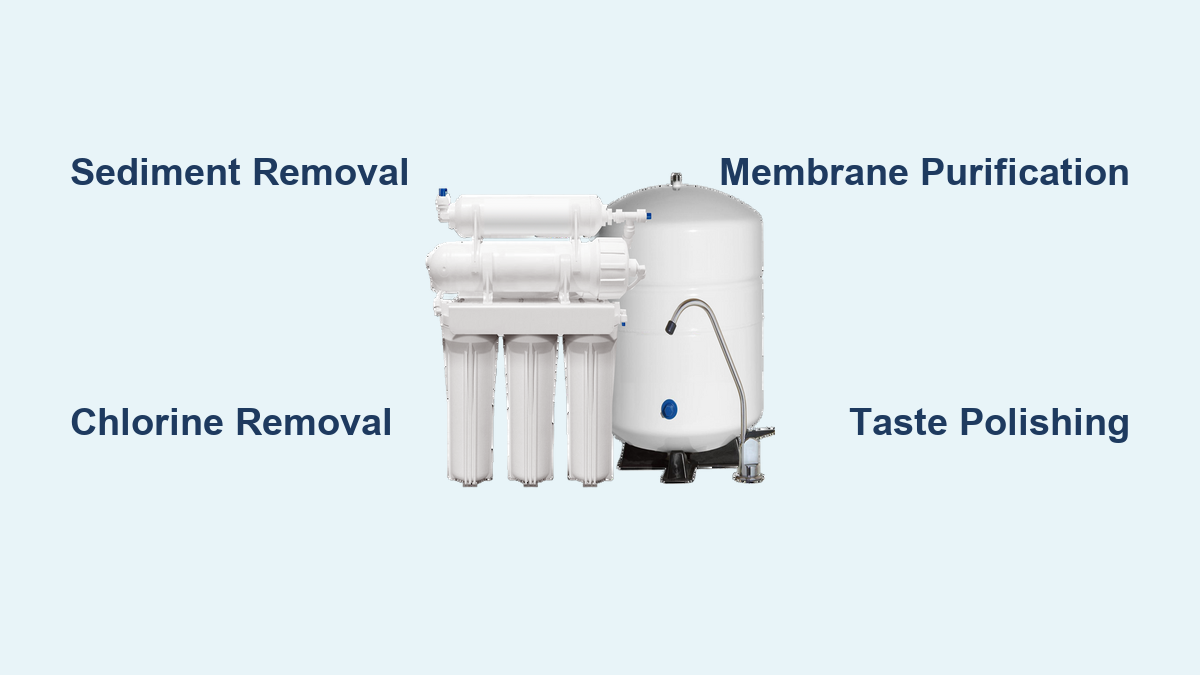
If your tap water tastes metallic, leaves spots on glasses, or you worry about invisible contaminants like lead and PFAS, understanding how does a 5 stage reverse osmosis system work can change the way you think about drinking water. This setup is not just a filter. It is a precision purification process that strips out up to 99% of dissolved solids, chemicals, and microbes using pressure, a semi-permeable membrane, and a sequence of specialized filters. Unlike a basic carbon pitcher, a reverse osmosis system tackles contaminants at the molecular level.
At its core, reverse osmosis flips nature’s osmotic flow on its head. Normally, water moves from a weak solution to a strong one to balance concentrations. RO forces water in the opposite direction through a microscopic membrane that traps contaminants. In a 5-stage system, each stage has a job: early filters protect the delicate membrane, the fourth stage does the heavy purification, and the final stage polishes the taste. The payoff is crisp, clean water free from heavy metals, chlorine, fluoride, and emerging chemical threats.
By the end of this guide, you will know exactly what happens at every stage, how the system manages flow and waste, what it removes (and what slips through), and how to keep it running at peak performance. Let us walk through how a 5 stage reverse osmosis system works from the first drop to your glass.
The 5 Filtration Stages Explained

Each stage in a 5-stage RO system plays a specific role. Together, they form a defense-in-depth strategy that maximizes purity and shields the most expensive component, the membrane.
Stage 1: 5-Micron Sediment Pre-Filter
This is your system’s first line of defense. As feed water enters, it passes through a 5-micron sediment filter that traps visible particles like sand, rust, dirt, and silt. The cartridge typically uses pleated polypropylene, forcing water from the outside in so debris collects on the surface.
Why it matters: Without this stage, sediment would clog the carbon filter and scratch the RO membrane. A scratched membrane loses efficiency and lifespan. This filter extends the life of every downstream component.
Visual cue: If your water looks cloudy or leaves gritty residue in a glass, this filter is working overtime. Replace it every 6–12 months, or sooner if flow drops noticeably.
Stage 2: Carbon Block Filter for Chlorine and Chemicals
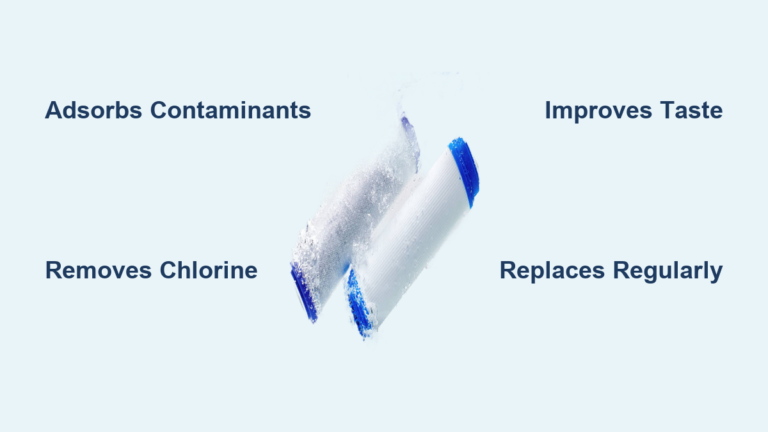
Next, water flows into an activated carbon block filter. This stage targets chemicals rather than particles. It strips out chlorine, chloramines, pesticides, herbicides, VOCs, and anything causing bad taste or odor.
How it works: The carbon block has a massive surface area packed with microscopic pores. Contaminants adsorb (stick) to the carbon through chemical attraction. Unlike loose granular carbon, a solid block prevents channeling and stops carbon fines from escaping downstream.
Critical protection: Most RO membranes use thin-film composite (TFC) material, which chlorine destroys. Even trace amounts can burn microscopic holes in the membrane, slashing rejection rates. This stage is not just about better taste. It is essential for membrane survival.
Pro tip: If your water smells like a swimming pool, this filter is earning its keep. Replace it every 6–12 months to protect your membrane investment.
Stage 3: 1-Micron Polishing Filter
Before water reaches the RO membrane, it gets a final particle cleanup. This 1-micron filter is usually fine polypropylene or spun fiber. Its job is to catch any carbon fines from Stage 2 and ultra-fine sediment that slipped past Stage 1.
Why it is often overlooked: Some assume it is redundant, but it is a crucial safeguard. Microscopic particles can embed in or scratch the membrane surface, reducing both efficiency and lifespan. This stage ensures only clean water touches the delicate membrane.
Maintenance clue: If your system’s output slows prematurely despite fresh Stage 1 and 2 filters, a clogged Stage 3 could be the culprit. Replace it alongside the other pre-filters every 6–12 months.
Stage 4: The RO Membrane – Where Purification Happens
This is the heart of the system. The reverse osmosis membrane removes up to 99% of dissolved contaminants through molecular-level filtration.
How the Membrane Filters at the Molecular Level
The membrane is a spiral-wound sheet of TFC material with pores around 0.0001 microns. That is smaller than bacteria, viruses, and most dissolved ions. Water is forced through under pressure (typically 40–80 psi), while contaminants are rejected and flushed away.
Two mechanisms drive separation:
- Size exclusion: Particles larger than the pore size are physically blocked.
- Charge repulsion: The membrane surface carries a negative charge, repelling negatively charged ions like nitrates and sulfates.
What it removes: Heavy metals (lead, arsenic, mercury), fluoride, nitrates, pharmaceuticals, microplastics, PFAS, and over 95% of total dissolved solids (TDS).
What it does not remove well: Dissolved gases like CO₂ and radon pass through. CO₂ can make RO water slightly acidic, usually not a health concern but sometimes noticeable in taste.
Cross-Flow Filtration Keeps the Membrane Clean
Unlike standard filters that trap contaminants inside until they clog, RO uses cross-flow filtration. Water flows across the membrane surface, not just into it. Two streams exit:
- Permeate: Clean water that passes through to the storage tank.
- Concentrate (brine): Contaminated water flushed to the drain.
This continuous flow sweeps away rejected particles, preventing rapid fouling. Without it, the membrane would clog within minutes.
Key point: The drain line is not optional. It is essential for operation. Blocking it halts production entirely.
Stage 5: Post-Carbon Polishing Filter
After storage, water gets one last touch before reaching your glass.
Final Taste and Odor Refinement
Even after RO purification, water stored in the pressurized tank can pick up slight rubbery or plastic tastes from the tank’s internal bladder. The Stage 5 filter, a small carbon cartridge, removes these residual odors and ensures the water tastes fresh.
Common misconception: This stage does not remove significant contaminants. Its sole purpose is taste polishing. Think of it as the finishing touch.
Remineralization Options
Some advanced Stage 5 filters go beyond carbon. They contain mineral balls made of calcium and magnesium to:
- Raise the pH of slightly acidic RO water.
- Add back beneficial minerals stripped during filtration.
- Improve mouthfeel and overall taste.
Users who find RO water flat often prefer remineralizing filters. These are optional but growing in popularity among health-conscious households.
Replacement tip: Change this filter every 12 months, even if water tastes fine. Stale carbon can harbor bacteria.
Key System Components Behind the Scenes
Filters and the membrane are only part of the picture. Several components ensure reliable, hands-free operation.
Pressure Storage Tank
RO membranes produce water slowly, often just 1–2 gallons per hour. To deliver instant flow at the faucet, systems use a pressurized storage tank.
How it works:
– The tank contains a butyl rubber bladder.
– As purified water enters, it compresses the air behind the bladder.
– When you open the faucet, air pressure pushes water out at usable flow rates.
Capacity: Most tanks hold 2–4 gallons, enough for several glasses or a pot of coffee.
Note: Tanks can develop air leaks or waterlogged bladders over time. If your faucet starts sputtering, the tank may need re-pressurizing or replacement.
Automatic Shut-Off Valve
This smart valve prevents waste and protects the system from over-pressurization.
Operation:
– When the storage tank fills, pressure builds inside.
– Once tank pressure equals incoming line pressure, the ASO valve closes.
– Feed water stops flowing to the RO unit.
– When you open the faucet, pressure drops, and the ASO reopens to refill.
Troubleshooting sign: If water runs down the drain constantly, the ASO or check valve may be faulty.
Drain Line and Wastewater Ratio
Yes, RO systems produce wastewater, but it is by design.
Why it is necessary: The concentrate stream carries away rejected contaminants. No drain flow means no purification.
Wastewater ratio:
– Older systems: 4 gallons waste per 1 gallon purified.
– High-efficiency models: As low as 1:1.
Improvements: Modern systems use permeate pumps or electronic controls to cut waste without sacrificing performance.
Warning: Never block the drain line. Doing so can damage the membrane and void your warranty.
How Water Flows Through the System
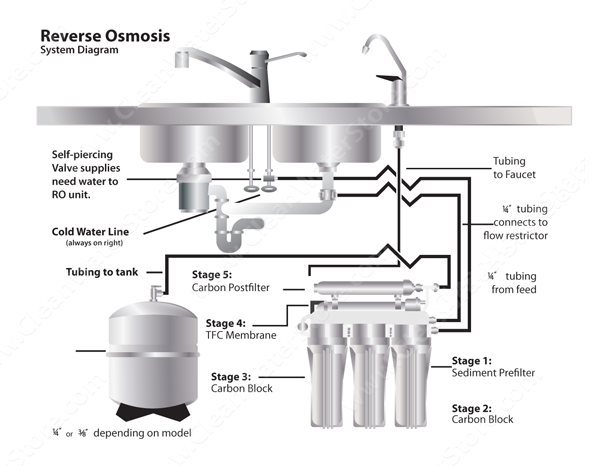
Understanding the path water takes clarifies how efficiency and purity are balanced.
Feed Water Path Step by Step
- A cold water line tap connects to your under-sink plumbing.
- Water enters Stage 1 (sediment filter).
- Water moves to Stage 2 (carbon block).
- Water passes through Stage 3 (1-micron polish).
- Water reaches the RO membrane, splitting into:
– Permeate, which flows to the storage tank.
– Concentrate, which flows to the drain. - When the faucet opens, tank water flows through Stage 5 (post-carbon).
- Pure water dispenses at the dedicated RO faucet.
Flow control: A flow restrictor on the drain line maintains enough backpressure to push water through the membrane. Too much flow means poor rejection. Too little means low production.
Role of Water Pressure and Temperature
RO performance depends heavily on incoming conditions.
Ideal pressure: 40–80 psi. Below 40 psi, production drops sharply. Well water users may need a booster pump.
Temperature impact: Cold water is thicker and more viscous. At 40°F, production can be half of what it is at 77°F. Systems in cold basements may underperform in winter.
Pro solution: Insulate feed lines or install a temperature-compensated system if cold water is an issue.
What a 5-Stage RO Removes (And What It Does Not)

Knowing the limits of RO helps set realistic expectations.
Proven Removal Capabilities
A 5-stage RO system effectively removes:
- 95–99% of TDS (total dissolved solids)
- Heavy metals: lead, arsenic, cadmium, mercury
- Nitrates and nitrites, common in well water
- Fluoride, up to 95% removal
- PFAS/PFOA, the so-called forever chemicals
- Microorganisms: bacteria, viruses, cysts
- Pharmaceuticals and pesticides, trapped by membrane and carbon
Certified performance: Look for NSF/ANSI 58 certification, which verifies contaminant reduction claims.
Limitations to Be Aware Of
RO is not perfect. It does not remove:
- Dissolved gases like CO₂, radon, or hydrogen sulfide
- Some small, uncharged solvent molecules
- Minerals, both harmful and beneficial ones
pH note: RO water is slightly acidic (6.0–6.8) due to CO₂ absorption. This is not harmful but can taste flat. Remineralization filters fix this.
Myth busting: RO water does not leach minerals from your body. Your digestive system regulates mineral balance, and diet is the primary source.
Maintenance Tips for Long-Term Performance
Even the best system fails without care. Follow these steps to keep yours running strong.
Filter Replacement Schedule
- Stages 1, 2, and 3: Replace every 6–12 months.
- Stage 5 (post-filter): Replace every 12 months.
- RO membrane: Replace every 3–5 years, depending on water quality.
Signs it is time:
– Slow faucet flow
– Declining water quality (test with a TDS meter)
– Bad taste or odor returning
Pro tip: Keep spare filters on hand. Set phone reminders or use smart systems with filter life tracking.
When to Clean the RO Membrane
Membranes can be cleaned in place if performance drops. Watch for:
- Low flow despite clean pre-filters
- High TDS in product water
- Frequent filter changes with no improvement
Cleaning solutions:
– Low pH cleaners remove mineral scale (calcium, iron).
– High pH cleaners remove organic fouling and biofilm.
Frequency: 1–4 times per year in hard water areas. Always follow manufacturer guidelines.
Leak Prevention and Safety Checks
RO systems connect to water lines and storage tanks, creating potential leak points.
Prevention steps:
– Inspect tubing and fittings annually.
– Ensure the drain saddle is secure.
– Test the automatic shut-off valve function.
– Install a leak detector with auto shut-off, available on smart models.
Peace of mind: Many modern systems include Wi-Fi alerts for leaks or low filter life.
Troubleshooting Common Issues
Quick fixes can save a service call.
Low Water Production
Possible reasons include:
– Clogged pre-filters (most common)
– Low feed pressure (check home water pressure)
– Cold water below 50°F
– Faulty ASO valve
– Fouled or aged membrane
Diagnostic: Bypass pre-filters one by one. If flow improves, replace that filter.
High TDS in Purified Water
If your RO water has high TDS:
– Test feed water first. If it is high, the system may be working fine.
– Check for membrane damage, often from chlorine exposure.
– Inspect O-rings and seals for leaks.
– Replace the membrane if rejection drops below 90%.
Tool: Use a $20 TDS meter to monitor performance monthly.
Continuous Drain Flow
Water should not run to the drain when the tank is full.
Causes:
– Failed ASO valve
– Defective check valve
– Clogged flow restrictor
Test: Close the tank valve. If water still flows to the drain, the ASO or check valve is faulty.
Fix: Replace the valves. They are usually inexpensive and DIY-friendly.
Choosing the Right System
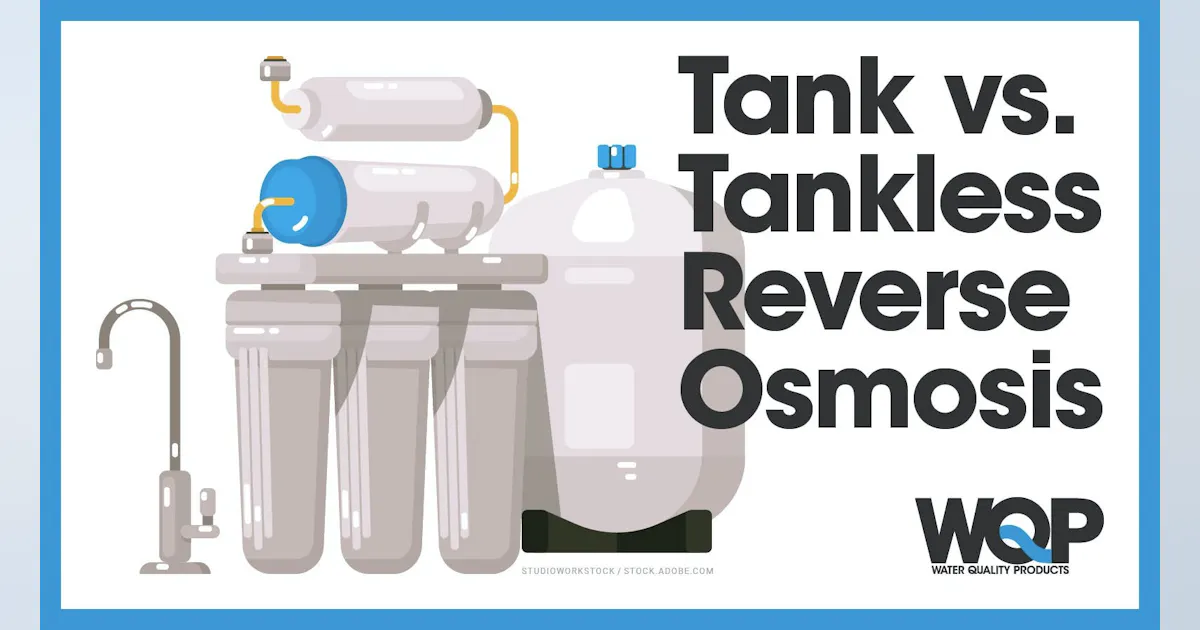
Not all 5-stage RO systems are equal. Consider these factors before buying.
Tank vs. Tankless Systems
| Feature | Tank System | Tankless System |
|---|---|---|
| Flow Rate | High (pressurized tank) | Limited by membrane speed |
| Footprint | Larger (tank under sink) | Compact |
| Water Freshness | Can stagnate (mitigated by post-filter) | Always fresh |
| Best For | Families, high usage | Small spaces, low usage |
Tankless trade-off: Requires larger or multiple membranes to deliver usable flow.
Smart Features Worth Considering
Modern RO systems offer:
– Real-time TDS display
– Filter life tracking via app
– Leak detection with auto shutoff
– Low-waste modes (1:1 ratio)
Value: Smart systems cost more upfront but reduce maintenance surprises and water waste.
Certification Matters
Always choose systems certified to:
– NSF/ANSI 58 (RO-specific)
– NSF 53 (health contaminants)
– NSF 42 (taste and odor)
– NSF 401 or P231 (emerging contaminants)
Certification ensures the system performs as advertised.
Frequently Asked Questions About 5-Stage Reverse Osmosis Systems
What is the difference between a 4-stage and 5-stage RO system?
A 4-stage system typically combines the sediment and carbon pre-filtration into fewer steps, while a 5-stage system separates them and adds a dedicated 1-micron polishing filter before the membrane. The extra stage provides better membrane protection and longer component life.
How often should I replace the filters in a 5-stage RO system?
Pre-filters (Stages 1–3) should be replaced every 6–12 months. The post-carbon filter (Stage 5) should be replaced every 12 months. The RO membrane typically lasts 3–5 years, depending on feed water quality and maintenance consistency.
Does a 5-stage RO system remove beneficial minerals from water?
Yes, the RO membrane removes both harmful and beneficial minerals like calcium and magnesium. If you want those minerals back, choose a Stage 5 remineralization filter that adds calcium and magnesium while improving taste and pH.
Why does my RO system produce so much wastewater?
Wastewater is necessary to carry away rejected contaminants through the concentrate stream. Older systems can waste 4 gallons per gallon purified, but modern high-efficiency models achieve ratios as low as 1:1. Adding a permeate pump can further reduce waste.
Can an RO system work with low water pressure?
RO systems need at least 40 psi to function properly. If your home’s pressure is below that, especially common with well water, install a booster pump to ensure adequate production and membrane performance.
Is reverse osmosis water safe to drink long-term?
Yes. RO water meets or exceeds EPA and NSF/ANSI safety standards. While it is slightly acidic and lacks minerals, it does not leach minerals from your body. Remineralization filters are available if you prefer mineral-rich water.
Key Takeaways for Understanding 5-Stage Reverse Osmosis
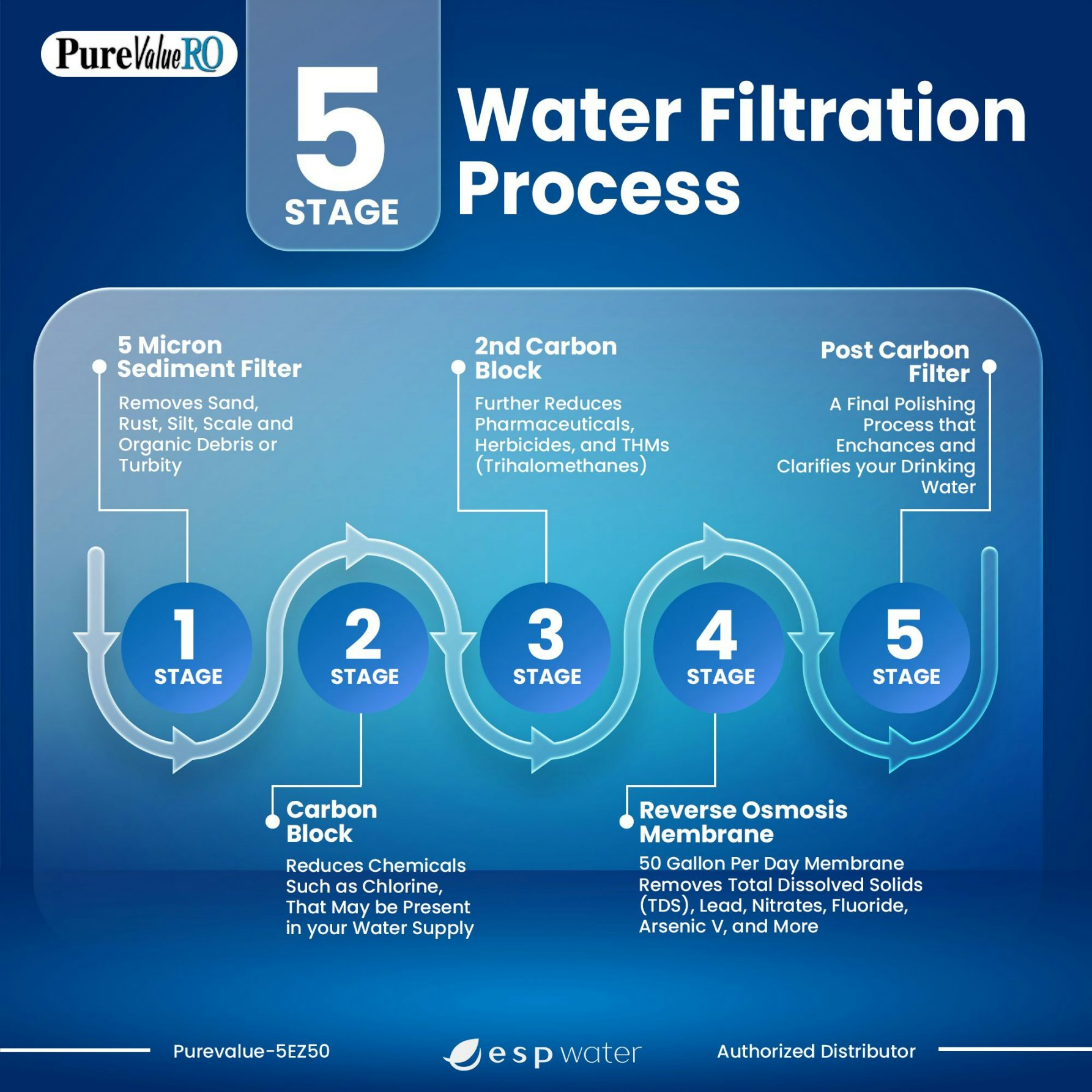
A 5-stage reverse osmosis system works by combining mechanical filtration, chemical adsorption, and molecular separation to deliver highly purified drinking water. Each stage plays a specific role: the first three protect the membrane by removing sediment, chlorine, and fine particles, while the fourth stage performs the actual purification at the molecular level. The fifth stage polishes taste and can optionally add beneficial minerals back into the water.
Understanding this process empowers you to choose the right system, maintain it properly, and trust the water it produces. With consistent filter changes and occasional membrane care, a 5-stage RO system can deliver clean, safe water for years, reducing your reliance on bottled water and protecting your household from contaminants you cannot see, taste, or smell.
Ready to take the next step? Test your tap water with a TDS meter, check your home’s water pressure, and compare certified 5-stage systems that match your household’s usage needs.