How to Choose a Water Filter: Quick Guide

You turn on the tap and fill your glass, only to pause, wondering what’s really in your water. You’re not alone. Millions of households face invisible threats like lead, PFAS, disinfection byproducts, and nitrates, even in municipally treated water. Choosing how to choose a water filter isn’t about guesswork. It’s about matching real data to your home’s unique needs.
Based on 2026 independent lab testing across 111+ water parameters, the best systems don’t just claim performance. They prove it. From renters using pitchers to families installing whole-house systems, the right filter can remove 100% of health-threatening contaminants. This guide cuts through the noise with verified data, cost analysis, and a step-by-step strategy to help you make a smart, lasting decision.
Identify Your Water Source First
Before buying any filter, know your starting point. Your water source determines the risks and the solution.
City Water: Hidden Chemicals in “Clean” Supply
Municipal water is treated, but not toxin-free. It often contains chlorine, disinfection byproducts like chloroform, pharmaceuticals, and even lead from old pipes. Your utility is required to provide a Consumer Confidence Report (CCR) each year. This document lists detected contaminants, but it has gaps.
Most CCRs don’t test for PFAS, microplastics, or lead from household plumbing. Just because a contaminant isn’t listed doesn’t mean it’s absent. For example, chloroform was reduced to 0 ppb by the Cloud RO system, yet it’s often missed in basic reports.
Don’t rely on taste or clarity. Colorado tap water, used in 2026 testing, looked and smelled fine, yet contained uranium, barium, and fluoride. The only way to know for sure? Lab testing.
Well Water: Test or Risk Your Health
Private wells are not regulated by the EPA. No annual report. No safety net. Contaminants like arsenic, nitrates, radon, and bacteria can go undetected for years.
A certified lab test is non-negotiable. Use services like Tap Score or Simple Labs with well-specific kits. These test for:
– Bacteria (E. coli, coliform)
– Nitrates (dangerous for infants)
– Heavy metals (arsenic, lead, uranium)
– Radionuclides
One family in rural Colorado discovered 18 ppb of uranium, twice the legal limit, only after testing. Their carbon pitcher did nothing. They needed reverse osmosis.
Test Your Water Like a Pro
You wouldn’t treat an illness without a diagnosis. Don’t filter water without testing.
Use Certified Third-Party Labs
Skip store-bought test strips. They’re inaccurate for critical contaminants. Instead, use NSF-certified labs that provide full-panel reports.
Recommended kits:
– Core City Water Kit: Tests for 80+ contaminants including PFAS, lead, DBPs, and pharmaceuticals.
– Core Well Water Kit: Adds bacteria, nitrates, arsenic, and radon.
Results typically arrive in 7–10 days. Look for:
– Lead > 1 ppb (no safe level)
– Nitrate > 10 ppm (dangerous for babies)
– TDS > 500 ppm (indicates high dissolved solids)
– PFAS > 4 ppt (EPA health advisory level)
One tested Colorado sample had 0.0096 mg/L of uranium, removed 100% by AquaTru and Cloud RO systems. Without testing, you’d never know it was there.
Don’t Trust Claims Without Proof
Many brands say “removes lead” or “tested to NSF standards.” That’s not enough. Verify certifications in the NSF or IAPMO database. “Tested to” means self-tested. Certified by means third-party verified.
For example, Culligan ZeroWater is IAPMO certified to NSF 53 for lead reduction, proven in lab tests. But many Amazon brands claim the same without proof.
Define Your Filtration Goals
Why are you filtering? Your answer shapes everything.
Remove Health Threats
If you’re worried about lead, PFAS, uranium, or nitrates, prioritize systems with NSF 53 or 58 certification.
- RO systems remove 95–99% of heavy metals and chemicals.
- ZeroWater pitcher removed 100% of nitrate and uranium in testing.
- AquaTru eliminated fluoride, barium, and chloroform.
Families with young children or pregnant women should prioritize health protection over cost.
Improve Taste and Smell
Chlorine and hydrogen sulfide (rotten egg smell) are common complaints.
- Activated carbon is best for taste and odor.
- Catalytic carbon handles chloramines common in city water.
- KDF media in shower filters removes chlorine and extends carbon life.
The British Berkefeld gravity filter uses carbon and ceramic to improve taste while removing cysts, ideal for off-grid use.
Protect Appliances from Hard Water
If you see scale in kettles or low water pressure, you likely have hard water with high calcium and magnesium.
- Ion exchange softeners remove hardness.
- Whole-house carbon + KDF systems like SpringWell CF reduce scale precursors.
- RO systems struggle with hard water unless pre-treated.
Note: Softeners add sodium. Use potassium chloride if on a low-sodium diet.
Prepare for Emergencies
Power outages, natural disasters, or well failures demand off-grid solutions.
- Gravity filters (British Berkefeld) need no electricity.
- Countertop RO (AquaTru) works during outages.
- Portable filters like LifeStraw are for short-term use.
Store filtered water in glass or BPA-free containers.
Match Technology to Contaminants
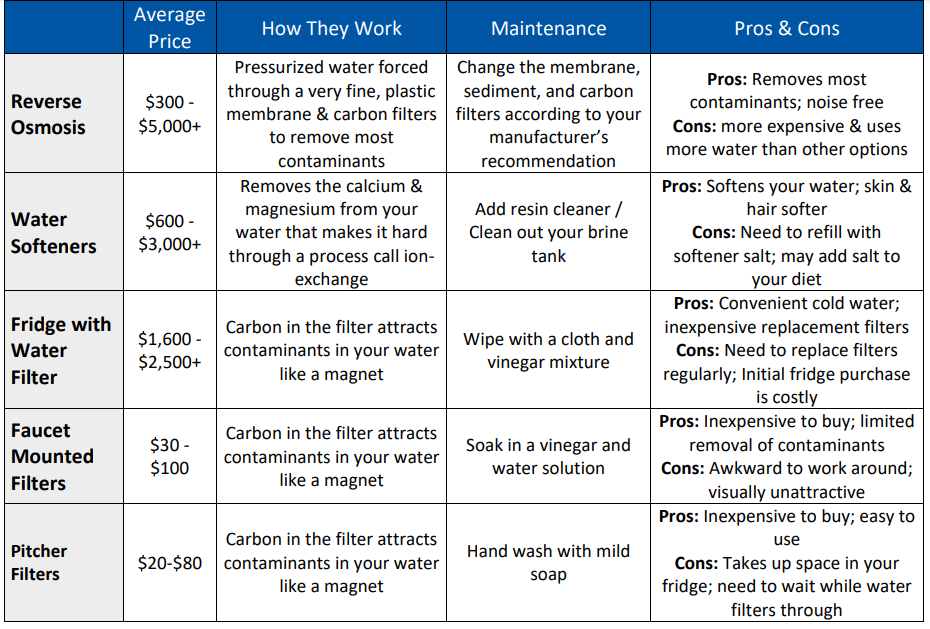
No single filter does it all. Choose based on what’s in your water.
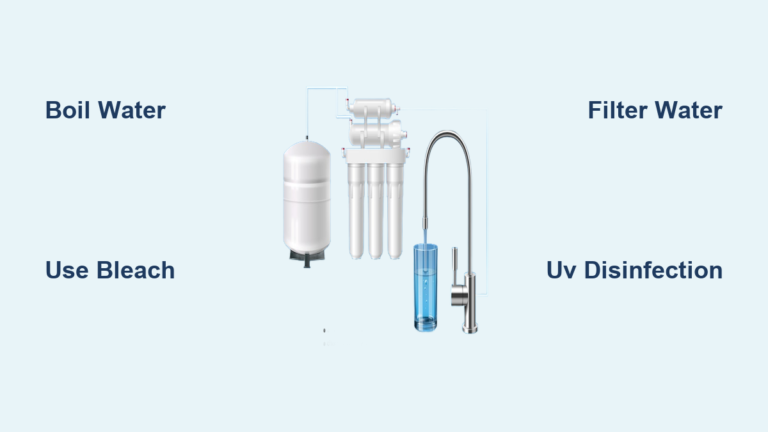
Reverse Osmosis (RO): The Gold Standard

Best for: Lead, PFAS, fluoride, nitrates, uranium, TDS.
RO forces water through a 0.0001-micron membrane, removing nearly all dissolved solids.
Proven performance:
– AquaTru Carafe: Removed 100% of fluoride (0.9 mg/L to 0), uranium, and DBPs.
– Cloud RO: Eliminated chloroform (8.22 ppb to 0) and fluoride (0.6 ppm to 0).
Trade-offs:
– Wastes water (1:1 to 4:1 waste-to-pure ratio).
– Slow flow (store purified water in advance).
– Removes beneficial minerals. Use remineralization.
Certification: Look for NSF 58.
Activated Carbon: Taste, Odor, and VOCs
Best for: Chlorine, pesticides, VOCs, bad tastes.
Types:
– Granular (GAC): Fast flow, less contact time.
– Block (BAC): Denser, better for lead and cysts.
– Catalytic: Handles chloramines.
Limitations: Does not remove fluoride, nitrates, or heavy metals unless combined with other tech.
Certification: NSF 42 (aesthetic), NSF 53 (health).
KDF: Chlorine and Heavy Metal Reducer
Best for: Whole-house systems, shower filters.
Copper-zinc alloy uses redox reactions to neutralize chlorine and precipitate heavy metals. Used in SpringWell CF to reduce lead by 96%. Often paired with carbon.
Certification: NSF 177 (shower), NSF 61 (materials).
Ion Exchange: Softens Hard Water
Best for: Calcium, magnesium, iron.
Common in salt-based water softeners. Exchanges hardness ions for sodium. Does not filter bacteria or chemicals. Pair with carbon or RO.
UV: Kills Microbes
Best for: Well water with bacteria.
UV light destroys DNA of E. coli, Giardia, and viruses. Requires pre-filtration since cloudy water blocks UV rays. Use after sediment and carbon filters.
Ceramic: Physical Barrier
Best for: Bacteria, cysts, sediment.
Sub-micron pores block pathogens. Used in gravity filters. Scrub surface to clean. Does not remove chemicals.
Choose the Right Filter Type
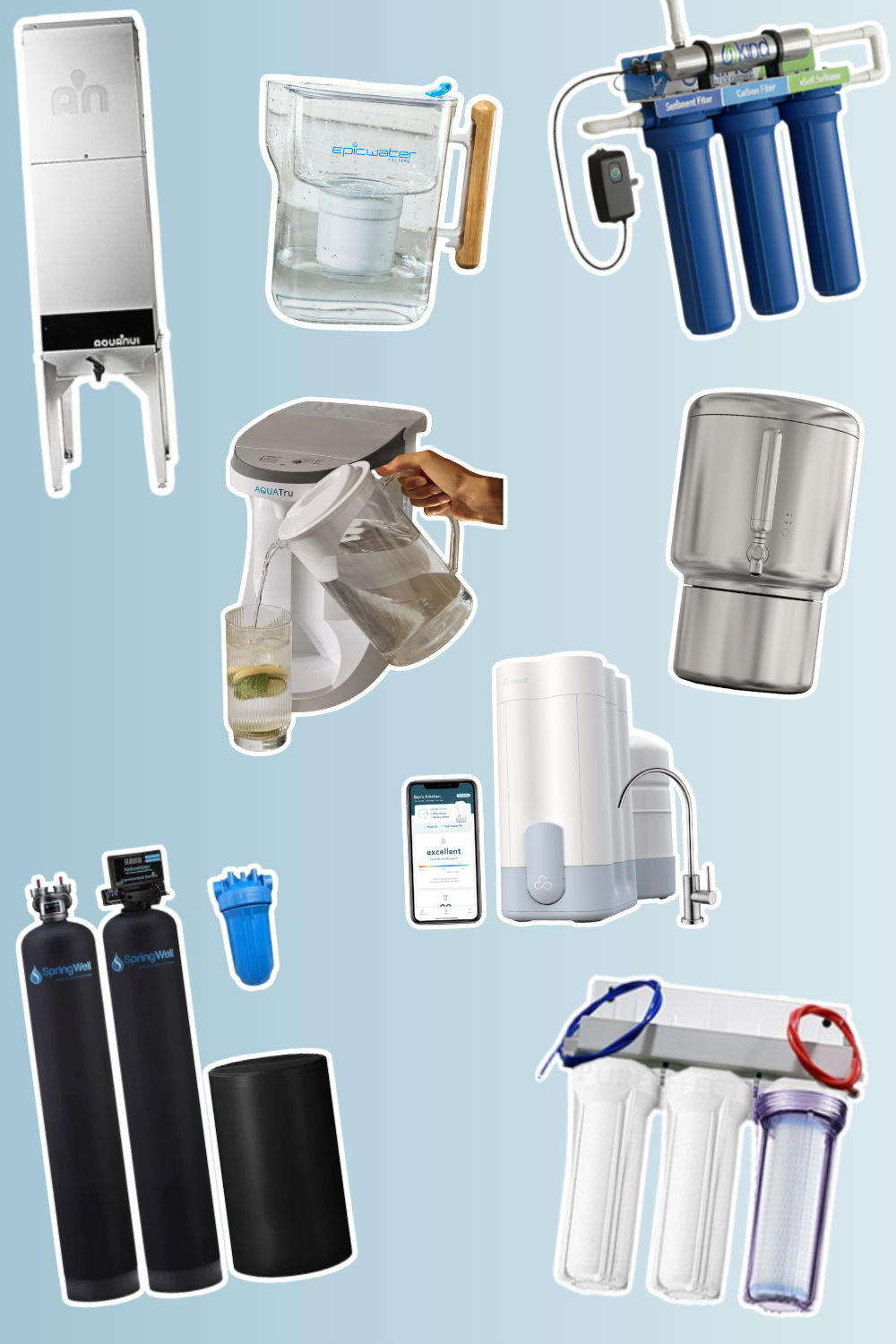
Your needs, space, and budget determine the best system type.
Countertop RO: Best for Renters and High Performance
Top pick: AquaTru Carafe (9.57/10).
- No installation, just plug and play.
- Glass carafe means no plastic taste.
- Removes 100% of fluoride, lead, DBPs.
- 4:1 recovery rate (4 gallons pure per 1 wasted), best in class.
Ideal for apartments. Filters 300–1,200 gallons per set. Cost: $0.19/gallon.
Under-Sink RO: Whole-Kitchen Protection
Top pick: Cloud RO (9.24/10).
- NSF 58 certified.
- Built-in remineralization raises pH to 9.7.
- App connectivity tracks TDS and filter life.
- 1:1 waste ratio saves water.
Requires under-sink space and drain line. Cost: $0.26/gallon.
Pitchers: Low Upfront, High Long-Term Cost
Top pick: Culligan ZeroWater (9.33/10).
- Removes 100% of nitrate, fluoride, uranium.
- IAPMO certified for all claims.
- But: Filters last only 20 gallons.
- Cost: $0.90 per gallon, the most expensive long-term.
Avoid if you drink more than 1 gallon per day.
Whole-House: Protect Every Faucet
Top pick: SpringWell CF (8.52/10).
- 1 million gallon media life (3–5 years).
- Removes 100% of nickel, cobalt, DBPs.
- Reduces lead by 96%.
- Cost: $0.0013 per gallon, cheapest long-term.
Requires professional installation. No third-party certification, relying on lab reports instead. Best paired with under-sink RO for drinking water.
Gravity Filters: Off-Grid and Emergency
Top pick: British Berkefeld (9.08/10).
- No electricity or plumbing needed.
- Removes bacteria, cysts, heavy metals.
- Lifetime warranty on housing.
- Cost: $0.09–$0.16 per gallon.
Slow flow, so plan ahead.
Verify Certifications, or Get Duped

Certifications are your shield against false claims.
What Each Standard Means
| Certification | What It Covers |
|---|---|
| NSF 42 | Chlorine, taste, odor, particulates |
| NSF 53 | Lead, mercury, VOCs, cysts, pesticides |
| NSF 58 | Reverse osmosis performance |
| NSF 401 | Pharmaceuticals, BPA, PFAS |
| NSF 372 | Lead-free materials |
| NSF 177 | Shower filter chlorine reduction |
| IAPMO | Independent verification of contaminant claims |
| WQA Gold Seal | Performance and safety |
How to Verify
- Go to nsf.org/certified
- Search the product name or model.
- Check the scope of certification to see if it lists your contaminant.
Example: AquaTru is certified to NSF 58 for TDS reduction, proven in lab tests. Many products say “meets NSF standards” but aren’t certified. That’s marketing, not proof.
Calculate True Cost: It’s Not Just the Price Tag
The cheapest filter can cost the most over time.
Long-Term Cost Comparison
| System | Upfront Cost | Cost Per Gallon | 10,000 Gallons Total |
|---|---|---|---|
| ZeroWater Pitcher | $25 | $0.90 | $9,025 |
| AquaTru Carafe | $350 | $0.19 | $2,250 |
| Cloud RO | $650 | $0.26 | $3,250 |
| SpringWell CF | $1,015 | $0.0013 | $1,145 |
| AQUA USA U1 RO | $750 | $0.08 | $1,550 |
ZeroWater costs 700% more per gallon than AquaTru. After 10,000 gallons, it’s over $6,000 more expensive than high-efficiency RO.
Factor in Water Waste
Traditional RO wastes 3–5 gallons per gallon filtered.
- Cloud RO: 1:1 waste ratio saves thousands of gallons.
- AquaTru: 4:1 pure-to-waste, highly efficient.
- SpringWell CF: No waste since it’s a non-RO whole-house system.
In drought-prone areas, this matters for bills and sustainability.
Install and Maintain for Lasting Performance
Even the best filter fails without care.
DIY vs. Professional Installation
- DIY-friendly: Pitchers, faucet mounts, AquaTru (countertop).
- Professional recommended: Whole-house (SpringWell), under-sink RO with drain line (Cloud RO).
Measure cabinet space before buying under-sink models. Most need 15″ height and 8″ depth.
Maintenance Must-Dos
- Replace filters on time. Overused filters leach contaminants back.
- Sanitize tanks every 6 months to prevent biofilm.
- Monitor TDS. A spike means RO membrane failure.
- Change sediment pre-filters every 6–9 months in whole-house systems.
Smart systems like Cloud RO alert you via app. AquaTru has a digital display.
Choose Safe Materials
- Avoid plastic tanks since they can leach over time.
- Prefer glass carafes (AquaTru) or stainless steel.
- Ensure NSF 372 certification for lead-free plumbing.
Match Your Profile to the Right System
Renter or Apartment Dweller
Best choice: AquaTru Carafe or ZeroWater pitcher.
No plumbing changes. Portable. AquaTru offers RO performance without installation.
Health-Conscious Family
Best choice: Cloud RO or AquaTru.
Removes 100% of lead, PFAS, fluoride. App monitoring ensures consistent safety.
Well Water Owner
Best choice: SpringWell CF + under-sink RO.
Whole house removes iron and sulfur. RO at kitchen tap removes nitrates and bacteria.
Budget-Conscious (Upfront)
Best choice: Pitcher (<$50).
But only if water quality is good. Otherwise, you’ll pay more long-term.
Budget-Conscious (Long-Term)
Best choice: SpringWell CF or high-capacity RO.
Over 5–10 years, whole-house systems save thousands.
Eco-Conscious
Best choice: High-efficiency RO (Cloud, AquaTru).
Minimizes water waste. Long-life filters reduce plastic.
Hard Water Area
Best choice: Water softener + carbon filter.
RO membranes clog fast without softening. Use KDF and carbon to reduce chlorine.
Frequently Asked Questions About Water Filters
Do I really need to test my water before buying a filter?
Yes. Visual clarity and taste don’t reveal invisible threats like lead, PFAS, or uranium. A certified lab test identifies exactly what’s in your water so you can match the right technology to your specific contaminants. Without testing, you might buy a filter that doesn’t address your actual risks.
Which filter type removes the most contaminants?
Reverse osmosis (RO) systems remove the broadest range, including lead, fluoride, PFAS, nitrates, and total dissolved solids. In 2026 testing, the AquaTru Carafe and Cloud RO both removed 100% of health-effect contaminants from Colorado tap water.
Are pitcher filters worth the cost?
Pitchers like Culligan ZeroWater are IAPMO certified and remove many contaminants effectively. However, with filters lasting only 20 gallons, the cost reaches $0.90 per gallon, making them the most expensive option long-term. They’re best for light users or renters who can’t install permanent systems.
What’s the difference between NSF 42 and NSF 53?
NSF 42 covers aesthetic improvements like chlorine taste and odor. NSF 53 covers health-related contaminants such as lead, mercury, VOCs, and cysts. For health protection, prioritize filters certified to NSF 53 or higher.
How often should I replace my water filter?
It depends on the system. Pitcher filters need replacement every 20 gallons. RO membranes last 2–5 years. Whole-house carbon and KDF media can last 3–5 years or 1 million gallons. Always follow manufacturer guidelines and watch for TDS spikes or flow changes.
Can a water filter remove fluoride?
Standard carbon filters cannot remove fluoride effectively. Only reverse osmosis systems and specialized filters like ZeroWater pitchers are proven to eliminate it. In testing, AquaTru removed 100% of fluoride, while SpringWell’s whole-house system reduced it by only 17%.
Key Takeaways for Choosing the Right Water Filter
Choosing a water filter comes down to data, certification, and fit. Start with a lab test to identify your specific contaminants. Match the technology to what you’re actually trying to remove, whether that’s lead, PFAS, chlorine, or hard water minerals. Verify every claim through the NSF or IAPMO database, since “tested to” standards is not the same as third-party certification.
The AquaTru Carafe leads for performance and value. Cloud RO wins for smart features and efficiency. SpringWell CF dominates long-term savings. ZeroWater works, but only for light users.
Your tap water may look clean, but the invisible threats are real. Order a water test kit today and take the first step toward protecting your family’s health for years to come.