How Water Filters Work: Simple Guide

You turn on the tap, pour a glass, and expect clean, safe water. But what if it carries hidden contaminants like chlorine, lead, bacteria, or microplastics? That’s where water filters come in. How does water filter work might seem like a simple question, but the answer involves physics, chemistry, and engineering working together to deliver cleaner water. Whether it’s a pitcher on your counter or a whole-house system, every filter uses one or more methods to trap, block, or neutralize impurities.
Understanding how water filters work helps you choose the right system for your needs. Some remove only sediment and chlorine, while others strip out heavy metals, dissolved solids, or even viruses. The key lies in the filtration method, media type, and system design. In this guide, you’ll learn the science behind water filtration, the different technologies available, and which systems tackle specific contaminants. By the end, you’ll know exactly how your water gets cleaner and how to make sure it stays that way.
Filter Mechanisms Explained
Water filters don’t just clean water; they target specific problems using distinct scientific principles. Most systems combine multiple methods to deliver comprehensive results.
Physical vs Chemical Filtration
Filtration works in two fundamental ways: mechanical (physical) and chemical (adsorption or ion exchange).
- Mechanical filtration acts like a sieve. Water passes through a porous medium such as mesh, ceramic, or sediment fiber, trapping particles too large to fit through. This removes visible debris like sand, rust, silt, and dirt.
- Chemical filtration relies on attraction. Media like activated carbon uses adsorption, where contaminants stick to the surface of the material. This removes chlorine, bad tastes, odors, and volatile organic compounds (VOCs).
Neither method alone is sufficient for all threats. That’s why advanced systems stack both, starting with mechanical pre-filters, then chemical polishing, and sometimes ending with microbial protection.
Filtration vs Purification vs Softening
Don’t confuse filtration with purification or softening; they solve different problems.
- Filtration reduces contaminants for better taste, clarity, and safety. It targets particles, chemicals, and some microbes.
- Purification goes further, removing nearly all impurities. Methods like reverse osmosis (RO) or distillation produce ultra-pure water, often used in labs or medical settings.
- Softening specifically targets hardness minerals (calcium and magnesium) using ion exchange. It prevents scale buildup but doesn’t purify water.
A whole-house softener improves appliance life and skin feel, while a reverse osmosis system under the sink ensures drinking water is free of lead, fluoride, and nitrates.
Mechanical Filtration Methods

Mechanical filters block solid particles using physical barriers. They’re often the first line of defense in any filtration system.
Sediment and Mesh Filters
These are the simplest mechanical filters, designed to catch large debris.
- Sediment filters (usually wound polypropylene) trap particles 1–100 microns in size, including rust flakes, sand, and silt. A 100-micron rating captures particles around 5 microns and larger.
- Mesh filters use tightly woven wire cloth screens to block grit. Common in inline filters for ice makers or coffee machines.
Tip: Replace sediment filters every 2–3 months. A clogged filter reduces water pressure and strains downstream components.
Ceramic and Absolute Micron Ratings
Ceramic filters offer superior mechanical filtration with microscopic pores.
- Pores as small as 0.2–1 micron block bacteria, cysts, and fine sediment.
- The surface can be scrubbed clean and reused, making it durable.
- Look for absolute micron ratings, meaning all pores are at or below the stated size. A 1-micron absolute filter catches every particle 1 micron or larger.
Warning: Nominal ratings only indicate average pore size, so some contaminants may slip through. For safety, always choose absolute-rated filters if removing pathogens.
Chemical Filtration Technologies

When contaminants are dissolved rather than visible, chemical filtration takes over. These methods use reactive media to capture or neutralize molecules.
Activated Carbon Adsorption
The most common chemical filter uses activated carbon, made from coconut shells, coal, or wood.
- Granular Activated Carbon (GAC): Loose carbon granules. Good for reducing chlorine and improving taste.
- Carbon Block: Compressed carbon. Denser, with smaller pores. More effective at removing VOCs, pesticides, and some heavy metals.
How it works: Contaminants adsorb (stick) to the carbon’s massive surface area. Some blocks have the surface area of a football field in just 10 cubic inches.
Limitations: Carbon doesn’t remove dissolved inorganic solids (like salts or nitrates) or most microorganisms. It also becomes saturated over time, so replace every 6–12 months.
Catalytic Carbon for Chloramines
Municipal water increasingly uses chloramines (chlorine + ammonia) for disinfection. Regular carbon struggles to remove them.
- Catalytic carbon is specially treated to break down chloramines efficiently.
- Essential for whole-house systems and homes with sensitive skin or aquariums.
Pro Tip: If your water has a medicinal or ammonia-like smell, you likely have chloramines. Opt for catalytic carbon in that case.
Activated Alumina for Fluoride and Arsenic
In areas with high fluoride or arsenic, activated alumina filters are used.
- Works best in slightly acidic water (pH 5.5–6.0).
- Can reduce fluoride by up to 90% and arsenic (Type V).
- Requires precise water chemistry; effectiveness drops if pH fluctuates.
Caution: Some concerns exist about aluminum leaching under certain conditions. Use only certified, tested media.
Ion Exchange and Sequestration
These methods alter water chemistry to prevent scale or remove dissolved metals.
Ion Exchange for Softening and Metal Removal
Ion exchange swaps harmful ions for harmless ones using resin beads.
- Sodium-based softeners: Replace calcium/magnesium with sodium. Great for appliances, but not ideal for drinking since they increase sodium levels and face a 200 mg/L legal limit.
- Hydrogen-based systems: Swap hardness minerals with hydrogen. Perfect for drinking water with no sodium added.
This method can also target heavy metals like lead or cadmium with specialized resins.
Maintenance: Resin must be recharged (with salt or acid). Replace every 5–10 years.
Sequestration for Scale Prevention
Sequestration doesn’t remove hardness; it binds minerals so they can’t form scale.
- Uses food-grade polyphosphate media, which coats calcium and magnesium ions.
- Prevents limescale in kettles, water heaters, and coffee machines.
- Doesn’t soften water since minerals are still present.
Best for: Low to moderate hardness (<15 grains/gallon). Fails above 95°C (203°F), so use ion exchange for high-temperature applications.
Reverse Osmosis Systems
For the most thorough filtration, reverse osmosis (RO) is unmatched.
How RO Membranes Remove Impurities
RO forces water through a semi-permeable membrane under pressure.
- Water molecules pass through; contaminants like lead, arsenic, nitrates, fluoride, and microbes are flushed away as wastewater.
- Removes up to 99% of dissolved solids (TDS).
- Produces near-pure water (99.9% purity).
Key fact: RO works against natural osmosis, pushing water from high to low concentration rather than the other way around.
Multi-Stage RO Process
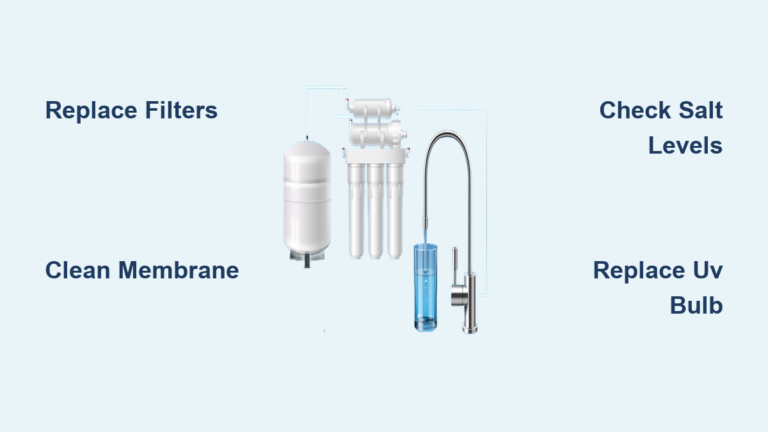
A typical RO system has 4–6 stages:
- Sediment pre-filter (5–10 microns): Removes sand and rust.
- Carbon pre-filter: Removes chlorine to protect the membrane.
- RO membrane (0.0001 micron): Removes dissolved solids and chemicals.
- Post-carbon filter: Polishes taste.
- Remineralization (optional): Adds back calcium/magnesium for taste and health.
- UV light (optional): Kills any remaining microbes.
Time to fill: 1–4 hours per gallon, depending on pressure and membrane size.
RO Limitations and Waste Water
- Waste water: For every 1 gallon purified, 3–5 gallons are flushed. Some eco-models reduce this to 1:1.
- No electricity needed: Uses water pressure alone.
- Mineral removal: Strips beneficial electrolytes, so consider a remineralization stage.
- Slow flow: Requires a storage tank.
Best for: Homes with well water, high TDS, or concerns about heavy metals and nitrates.
Specialized Purification Methods
When standard filtration isn’t enough, advanced methods step in.
UV Light for Microbial Sterilization
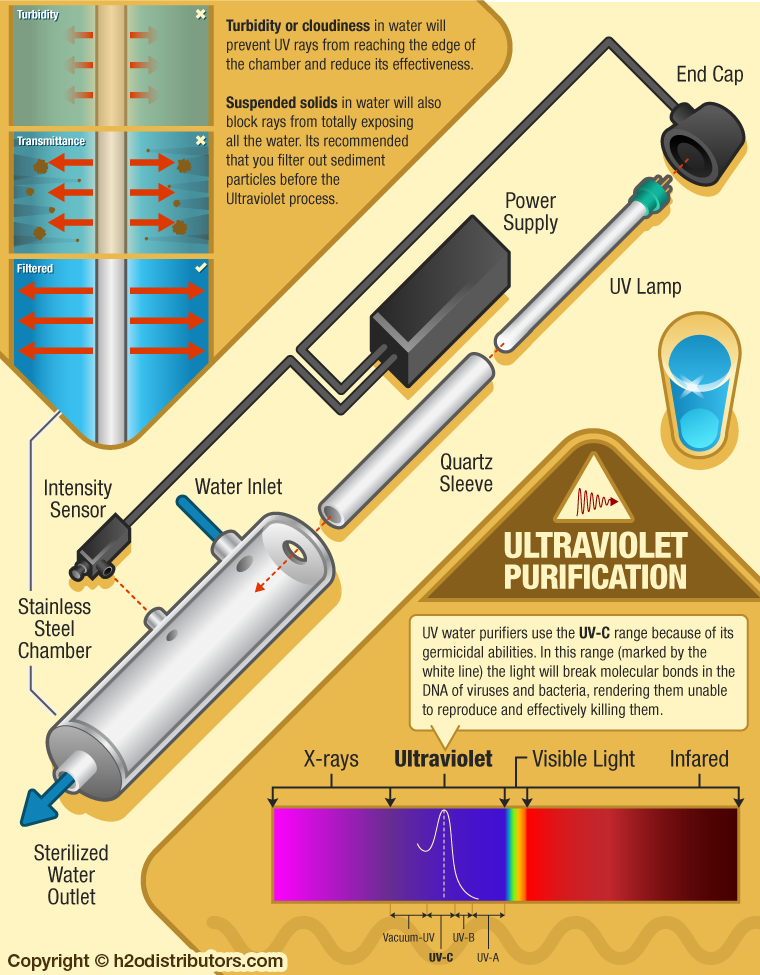
Ultraviolet (UV) light kills bacteria, viruses, and cysts.
- UV-C light disrupts DNA, preventing reproduction.
- Does not remove chemicals, particles, or taste issues.
- Requires pre-filtration (sediment and carbon) so light isn’t blocked.
Critical for: Well water, where pathogens like E. coli, Giardia, or Cryptosporidium are risks.
Must-have: Quartz sleeve to keep the bulb clean. Replace bulb annually.
Distillation and Ultrafiltration
Two other high-purity methods:
- Distillation: Boils water into steam, then condenses it. Leaves behind minerals, chemicals, and microbes.
- Pros: Removes nearly everything.
- Cons: Slow, energy-intensive, flat-tasting water.
- Ultrafiltration (UF): Uses hollow fiber membranes with 0.01-micron pores.
- Removes bacteria, cysts, and some viruses.
- Retains minerals, making it ideal for drinking water.
- No wastewater and no pressure needed.
UF vs RO: UF is faster and eco-friendly; RO is more thorough.
Point-of-Use vs Whole-House Systems
Where you install the filter determines what it protects.
Under-Sink and Faucet Filters
Point-of-use (POU) systems serve one tap, usually for drinking and cooking.
- Faucet mounts: Easy DIY install. Combine carbon and sediment filtration.
- Under-sink: Larger capacity. Can include RO, UV, or multi-stage carbon.
- Pitcher/fridge filters: Basic carbon + ion exchange. Improve taste and reduce lead. Do not remove germs.
Best for: Renters, small households, and targeted drinking water improvement.
Whole-House (POE) Filtration
Point-of-entry (POE) systems filter all water entering your home.
- 3-stage standard setup:
1. Pre-filter (5–10 microns): Removes sediment.
2. Main tank (KDF + carbon): Reduces chlorine, heavy metals, and inhibits bacteria.
3. Post-filter (1–5 microns): Polishes water. - Optional upgrades: UV, softener, or sequestration.
Benefits: Protects plumbing, appliances, skin, and hair. Prevents chlorine vapor in showers.
Replace: Pre-filter every 2 months; post-filter every 6 months.
Contaminant-Specific Filter Matching
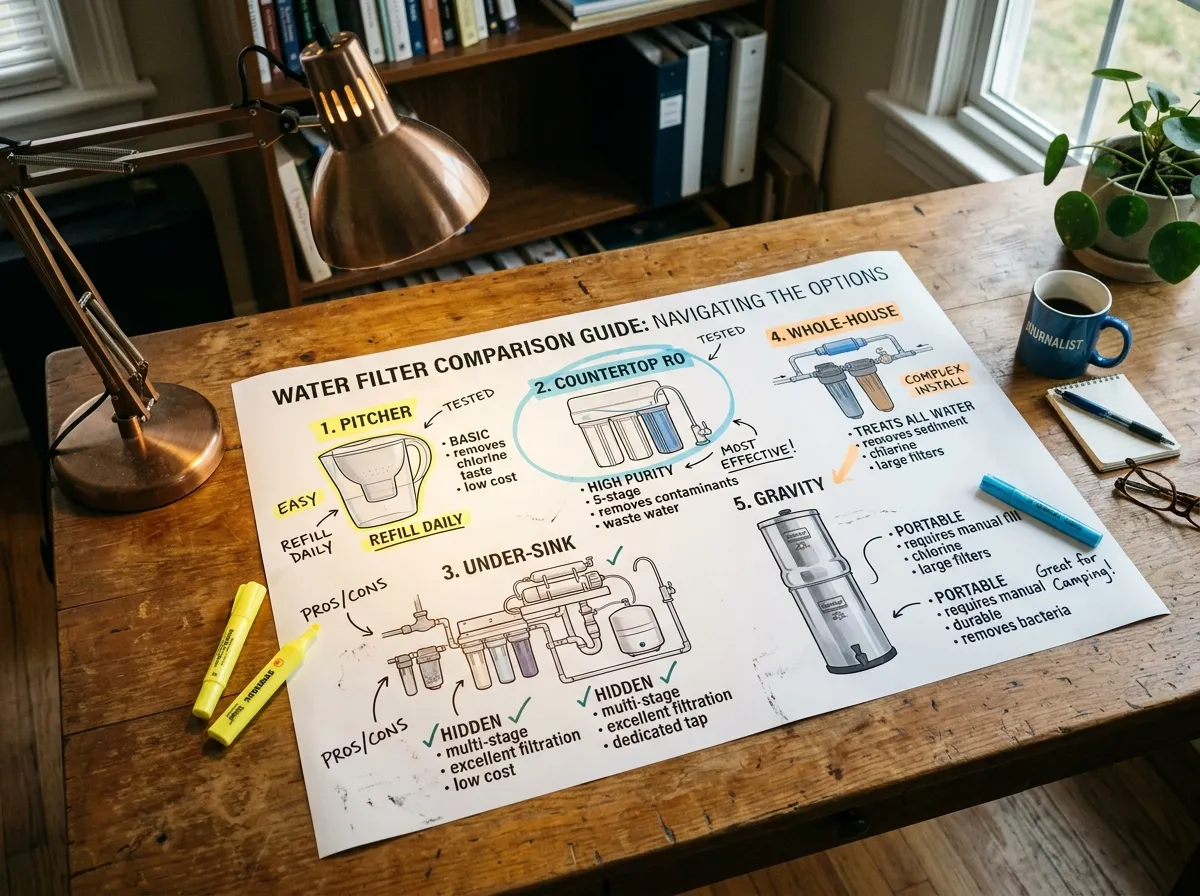
Not all filters remove all contaminants. Match the system to your water quality.
Lead, Arsenic, and Heavy Metals
- Reverse osmosis: Removes 95–99% of lead, arsenic, and mercury.
- Specialty carbon blocks: Certified for lead reduction (NSF 53).
- Distillation: Effective but slow.
Test first: Use a certified lab if you have old pipes or well water.
Bacteria, Viruses, and Cysts
- Bacteria (E. coli, Salmonella): RO, UV, UF, ceramic (0.3-micron absolute).
- Cysts (Giardia, Cryptosporidium): RO, UV, ceramic (1-micron absolute).
- Viruses (Norovirus, Hepatitis A): Only RO or NF (nanofiltration) reliably remove them.
Note: Standard pitcher filters do not kill germs. If immunocompromised, use RO + UV and avoid changing filters yourself.
Chlorine, VOCs, and Bad Taste
- Activated carbon: Best for chlorine, VOCs, and pesticides.
- Catalytic carbon: For chloramines.
- KDF media: Reduces chlorine and inhibits bacterial growth in whole-house systems.
Result: Crisp, clean taste, ideal for coffee, tea, and cooking.
Maintenance and Performance Tips
Even the best filter fails without proper care.
Filter Replacement Schedules
- Sediment pre-filter: Every 2 months (or when brown/black).
- Carbon filter: Every 6–12 months.
- RO membrane: Every 2–3 years.
- UV bulb: Annually.
- Softener resin: Every 5–10 years.
Pro Tip: Set calendar reminders. Clogged or expired filters can harbor bacteria. Wear gloves when changing filters to avoid exposure to trapped contaminants.
NSF Certification and Testing
- NSF Standard 42: Covers aesthetic effects (taste, odor).
- NSF Standard 53: Health effects (lead, cysts, VOCs).
- NSF Standard 58: Reverse osmosis systems.
- Verify claims in the NSF database, since not all filters live up to marketing.
Water Testing Before Buying
- City water: Review your Consumer Confidence Report (CCR).
- Well water: Test annually for bacteria, nitrates, and heavy metals. Test immediately if color, taste, or smell changes.
- In-home tests: Can check chlorine, iron, TDS, and hardness in about 30 minutes.
Bottom line: Don’t guess. Know what’s in your water before choosing a filter.
Frequently Asked Questions About Water Filters
What is the difference between filtration and purification?
Filtration reduces specific contaminants like sediment, chlorine, and some chemicals to improve taste and clarity. Purification is a more intensive process that removes nearly all impurities, often using reverse osmosis or distillation. Purification is typically reserved for medical, industrial, or high-contamination scenarios.
Do water filters remove bacteria and viruses?
Standard carbon and pitcher filters do not remove germs. To eliminate bacteria like E. coli, you need a filter with an absolute pore size of 0.3 microns or smaller, ultrafiltration, or reverse osmosis. Viruses require nanofiltration or reverse osmosis, since they are the smallest pathogens.
How often should I replace my water filter?
Replacement depends on the filter type. Sediment pre-filters need changing every 2 months. Carbon filters last 6–12 months. RO membranes work for 2–3 years. UV bulbs should be replaced annually. Always follow manufacturer guidelines and set reminders.
Is reverse osmosis water safe to drink long-term?
RO water is extremely clean and removes up to 99% of contaminants, including harmful heavy metals and nitrates. However, it also strips beneficial minerals like calcium and magnesium. Adding a remineralization stage restores balance and improves taste for long-term health.
What is the best filter for well water?
Well water requires a multi-stage approach. Start with sediment and carbon filtration to remove particles and odors. Add UV light to kill bacteria, viruses, and cysts like Giardia and Cryptosporidium. Test your water annually for contaminants specific to your region.
Do whole-house filters reduce water pressure?
If maintained properly, whole-house filters should not significantly reduce pressure. However, clogged pre-filters or dense carbon blocks can restrict flow. Replace filters on schedule and monitor for pressure drops as a sign of needed maintenance.
Key Takeaways for Understanding How Water Filters Work
Water filtration combines physical barriers, chemical adsorption, and advanced processes like reverse osmosis and UV sterilization to remove contaminants. The right system depends on your water source, the specific impurities present, and your household needs. A simple carbon pitcher improves taste and reduces chlorine, while a whole-house RO + UV setup delivers comprehensive protection against heavy metals, dissolved solids, and pathogens.
Before purchasing any system, test your water to identify contaminants. Match the filter technology to your specific concerns, whether that’s lead, bacteria, hardness, or chlorine. Finally, commit to regular maintenance. Even the best filter fails if you neglect replacement schedules. With the right knowledge and routine care, you can enjoy clean, safe, great-tasting water from every tap in your home.