How to Purify Water by Boiling
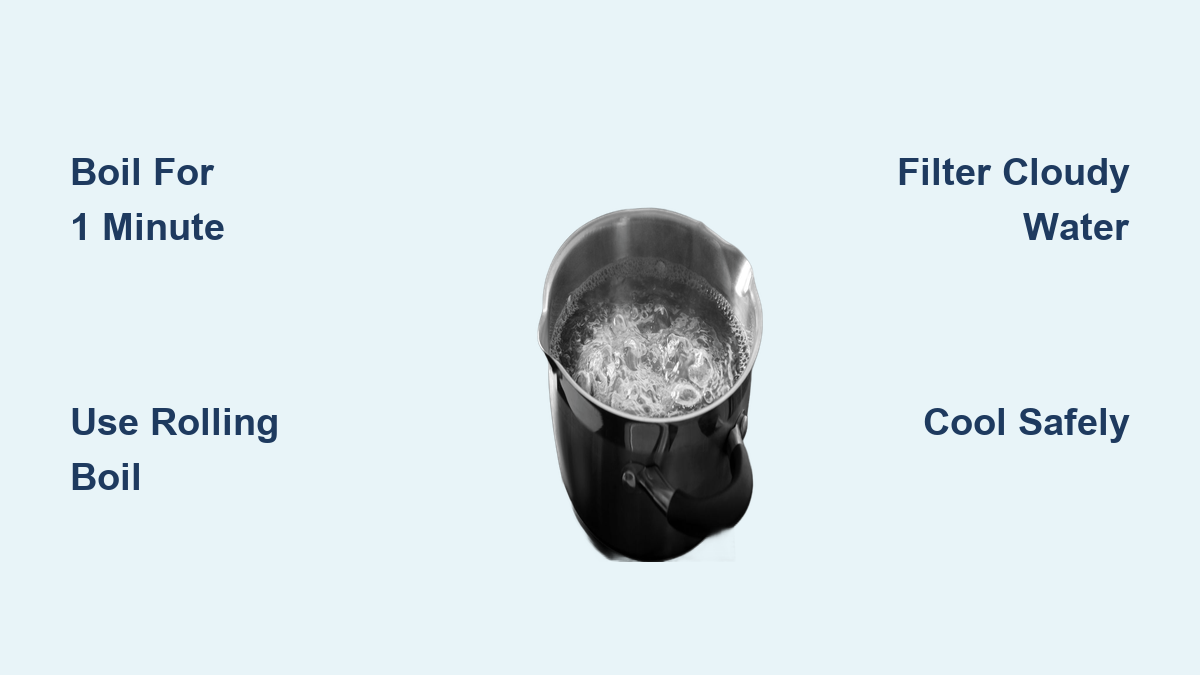
You’re hiking in the backcountry, a storm knocks out your city’s water supply, or you’re traveling where tap water isn’t safe. In every scenario, one question arises: how do I make water safe to drink? The most reliable answer, backed by the CDC, WHO, and EPA, is simple: purify water by boiling. This method destroys nearly all disease-causing bacteria, viruses, and parasites, making it the gold standard for emergency disinfection.
But boiling isn’t just “heat and go.” To be effective, it must be done correctly. Altitude matters. Cloudy water reduces effectiveness. And critically, boiling does not remove chemicals, heavy metals, or microplastics. In fact, it can concentrate them. If you’re relying solely on boiling without understanding these nuances, you could still be at risk.
This guide breaks down exactly how to purify water by boiling, step by step. You’ll learn when boiling works, when it doesn’t, how long to boil, and what to do before and after. Whether you’re prepping for a disaster or heading into the wilderness, this is everything you need to turn unsafe water into safe, drinkable water quickly, safely, and effectively.
Choose a Safe Water Source First
Before you even think about boiling, your starting point matters. Not all water is created equal, even if it looks clean.
Prioritize Flowing Over Stagnant Water
Moving water from streams or rivers is generally safer than stagnant ponds or puddles. Stagnant water allows pathogens like Giardia and E. coli to multiply and become breeding grounds for insects and parasites.
Avoid Contamination Zones
Stay away from water near:
– Animal trails or grazing areas
– Downstream from campsites or agricultural runoff
– Industrial zones or visible oil slicks
Even clear-looking water can carry invisible threats. Always assume natural sources are contaminated unless confirmed otherwise.
Collect Cleanly
Use a clean container. Dip just below the surface to avoid floating debris. Wash your hands or use hand sanitizer before handling your water bottle or pot to prevent introducing new germs.
Pre-Filter Cloudy Water

Boiling alone isn’t enough if the water is murky. Particles can shield microbes from heat, reducing effectiveness.
Let Sediment Settle
Pour cloudy water into a container and let it sit undisturbed. Heavier particles will sink to the bottom. Carefully scoop or pour off the clearer water from the top.
Filter Through Cloth or Paper
Use a clean bandana, coffee filter, paper towel, or specialized backcountry filter to strain remaining particles. This step is crucial; it makes boiling far more effective and improves taste.
Pro Tip: Standard filters with pores ≤1 micron (NSF 53 or 58 rated) remove Giardia and Cryptosporidium, but not viruses. So filtering is a pre-treatment, not a full purification method.
Achieve a Rolling Boil
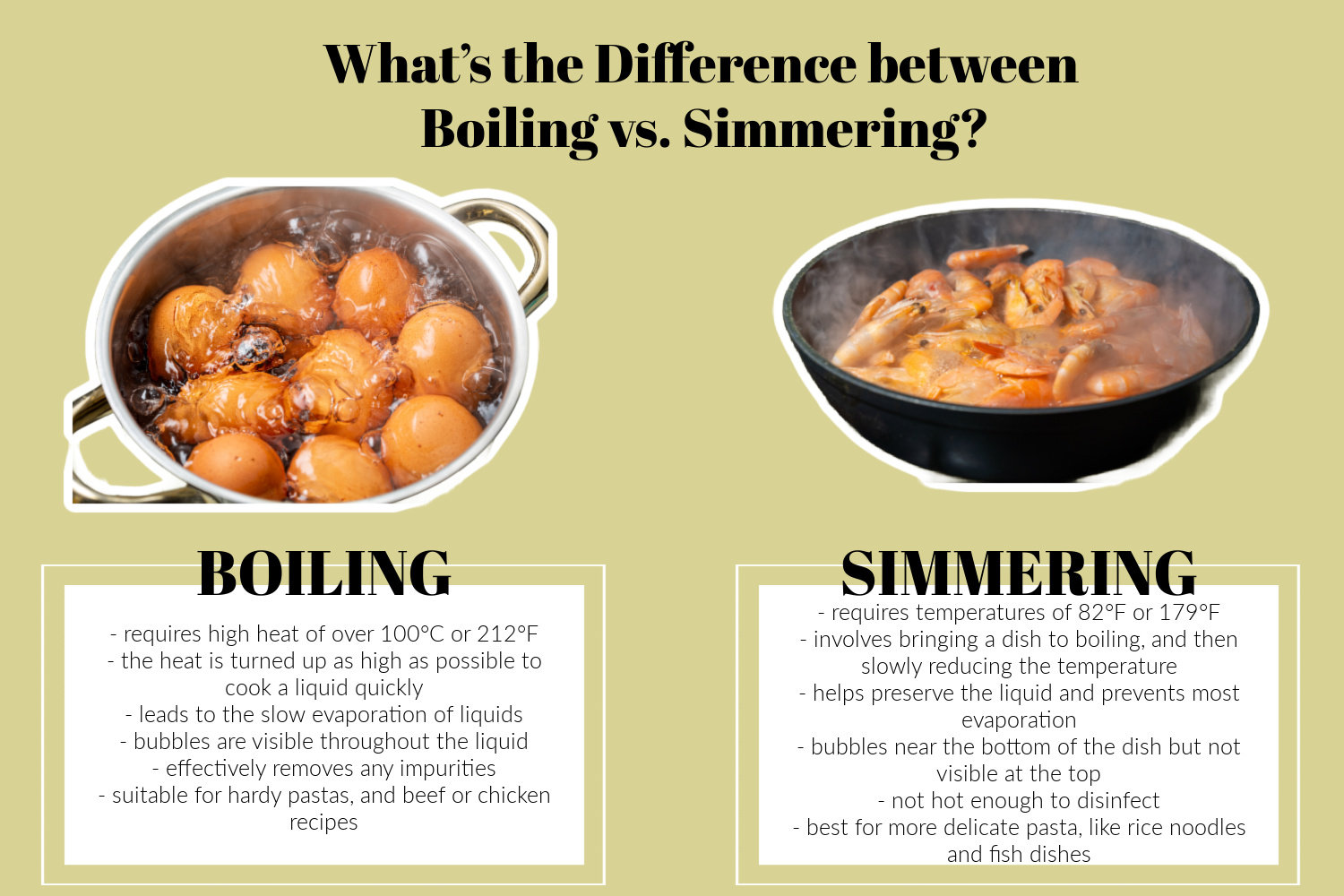
This is where most people get it wrong. A few bubbles rising from the bottom aren’t enough. You need a rolling boil.
What Is a Rolling Boil?
A rolling boil means vigorous, continuous bubbling across the entire surface of the water, not just around the edges. This ensures every drop has reached the lethal temperature for pathogens.
Boil for the Right Duration
Time starts after the rolling boil begins:
- Below 6,500 feet (2,000 meters): Boil for 1 minute
- Above 6,500 feet (2,000 meters): Boil for 3 minutes
At higher elevations, water boils at lower temperatures (around 194°F at 9,800 feet), so longer boiling compensates for reduced heat.
Myth Busting: The “1-minute rule” only applies at low altitudes. If you’re unsure of your elevation, default to 3 minutes for safety.
Cool and Store Safely
Boiled water must cool properly and be stored to prevent recontamination.
Let It Cool Naturally
Do not add ice or cold water; this can reintroduce bacteria. Leave the pot covered and let it sit at room temperature.
Use Clean, Sealed Containers
Transfer cooled water to sanitized bottles or jugs with tight lids. Avoid pouring boiling water directly into plastic bottles unless they’re heat-rated. Hot water can leach BPA from regular plastics.
Improve Flat Taste
Boiled water often tastes flat due to lost dissolved oxygen. Fix this by:
– Pouring it between two clean containers 5 to 10 times
– Adding a pinch of salt per liter
– Letting it sit uncovered for an hour with a mesh cover to keep bugs out
Understand What Boiling Can’t Do
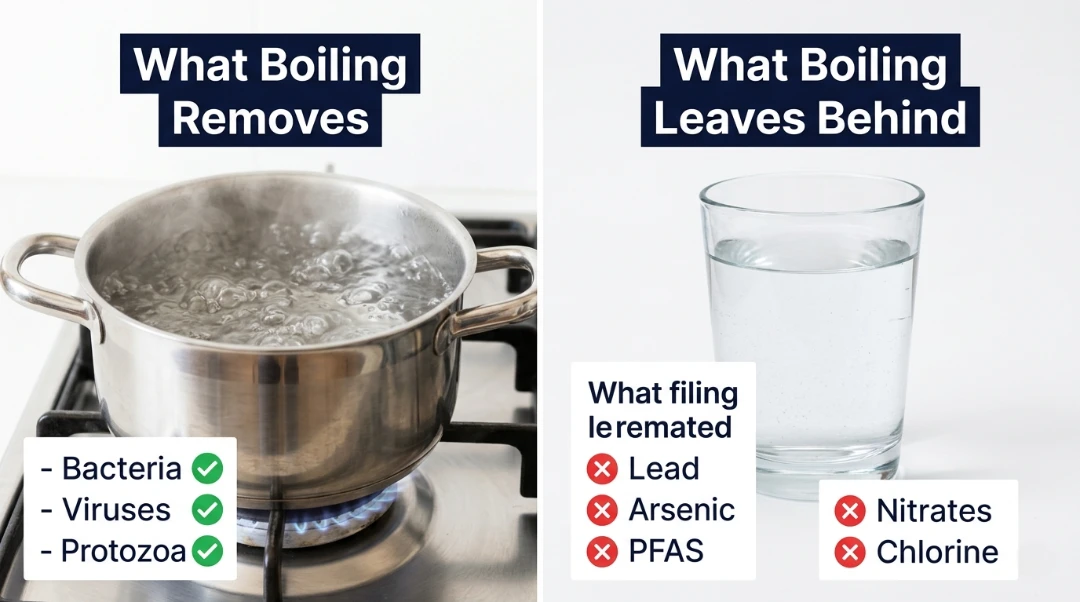
Boiling kills germs, but that’s all it does. It does not remove chemicals, toxins, or heavy metals.
Boiling Increases Chemical Concentrations
Because water evaporates during boiling, non-volatile contaminants become more concentrated in the remaining liquid. These include:
– Lead and mercury
– Arsenic and chromium 6
– PFAS (“forever chemicals”)
– Pesticides and nitrates
– Fluoride
If your water source is near industrial sites, farms, or old plumbing, boiling alone may make it more dangerous.
Warning: In cities with lead pipes or chemical spills, boiling is not safe unless paired with filtration.
Follow Boil Water Advisories Correctly
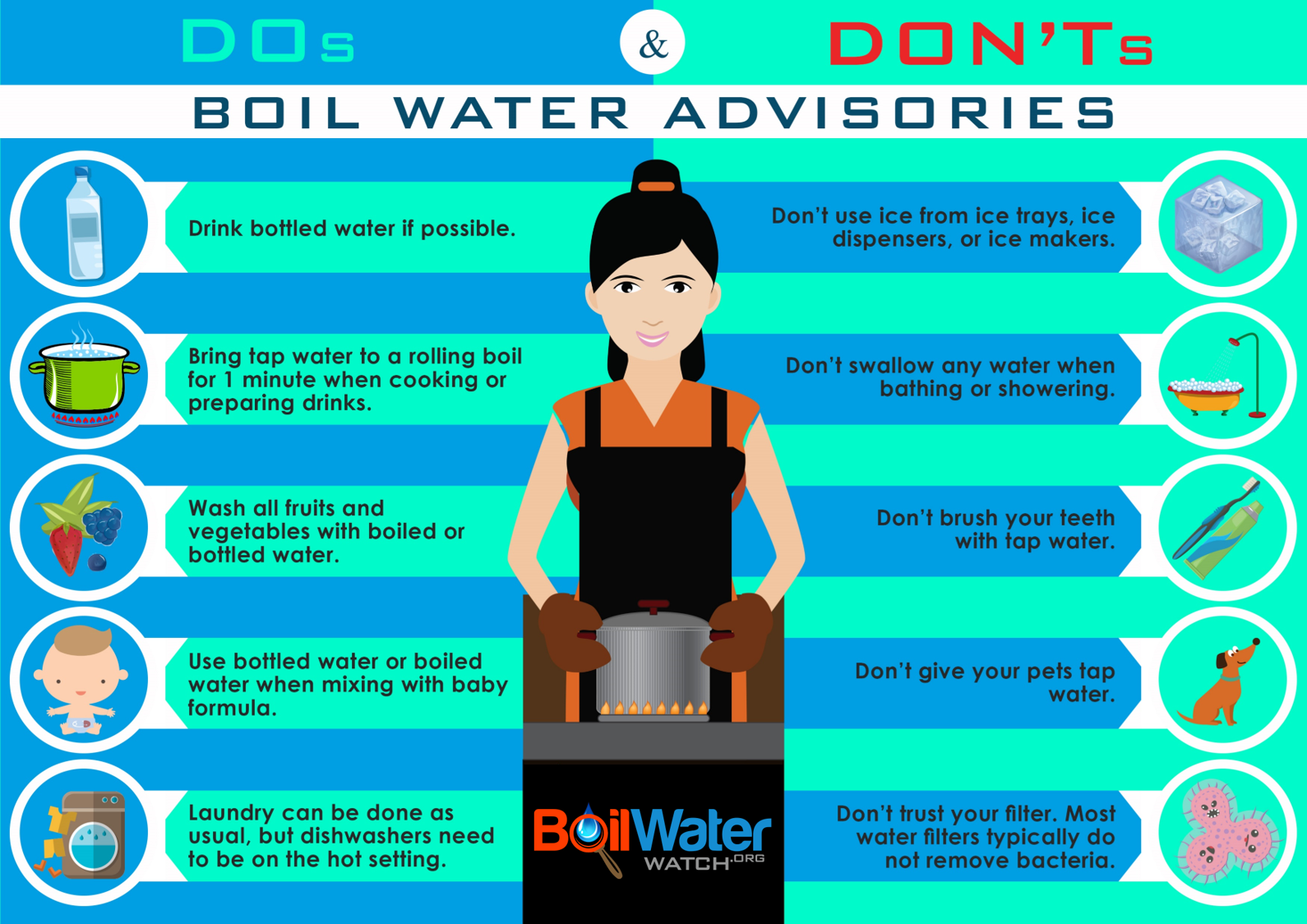
When officials issue a “Boil Water Advisory,” they mean no exceptions.
Use Boiled or Bottled Water For:
- Drinking and cooking
- Making ice
- Brushing teeth
- Preparing baby formula
- Washing dishes (unless dishwasher has sanitizing cycle)
- Pet water
Bathing Caution
Showers are okay if you don’t swallow water. For infants or those with weakened immune systems, use sponge baths with boiled water.
Advisory Duration
Advisories last until multiple water tests confirm safety, usually 24 to 48 hours. Don’t assume it’s over just because the water looks clear.
Know When to Use Alternatives
If you can’t boil, other methods can disinfect, but only after filtering.
Use Unscented Household Bleach
Only use regular liquid bleach with sodium hypochlorite (6% to 8.25%), no additives.
| Water Volume | 6% Bleach | 8.25% Bleach |
|---|---|---|
| 1 Quart/Liter | 2 drops | 2 drops |
| 1 Gallon | 8 drops | 6 drops |
| 4 Gallons | 1/3 tsp | 1/4 tsp |
Stir and wait 30 minutes. Water should smell slightly of chlorine. If not, repeat the dose and wait 15 more minutes.
Try Iodine or Tablets
- Iodine (2%): 5 drops per liter for clear water, 10 drops for cloudy. Wait 30 minutes. Avoid if pregnant, have thyroid issues, or for long-term use.
- Chlorine Dioxide Tablets: Effective against Cryptosporidium. Follow package instructions (often 30 minutes to 4 hours).
UV Light Purifiers
Portable UV pens work on clear water only. Stir for full exposure. Requires batteries, so don’t rely on them if power is low.
Never use pool chlorine or tablets. They are toxic for drinking.
Avoid Common Boiling Mistakes
Even experienced campers make errors that compromise safety.
Mistake: Boiling in Dirty Pots
Always use a clean container. Residue or biofilm can harbor bacteria that survive boiling.
Mistake: Using Porous Rocks
Never heat river rocks in a fire. They can trap water and explode when heated.
Mistake: Ignoring Altitude
At 10,000 feet, water boils at 193°F, which is too low for instant germ kill. Always boil for 3 minutes above 6,500 feet.
Mistake: Storing Boiled Water Improperly
Leaving boiled water in an open container invites airborne bacteria. Use sealed, sanitized bottles.
Compare Boiling to Other Methods
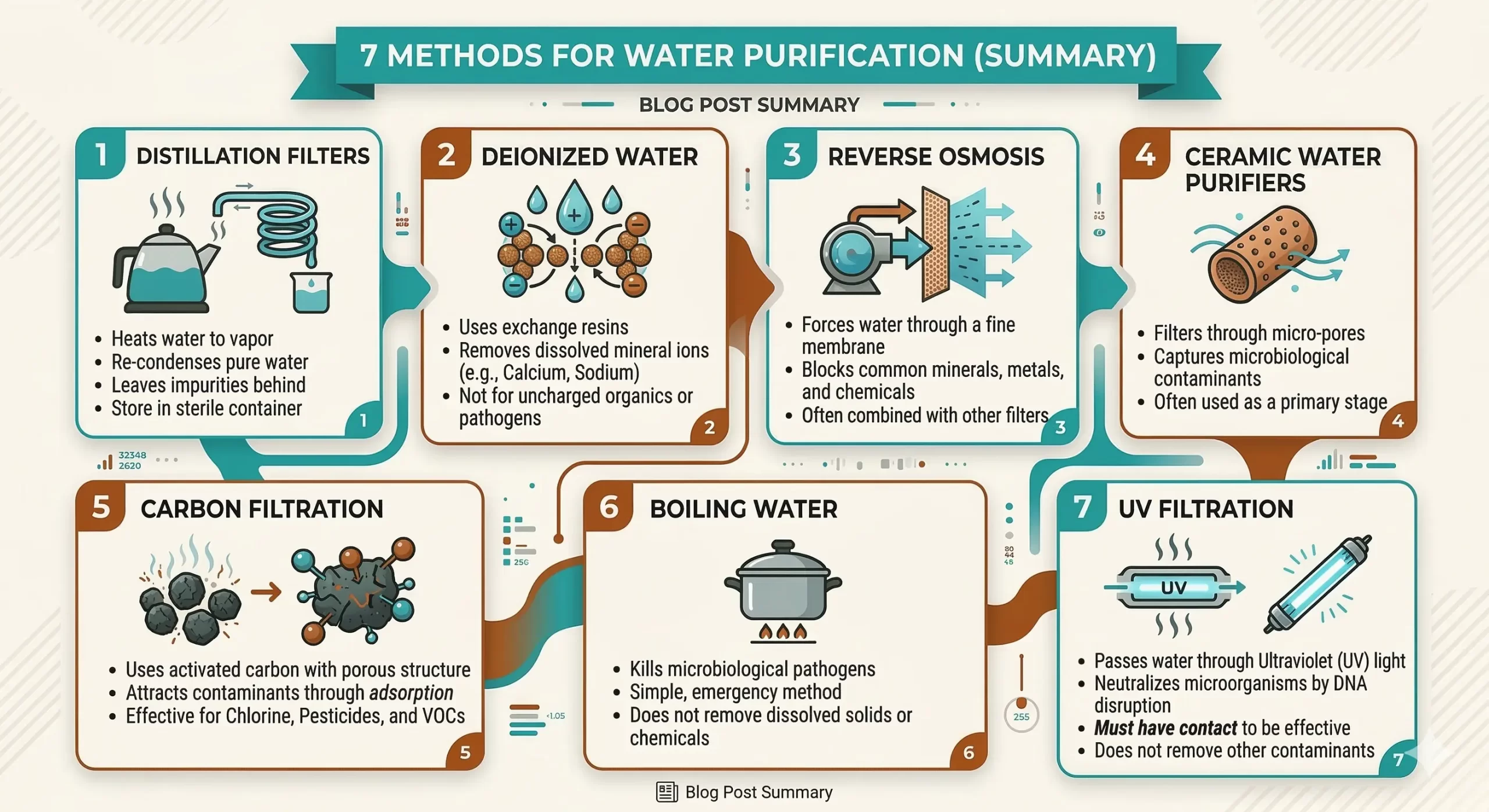
No single method is perfect. Here’s how boiling stacks up:
| Feature | Boiling | Bleach | Filter | UV | Reverse Osmosis |
|---|---|---|---|---|---|
| Kills Bacteria | Yes | Yes | No (traps) | Yes | Yes |
| Kills Viruses | Yes | Yes | No | Yes | Yes |
| Kills Protozoa | Yes | Yes | Yes | Yes | Yes |
| Removes Chemicals | No | No | Yes (carbon) | No | Yes |
| Removes Heavy Metals | No | No | No | No | Yes |
| Removes PFAS | No | No | No | No | Yes |
| Fuel Needed | High | No | No | Battery | Power |
| Best For | Emergencies, backcountry | Backup, no heat | Hiking, sediment | Travel, clear water | Home, full purification |
Bottom Line: Boiling wins for biological safety. For chemical threats, you need reverse osmosis or activated carbon filters.
Field-Tested Tips for Success
Save Fuel with Smart Practices
- Use a lid to reduce boiling time by up to 30%
- Build a windscreen around your stove
- Only boil what you need, since evaporation loses 10% to 15% of volume
Re-aerate for Better Taste
After cooling, pour water between containers to restore oxygen and improve flavor.
Plan Ahead
Purifying water takes time. In hot weather or during heavy activity, boil water before you get thirsty.
Prevent Recontamination
Add a drop of bleach per gallon to stored water if keeping it longer than 24 hours. This stops microbial regrowth.
Debunk Boiling Myths
Myth: “Clear Water Is Safe Water”
False. Giardia and E. coli are invisible. Clear water can still make you sick. Always treat it.
Myth: “Freezing Purifies Water”
No. Freezing slows microbes but doesn’t kill them. Thawed ice from a lake is still unsafe.
Myth: “Any Bubbles Mean It’s Boiling”
Not true. A few bubbles mean simmering. Wait for a full, rolling boil across the surface.
Myth: “Boiling Removes All Contaminants”
Only biological ones. Chemicals get worse. If you suspect lead or pesticides, boiling isn’t enough.
Protect Vulnerable Groups
Infants, elderly, pregnant women, and immunocompromised individuals face higher risks from waterborne illness.
For Babies
- Use only boiled or bottled water for formula
- Boil for a full 3 minutes, even at low altitudes
- Cool completely before mixing
For Pets
Animals can also get Giardia or Salmonella. Give them boiled or bottled water during advisories.
Frequently Asked Questions About Boiling Water
Does boiling water remove chemicals like lead or chlorine?
No. Boiling only kills biological pathogens like bacteria, viruses, and protozoa. It does not remove lead, mercury, arsenic, PFAS, pesticides, or fluoride. In fact, boiling concentrates these chemicals as water evaporates. For chemical removal, use activated carbon filters or reverse osmosis.
How long should I boil water at high altitude?
Above 6,500 feet (2,000 meters), boil water for 3 minutes after reaching a rolling boil. At higher elevations, water boils at lower temperatures (around 194°F at 9,800 feet), so extra time compensates for reduced heat. When in doubt, default to 3 minutes.
Can I boil cloudy water without filtering it first?
It’s not recommended. Sediment and particles can shield microorganisms from heat, making boiling less effective. Let cloudy water settle, then pour it through a clean cloth, coffee filter, or paper towel before boiling. Pre-filtering dramatically improves disinfection results.
Is it safe to reboil water that has already been boiled?
Reboiling is generally safe if the water was stored properly in a sealed, clean container. However, repeated boiling can further concentrate any minerals or chemicals present, and it increases fuel use. For best results, boil only what you need and store leftovers properly.
What containers are safe for storing boiled water?
Use clean glass or food-grade stainless steel containers with tight lids. Heat-rated plastics (like Nalgene) are also acceptable. Avoid regular plastic bottles that aren’t designed for hot liquids, as heat can cause BPA leaching or container deformation.
Does freezing water purify it?
No. Freezing slows bacterial growth but does not kill pathogens or remove chemicals. Thawed ice from natural sources remains unsafe to drink. Always boil or chemically treat water regardless of whether it has been frozen.
Key Takeaways for Purifying Water by Boiling
Boiling is the most trusted, accessible method for killing dangerous pathogens in water, but it works only when done correctly. Always filter cloudy water first, achieve a true rolling boil, and adjust your timing based on altitude: 1 minute below 6,500 feet and 3 minutes above. Store boiled water in clean, sealed containers to prevent recontamination.
Remember that boiling does not remove chemicals, heavy metals, or PFAS. If you suspect chemical contamination from industrial runoff, old plumbing, or agricultural sources, boiling alone can actually make water more dangerous by concentrating toxins. In those situations, pair boiling with activated carbon filtration or use bottled water instead.
Your next step: prepare a simple emergency kit with a clean pot, water purification tablets, unscented bleach, and a coffee filter or cloth. With these supplies and the steps in this guide, you can turn any questionable water source into safe drinking water, no matter where you are.