How to Purify Lake Water for Drinking
You’re standing at the edge of a peaceful lake, water so clear you can see fish darting below. It looks safe enough to drink straight from the shore, but never drink untreated lake water. Even the most pristine-looking lakes can hide bacteria, viruses, parasites, and chemical runoff that cause serious illness. Every year, hikers, campers, and off-grid homeowners end up with giardia, crypto, or heavy metal poisoning because they assumed natural meant safe.
Purifying lake water takes more than just a filter. It requires a layered approach that tackles biological threats, chemicals, and heavy metals in stages. Boiling kills germs but won’t remove lead. Filters catch bacteria but miss viruses. This guide breaks down the exact steps to make lake water genuinely safe, whether you’re filling a bottle on a weekend trip or building a whole-house system for a remote cabin.
Assess the Contamination Risk Before You Collect
Clear water is not clean water. Before you scoop a single drop, you need to know what threats you’re dealing with.
Identify Biological Hazards
Lake water commonly contains invisible pathogens that cause diarrhea, cramps, and long-term gut problems:
– Bacteria like E. coli and salmonella
– Protozoa such as Giardia and Cryptosporidium
– Viruses including norovirus and hepatitis A
Even one swimmer, animal, or upstream campsite can contaminate the entire area.
Spot Chemical and Environmental Threats
Runoff introduces more than just rainwater into lakes:
– Pesticides and herbicides from nearby farms
– Heavy metals like lead, arsenic, and mercury from soil or old pipes
– Nitrates and nitrites from septic systems and fertilizers
– PFAS and microplastics from industrial sources
– Algal toxins during summer blooms, some of which survive boiling
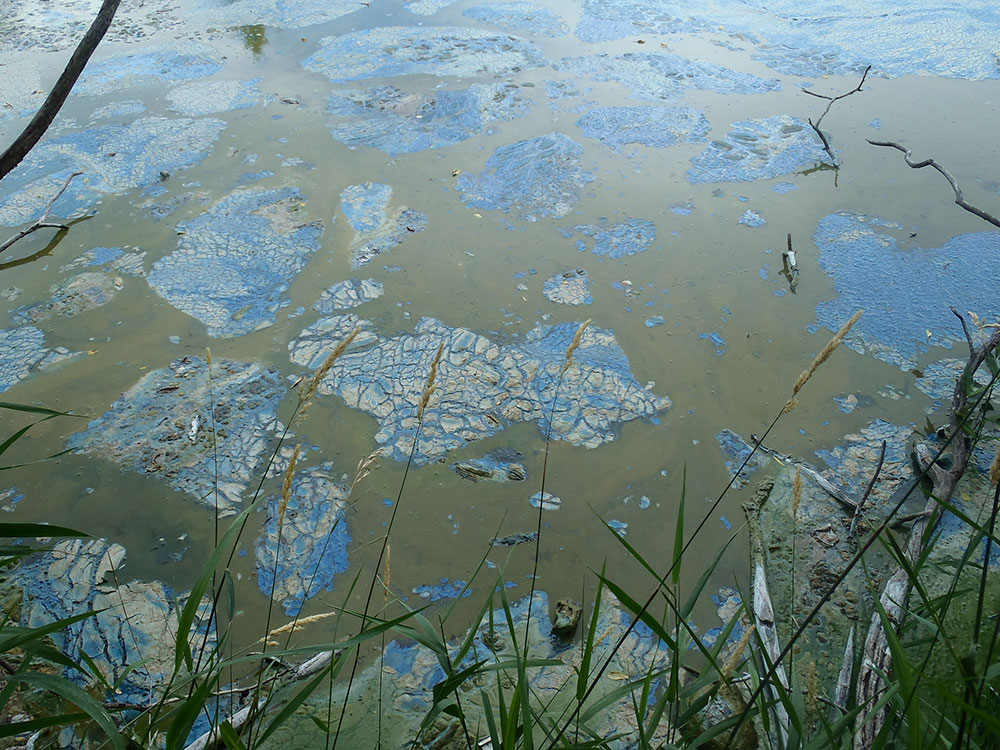
If the water has a green, slimy film or strong odor, walk away. This signals a harmful algal bloom that standard treatment can’t neutralize.
Pick a Safer Collection Spot
Where you collect matters as much as how you treat the water:
– Avoid areas near campsites, trails, docks, or animal activity
– Prefer moving water or scoop from the top few inches of a calm lake
– For permanent systems, place intake lines 10–20 feet deep to skip surface scum and sediment
– Use clean containers and sanitize your hands before filling
Pro Tip: In large lakes like Lake Powell, main channel water stays cleaner than back bays where swimmers and boats concentrate.
Build a 4-Stage Purification System
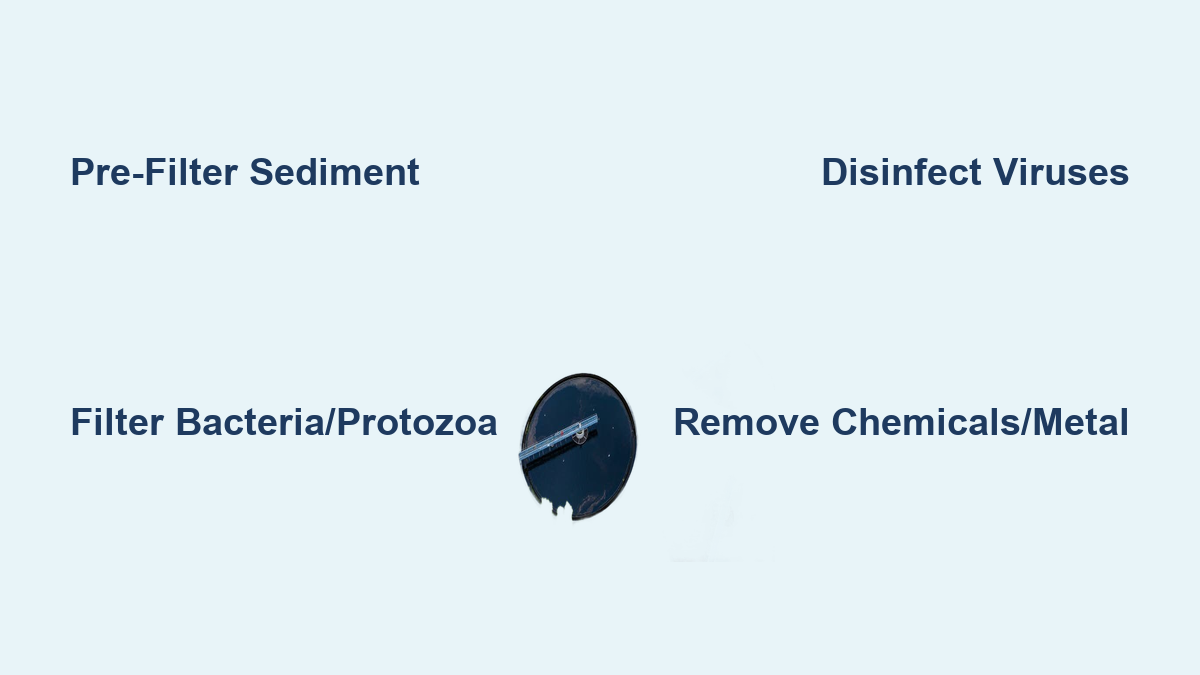
No single method removes everything. Layering treatments is the only way to cover all threats:
- Pre-filtration to remove sediment
- Mechanical filtration to catch bacteria and protozoa
- Disinfection to kill viruses and remaining pathogens
- Polishing to strip out chemicals and heavy metals
Remove Sediment First
Sediment clogs filters, shields pathogens from UV light, and reduces chemical effectiveness. Clearing it upfront makes every downstream step work better.
Choose the Right Pre-Filter Method
Match your approach to the water’s cloudiness:
– Let it settle: Pour murky water into a bucket and wait 6–12 hours, then scoop clear water from the top
– Cloth or mesh screen: A bandana, coffee filter, or fine mesh strains out leaves and silt
– Spin-down filter: Uses centrifugal force to remove sand and grit; flush every few days
– Sediment cartridge (5-micron): Fits into housing units; replace when flow drops
– Automatic backwashing filter: Best for high-sediment sources; self-cleans every 4 days with no replacements needed
Warning: Never run cloudy water into UV or RO systems. Particles block UV light and damage RO membranes.
Filter Out Bacteria and Protozoa

Mechanical filtration removes most pathogens but not viruses. Always follow with a disinfection step.
Compare Filter Types
| Type | Best For | Pore Size | Removes |
|---|---|---|---|
| Hollow fiber membrane | Backpacking | 0.1–0.2 micron | Bacteria, protozoa |
| Ceramic filter | Long-term use | <1 micron | Same |
| Gravity filter (Platypus, Katadyn) | Groups and cabins | 0.1–0.2 micron | Same |
| Squeeze filter (Sawyer) | Portability | 0.1 micron | Same |
Understand Filter Limitations
Most filters cannot remove viruses because they’re too small (0.004–0.1 micron). If you’re near human activity, viruses are a real concern. The solution is combining filtration with a disinfection method like UV, chemicals, or boiling.
Kill Viruses and Remaining Pathogens
Disinfection is the most critical step for full purification. Here’s how the main methods compare.
Boil Water (Most Reliable)
Boiling kills everything, including bacteria, viruses, and protozoa, even in cloudy water:
– Bring water to a rolling boil
– Wait 1 minute below 6,500 ft elevation
– Wait 3 minutes above 6,500 ft due to lower boiling temperatures
Let it cool before drinking or storing. This method works best for emergencies, small batches, or when no equipment is available.
Use Chemical Disinfection
Chemicals work when fuel or electricity aren’t available, but they require patience.
Chlorine Dioxide (Recommended)
– Kills bacteria, viruses, and Cryptosporidium
– Better taste than iodine
– Wait 30 minutes, or 4 hours for cold or cloudy water
Iodine Tablets
– Effective but not safe for pregnant women, thyroid patients, or long-term use
– Leaves an unpleasant taste
Household Bleach (Last Resort)
– Use unscented 5–9% sodium hypochlorite only
– Add 8 drops per gallon, mix, and wait 30 minutes
– A slight chlorine smell should be detectable
Never use pool chlorine. It’s toxic for drinking.
Try UV Purification for Clear Water
UV pens like SteriPen zap pathogens with light:
– Effective against all microbes
– Fast: treats 1 liter in 90 seconds
– Battery-powered, so keep spares charged
Requirements:
– Water must be clear (pre-filter first)
– Stir during treatment to expose all water
– Replace the bulb yearly, even if it still glows
Best paired with a filter: Filter removes particles; UV kills viruses.
Consider Ozone or Chlorine Injection for Whole-House Systems
For permanent off-grid homes, these systems disinfect all incoming water.
Ozone Treatment
– Injects ozone (O₃) into water
– Breaks down into oxygen, leaving no chemical taste
– Often paired with UV to destroy residual ozone
– Low power draw (~50 watts)
Chlorine Injection
– Uses a metering pump to add chlorine
– Requires an activated carbon post-filter to remove taste
– Test chlorine levels regularly (1–4 ppm is ideal)
Remove Chemicals and Heavy Metals
:max_bytes(150000):strip_icc()/installing-a-reverse-osmosis-system-2718849-hero-4b9b0d7bbd3941eeb12d23d3ebd7296b.jpg)
Filtration and disinfection don’t touch dissolved contaminants. For drinking water, add a polishing stage.
Install Reverse Osmosis (RO)
RO removes up to 99% of dissolved solids, including:
– Heavy metals (lead, arsenic, uranium)
– Nitrates, fluoride, PFAS
– Microplastics and pharmaceuticals
How It Works: Forces water through a semi-permeable membrane. Expect about 3 gallons of wastewater per 1 gallon purified.
Best Setup: A point-of-use system under the kitchen sink with sediment and carbon pre-filters. Replace the membrane every 2–4 years.
Warning: Some RO filters may leach nanoplastics. Add distillation for maximum purity.
Use Distillation for Ultimate Purity
Distillation produces the cleanest water possible by boiling water into steam and condensing it back to liquid. Contaminants stay behind.
Pros:
– Removes everything: pathogens, metals, chemicals
– No filter replacements
Cons:
– High energy use (~700–1,100W)
– Slow: about 1 gallon in 2 hours
– Needs descaling over time
This method works well for off-grid solar homes during peak sun or when nanoplastics are a top concern.
Add Activated Carbon for Better Taste
Activated carbon doesn’t purify, but it improves taste and removes chemicals like chlorine, pesticides, and VOCs. Use it as a pre-filter for UV systems or a post-filter for RO and chlorine injection. Replace every 6–12 months.
Treat Tannins If Water Looks Yellow
Tannins from decaying leaves cause staining and a bitter taste. Use a tannin filter with specialized resin that regenerates with water softener salt every 3 days. This is essential for forested lakes but doesn’t remove pathogens, so disinfection is still required.
Match Your System to Your Situation

For Backpacking and Camping
Goal: Lightweight, fast, and reliable.
Recommended Setup:
1. Collect from moving water, away from campsites
2. Pre-filter with a bandana or built-in mesh
3. Filter through a Sawyer Squeeze or gravity system
4. Disinfect with a UV pen, chlorine dioxide drops, or boiling for 1 minute
Pro Tip: Use a filter plus chemical combo for virus protection. Store filters dry to prevent mold.
For Off-Grid Cabins and Lake Houses
Goal: Whole-house clean water plus safe drinking supply.
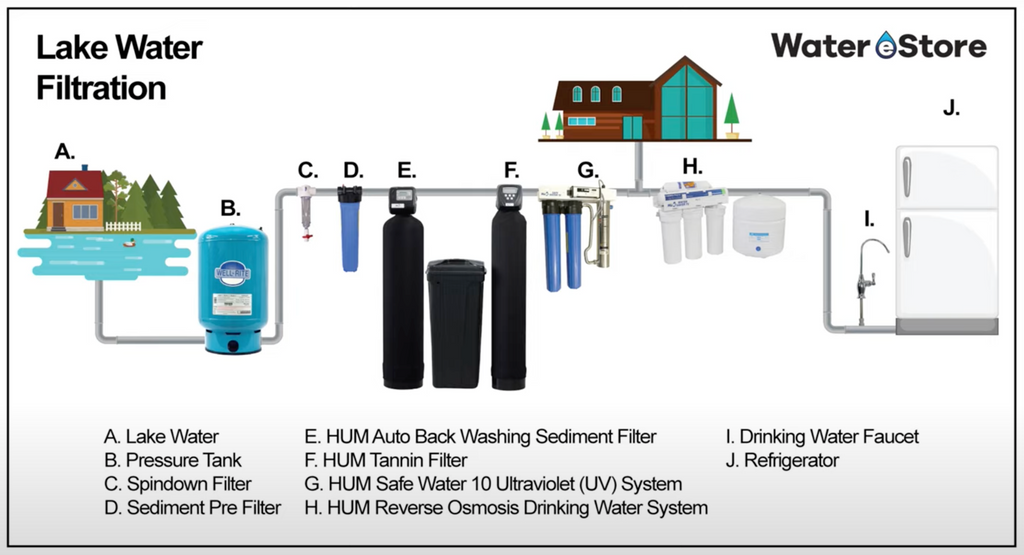
Standard Setup:
1. Intake pump placed 10–20 ft deep
2. Pressure tank
3. Automatic backwashing sediment filter
4. Tannin filter if water is discolored
5. UV system with 1-micron and carbon pre-filters (or chlorine injection with a carbon post-filter)
6. RO system at the kitchen sink for drinking and cooking
7. Optional distillation step for nanoplastic-free water
For Houseboats and Marine Use
Challenge: Limited space and freezing risk.
Compact Setup:
– Submersible pump → sediment filter → UV purifier
– Use a portable RO unit or boil for drinking water
– Winterize by draining all lines to prevent freeze damage
Test and Maintain Your System
Test Water Before Installation
Send a sample to a certified lab to check for:
– Biological: E. coli, coliform
– Chemical: Lead, arsenic, nitrates, PFAS
– Physical: pH, TDS, turbidity
Home kits are unreliable. Lab testing ensures accuracy. Retest annually or after floods, storms, or nearby construction.
Follow a Maintenance Schedule
| Component | Replacement or Service |
|---|---|
| Sediment filter | Every 3–12 months or when flow drops |
| UV bulb | Every 12 months (keep a spare) |
| RO membrane | Every 2–4 years |
| Carbon filter | Every 6–12 months |
| Ozone bulb | Every 1–2 years |
| Tannin filter | Regenerate with salt every 3 days |
Critical: Clean and dry portable filters before storage. Mold and biofilm grow fast.
Troubleshoot Common Problems
Low water flow?
– Cause: Clogged sediment or carbon filter
– Fix: Backwash or replace pre-filters
Bad taste or smell?
– Cause: Old carbon filter or bacterial growth
– Fix: Replace carbon filter and sanitize system with a bleach flush
Yellow water or stains?
– Cause: Tannins or iron
– Fix: Regenerate tannin filter or test for iron
Cloudy water after UV?
– Cause: UV bulb failure or pre-filter breach
– Fix: Replace bulb and inspect filters
Follow These 7 Safety Rules
- Never drink untreated lake water, even if it looks clean
- Use a double barrier: filter plus disinfect (filter + UV or chlorine)
- Respect contact time: don’t drink chemically treated water too soon
- Adjust for cold: double chemical wait time if water is below 65°F
- Avoid algal blooms: if water looks green or scummy, don’t use it
- Check system integrity: leaks or cracks can re-contaminate water
- Consult a doctor if pregnant, immunocompromised, or caring for infants. Distilled or boiled water is safest for these groups.
Frequently Asked Questions About Purifying Lake Water
Can you drink lake water after boiling it?
Yes. Boiling for 1 minute below 6,500 ft (or 3 minutes above) kills bacteria, viruses, and protozoa. However, boiling does not remove chemical contaminants, heavy metals, or PFAS. For full safety, combine boiling with a carbon filter or RO system.
What is the best filter for lake water?
For backpacking, a 0.1-micron squeeze filter like the Sawyer removes bacteria and protozoa. For cabins, a multi-stage system with sediment pre-filtration, UV disinfection, and RO polishing delivers the safest drinking water.
How do you remove viruses from lake water?
Standard mechanical filters cannot remove viruses because they’re too small. Use UV light, chlorine dioxide drops, iodine, or boiling to kill viruses. Combining filtration with one of these methods gives full protection.
Is lake water safe to drink if you filter it?
Filtering alone is not enough. Most filters miss viruses and do nothing for chemicals or heavy metals. Always follow filtration with a disinfection step and consider a polishing stage like RO or activated carbon for drinking water.
How long does it take to purify lake water with chemicals?
Chlorine dioxide requires 30 minutes of contact time in clear water, or up to 4 hours if the water is cold or cloudy. Always pre-filter cloudy water before adding chemicals.
Can you get sick from lake water even after filtering?
Yes, if you only use a mechanical filter. Filters miss viruses and do not remove chemical contaminants. A layered system (filter + disinfection + polishing) is the only way to make lake water reliably safe.
Key Takeaways for Safely Purifying Lake Water
Purifying lake water comes down to three essentials: layer your treatments, match the system to your situation, and maintain it religiously. Start with sediment removal, add filtration for bacteria and protozoa, disinfect for viruses, and polish with RO or carbon for chemicals and metals.
Your next step is to test your water source through a certified lab, then build a system based on the results. Whether you’re filling a bottle on a trail or outfitting a whole cabin, the layered approach is the only way to turn lake water into genuinely safe drinking water.