How to Purify Rain Water: Quick Steps
Rainwater may seem pure as it falls from the sky, but how to purify rainwater safely for drinking is a critical concern for off-grid homes, preppers, and eco-conscious households. While nature’s cycle distills water through evaporation, rain collects pollutants during its descent, absorbing airborne chemicals like PFAS (“forever chemicals”), dust, smoke, and microplastics. Once it hits your roof, it picks up bird droppings, heavy metals from roofing materials, and bacteria like E. coli, Legionella, and Giardia. Drinking untreated rainwater can lead to serious illness.
Even boiling, the most commonly suggested method, is not enough. While boiling kills microbes, it concentrates non-volatile contaminants like lead and PFAS, making the water more dangerous. True purification requires a multi-stage approach: starting with smart collection and ending with verified disinfection. This guide breaks down the safest, most effective methods, backed by science and real-world use, so you can turn rooftop runoff into clean, drinkable water with confidence.
Optimize Your Collection System

Before purification begins, your setup must minimize contamination at the source.
Choose Safe Roofing Materials
Your roof is the first point of contact. Not all materials are safe:
– Galvanized steel is ideal because it is durable and low-leach
– Asphalt shingles and terra cotta tiles shed toxins and organic debris, making downstream filtration less effective
Install a First Flush Diverter
The first rainfall after a dry spell carries the most contaminants. A first flush diverter automatically redirects the initial 10–20 gallons (or first 1–2 minutes) away from your tank. This simple device removes:
– Dust and pollen
– Bird droppings
– Pollutants accumulated on the roof
Install it on the downspout line before water reaches the storage tank.
Use Covered, Food-Grade Storage Tanks
Your tank must prevent contamination after collection:
– Material: Use polyethylene or fiberglass tanks rated ANSI/NSF 61 for potable water
– Design: Keep tanks covered and sealed to block mosquitoes, animals (rats, birds), and sunlight (which triggers algae growth)
– Maintenance: Clean annually to remove sediment and biofilm
Pre-Filter Rainwater Effectively
Mechanical filtration removes physical debris before advanced treatment.
Screen Out Large Debris
Install a 100–200 micron screen filter at the downspout or tank inlet. This stops:
– Leaves
– Twigs
– Insects
– Nests
Use leaf guards or gutter mesh to reduce clogging and maintenance.
Remove Fine Sediment
Even after screening, silt and fine particles remain. A 5–10 micron pleated sediment filter catches:
– Pollen
– Fine dust
– Rust particles
Place this before any UV, RO, or carbon system. Without it, downstream filters clog fast, and UV light cannot penetrate cloudy water.
Disinfect with UV Light

UV is the gold standard for whole-house rainwater disinfection.
How UV Purification Works
UV-C light inactivates pathogens by damaging their DNA. It kills:
– E. coli
– Legionella
– Cryptosporidium
– Giardia
– Viruses like Hepatitis A and Norovirus
Effectiveness: 99.99% microbial kill rate when properly installed.
Requirements for Success
UV only works if:
– Water is pre-filtered to <5 microns (clear, not cloudy)
– System delivers 40 mJ/cm² dose (Class A, per ANSI/NSF 55)
– Power is continuous (solar/battery backup recommended for off-grid)
Maintain Your UV System
- Replace the bulb yearly; even if it still glows, output degrades
- Inspect quartz sleeve twice a year for cloudiness or fouling
- Install a system alarm to alert you if flow is too high or bulb fails
Pros: No chemicals, no taste change, low maintenance
Cons: No residual protection, requires power, does not remove chemicals
Use Chlorine for Residual Protection

Chemical treatment is effective, especially for large tanks or emergency use.
Choose the Right Chlorine Source
- Household bleach: Only unscented, additive-free bleach with 4–8% sodium hypochlorite
- Liquid sodium hypochlorite: 5–12.5% concentration, ANSI/NSF 60 certified, better for long-term use
- Avoid pool chlorine because it may contain cyanuric acid or cyanide byproducts
Dose Correctly by Tank Size
| Tank Size | 12% Solution | 4% Solution |
|---|---|---|
| 100 gal | 21.5 mL | 45 mL |
| 500 gal | 107.5 mL | 225 mL |
| 1,000 gal | 215 mL | 450 mL |
| 5,000 gal | 1,075 mL | 2,250 mL |
Note: 1 US tablespoon ≈ 14.8 mL
Monitor Residual Levels
Chlorine provides residual protection, preventing recontamination in pipes and tanks. Target: 0.2–4 PPM (mg/L). Test weekly with a home chlorine test kit.
Remove Taste with Carbon Filtration
Chlorine can leave an unpleasant taste. Install an activated carbon filter after the tank but before the tap to remove odor and improve palatability.
Pros: Residual protection, low cost, works off-grid
Cons: Does not kill Cryptosporidium, alters taste, requires testing
Remove Chemicals with Reverse Osmosis

For chemical removal, especially PFAS, lead, or nitrates, RO is essential.
How RO Works
Water is forced through a 0.0001 micron membrane, removing:
– Heavy metals (lead, copper, arsenic)
– PFAS and VOCs
– Fluoride, nitrates, salts
– Most bacteria and viruses
RO Is Not Standalone
Pair RO with UV disinfection for full microbial safety. RO membranes can fail under high microbial loads.
Pre-Filtration Is Critical
RO systems require:
1. Sediment filter (5 micron) to prevent clogging
2. Carbon filter to remove chlorine, which damages the membrane
Know the Trade-Offs
- Waste ratio: 3–4 gallons wasted per 1 gallon purified
- Slow flow: Requires a storage tank to meet demand
- Maintenance: Replace pre-filters every 6–12 months, membrane every 2–3 years
Pros: Removes widest range of contaminants
Cons: High cost, waste water, slower output
Consider Distillation for Small Batches
Distillation mimics nature’s cycle: boil, evaporate, condense.
What It Removes
- All microbes
- Heavy metals
- Chemicals
- Minerals
Produces ultra-pure water ideal for medical or lab use.
Why It Is Not Practical for Whole House
- Speed: ~1 gallon every 4 hours
- Energy: High electricity use
- Batch process: Not continuous
Best for emergency or small-scale use with portable distillers.
Use Gravity Filters for Off-Grid Safety
For power-free purification, gravity-fed filters like Berkey or LifeStraw Home are ideal.
How They Work
Water flows by gravity through:
– Ceramic or carbon block filters
– Ion exchange media
Removes:
– Bacteria and viruses
– Heavy metals
– Pesticides
– Sediment
Ideal Use Cases
- Emergency backup
- Kitchen countertop drinking water
- Off-grid cabins without electricity
No power, no plumbing, minimal maintenance, just occasional cleaning.
Follow Multi-Stage Purification Sequences
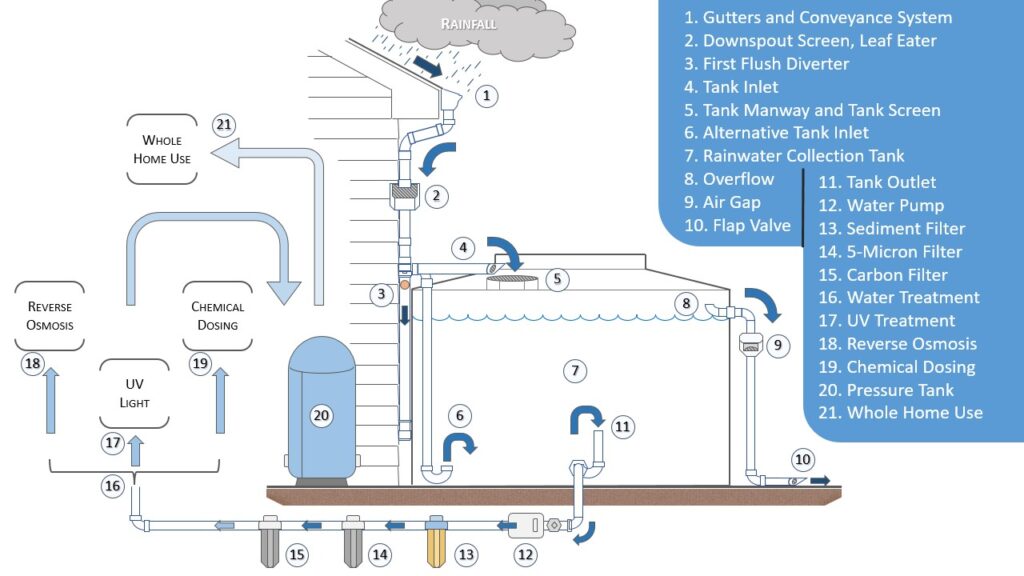
No single method is enough. Use layered protection.
Best Sequence: UV + Filtration
- First Flush Diverter
- Screen Filter (100–200 µ)
- Sediment Filter (5–10 µ)
- Activated Carbon Filter
- UV Sterilizer (40 mJ/cm²)
- (Optional) Under-Sink RO for chemical removal
Chemical Treatment Sequence
- First Flush Diverter
- Sediment Filter (optional but recommended)
- Chlorine Dosing into Tank
- Contact Time (20–30 min)
- Post-Carbon Filter (to remove taste)
High-Purity RO Sequence
- First Flush + Screen + Sediment (5 µ)
- Carbon Filter
- RO Membrane
- UV Sterilizer (post-RO)
- (Optional) Remineralization Cartridge (adds calcium/magnesium for taste)
Test and Maintain Your System
Purification is only as good as your verification.
Test Water Quarterly
Use a certified lab to check:
– Microbial: Total coliform, E. coli
– Chemical: Lead, copper, nitrates, PFAS (if suspected)
– Physical: Turbidity, pH
If using chlorine, test residual levels weekly (target: 0.2–4 PPM).
Stick to a Maintenance Schedule
| Frequency | Task |
|---|---|
| Monthly | Inspect system, clean pre-filters |
| Quarterly | Test water quality |
| Semi-Annually | Check UV sleeve, clean gutters |
| Annually | Replace UV bulb, clean tank, change filters |
Replace sediment filters immediately if flow drops.
Match Method to Use Case
Drinking and Cooking
- Must-have: UV or chlorine + carbon + sediment
- Recommended: RO for chemical removal
- Verify: Quarterly testing
Bathing and Showering
- UV disinfection between tank and shower
- RO not needed because skin does not absorb most contaminants
- Rainwater is naturally soft, gentler on skin and hair
Gardening
- Minimal filtration: Screen only
- Avoid spraying on edible plants unless filtered
- Rainwater is chlorine-free, better for plant health
Emergency Use
- Store water in sealed, dark containers
- Treat with:
- Gravity filter (Berkey)
- Bleach dosing (4 drops per liter, wait 30 min)
- Boiling (only if chemical risk is low)
Compare Purification Methods

| Feature | UV | Chlorine | RO | Distillation | Gravity Filter |
|---|---|---|---|---|---|
| Kills Microbes | Yes | Yes (not Crypto) | Yes | Yes | Yes |
| Removes Chemicals | No | No | Yes | Yes | Yes (select models) |
| Removes Heavy Metals | No | No | Yes | Yes | Yes |
| Residual Protection | No | Yes | No | No | No |
| Power Needed | Yes | No | Yes | Yes | No |
| Best For | Whole house | Large tanks | Chemical removal | Small batches | Off-grid/emergency |
Frequently Asked Questions About Purifying Rainwater
Is boiling rainwater enough to make it safe to drink?
Boiling kills bacteria, viruses, and protozoa, but it does not remove chemicals, heavy metals, or dust. Boiling actually concentrates non-volatile contaminants like lead and PFAS in the remaining water. Mechanical filtration must precede boiling to remove particulates, but chemical contaminants will still remain.
What is the best roofing material for collecting rainwater?
Galvanized steel is the preferred roofing material because it produces clean runoff with minimal contamination. Avoid asphalt shingles and terra cotta tiles, which leach chemicals, heavy metals, and organic debris that make effective filtration difficult.
How often should I test my rainwater for safety?
Test your water quarterly using a certified lab. Check for total coliform, E. coli, lead, copper, nitrates, pH, and turbidity. If you use chlorine treatment, test residual levels weekly with a home test kit, targeting 0.2–4 PPM.
Can I purify rainwater without electricity?
Yes. Gravity-fed filters like Berkey or LifeStraw Home work without power and remove bacteria, viruses, heavy metals, and sediment. Chlorine treatment is another off-grid option, though it does not kill Cryptosporidium and requires testing.
Does rainwater need to be filtered for gardening?
For non-edible plants, screen filters or mesh guards are sufficient to prevent clogging of irrigation heads. For edible plants, avoid direct contact with unfiltered rainwater due to E. coli risk from rooftop animal feces.
How long does a UV bulb last?
Replace UV bulbs annually, even if they still glow. Output degrades over time, and a glowing bulb does not guarantee effective disinfection. Lamp life typically ranges from 3,000 to 9,000 hours.
Key Takeaways for Purifying Rainwater Safely
Purifying rainwater is not about relying on one method; it is about building layered defenses. Start with clean collection using safe roofing materials, first flush diverters, and sealed storage tanks. Follow with mechanical filtration to remove debris and sediment, then apply disinfection through UV light or chlorine depending on your power setup. For chemical-heavy environments, add reverse osmosis as a final polishing step.
Maintain your system on a strict schedule and verify safety through quarterly water testing. A clean system can fail silently, so consistent monitoring is non-negotiable. With the right setup, rainwater can taste cleaner and softer than municipal supplies, free of chlorine and hardness minerals, while keeping your family safe from harmful contaminants.