How to Purify Water with Charcoal
You’re hiking a remote trail when your water bottle runs dry. A stream trickles nearby, but the water looks cloudy and smells faintly metallic. You remember reading about charcoal filtration, and you wonder if those black chunks from last night’s fire could really make this water safe to drink. The short answer is yes, with important conditions.
How to purify water with charcoal works through a scientific process called adsorption, where contaminants cling to carbon surfaces rather than soaking into them. Activated charcoal is used worldwide in emergency kits, home pitchers, and survival gear. However, charcoal alone cannot kill bacteria or viruses, so pairing it with a disinfection method is essential for truly safe drinking water.
This guide covers how to build a charcoal filter from scratch, what contaminants it actually removes, and why boiling or UV treatment must follow filtration. You’ll also learn maintenance tips and when to choose commercial filters over DIY options.
The Science Behind Charcoal Water Filtration
Adsorption vs. Absorption
Charcoal cleans water through adsorption, a surface-level process where contaminants stick to the carbon. This differs from absorption, where a material soaks up liquid like a sponge. As water passes through charcoal, organic chemicals, chlorine, and volatile compounds bind to carbon surfaces through electrochemical attraction, leaving water cleaner and better-tasting.
Why Surface Area Matters
Filtration effectiveness depends on surface area. High-quality activated charcoal contains a porous structure so dense that one gram offers over 1,000 square meters of surface area, roughly half a football field. These microscopic pores trap pollutants, making charcoal a powerful chemical filter.
Activated Charcoal vs. Regular Charcoal
Activated Charcoal: The Most Effective Option
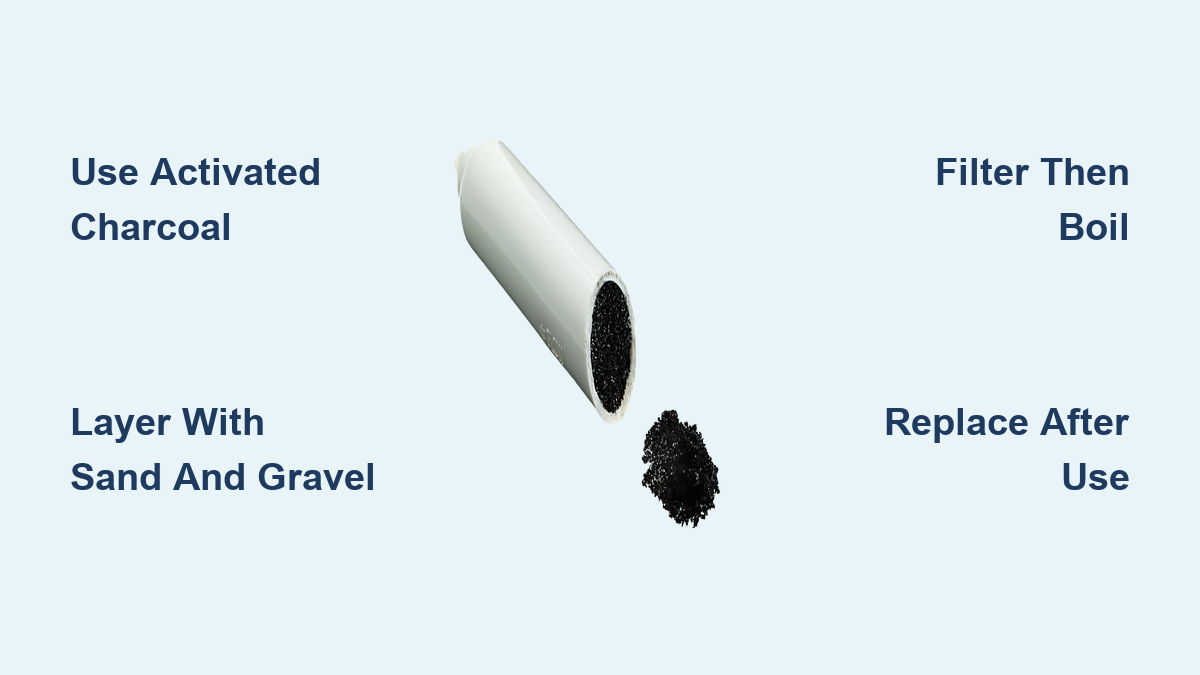
Activated charcoal undergoes secondary treatment with steam or chemicals at high heat. This process clears blocked pores and dramatically expands surface area. The result is a material 50 to 1,000 times more efficient than regular charcoal for filtration.
Regular Charcoal: Emergency Substitute
Regular campfire charcoal can filter water in a pinch, but many pores remain clogged with tars and resins. Crush it finely and rinse thoroughly before use, but expect reduced performance.
DIY Activation Methods
True activation requires industrial conditions. A survival workaround involves crushing hardwood charcoal into granules, soaking it in lemon juice or diluted vinegar, then rinsing and drying. This improves performance but never matches commercial activated carbon.
What Charcoal Filters Remove (and What They Miss)
Contaminants Effectively Removed
- Chlorine and chloramines: Eliminates chemical taste and odor
- Pesticides and herbicides: Adsorbs many agricultural chemicals
- Volatile Organic Compounds (VOCs): Removes solvents and industrial pollutants
- Tannins (partially): May reduce tannic acid, which gives swamp water a tea-like tint that is harmless
Contaminants NOT Removed
- Bacteria and viruses: Too small and uncharged to be trapped
- Protozoa (Giardia, Cryptosporidium): Pass through unchanged
- Heavy metals (lead, mercury, arsenic): Require specialized filters
- Dissolved salts and minerals: Does not desalinate or remove fluoride
- pH imbalances: Does not neutralize acidic water
Clear, odor-free water from a charcoal filter can still make you sick. Biological pathogens are invisible, so always follow filtration with a disinfection method.
How to Make Charcoal for Filtration
Choosing the Right Wood
Use only hardwoods like oak, hickory, or maple. Avoid treated, painted, or pressure-treated wood, which releases toxins. Skip softwoods like pine because resins can leach into water. Green wood produces less carbon and more smoke.
Dutch Oven Method
- Fill a Dutch oven with dry hardwood scraps
- Cover and place over a fire
- Heat slowly with limited oxygen to prevent full combustion
- After 1–2 hours, let cool completely
Canteen Cup Method
- Pack small wood pieces into a metal canteen cup
- Cover with a rock or lid to restrict airflow
- Heat over fire until smoking stops
- Cool and remove the charcoal
Preparing Charcoal for Filtration
Crush for Maximum Surface Area
Break charcoal into fine granules or powder. Smaller particles expose more surface area for adsorption. Use a rock, mortar and pestle, or sealed bag with a hammer. Wear a dust mask because charcoal dust irritates lungs.
Flush Before Use
New charcoal releases black dust called fines that cloud water. Place crushed charcoal in a cloth and rinse with clean water, or run the first few batches through and discard until output runs clear. This dust is harmless but unappealing.
Building a DIY Charcoal Water Filter
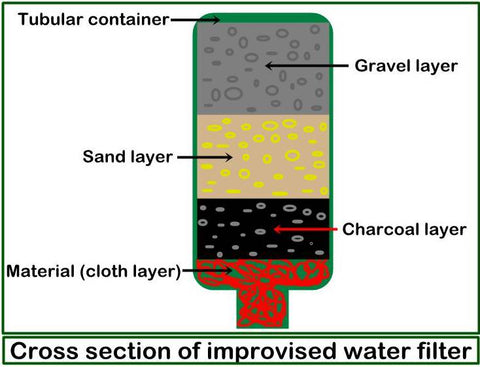
Materials Needed
- Plastic bottle (2L) with bottom cut off
- Cloth, bandana, or coffee filter
- Crushed charcoal
- Fine sand
- Small gravel or pebbles
- Optional: cedar boughs for natural antimicrobial properties
Layering Order (Top to Bottom)
- Coarse gravel: Catches large debris
- Fine sand: Filters silt and supports the carbon layer
- Crushed charcoal: Removes chemicals and odors
- Fine sand: Prevents carbon from washing out
- Cloth layer: Holds everything in place
- Bottle cap with small hole: Controls flow rate
For best results, use a sand-charcoal-sand sequence with cedar boughs between layers to prevent mixing.
Operating Your Filter Correctly
Pour Slowly for Best Results
Fast pouring causes water to bypass the charcoal. Aim for a gravity-fed drip allowing 10–30 seconds per cup.
Pre-Filter Dirty Water
If source water is muddy or full of leaves, pour it through a bandana first. This prevents clogging and extends charcoal life.
Discard Initial Output
Run 2–3 cups through and discard to flush carbon fines before collecting drinking water.
Why Secondary Purification Is Non-Negotiable
The Critical Limitation
Charcoal improves taste and removes chemicals, but does not kill pathogens. Drinking unboiled filtered water can still cause giardia, dysentery, or E. coli infection.
Boiling: The Most Reliable Method
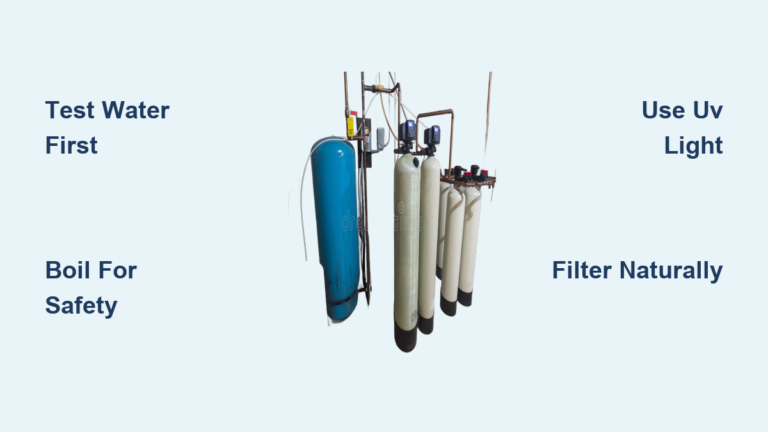
Bring filtered water to a rolling boil for 1 minute (3 minutes at high altitude). This kills all bacteria, viruses, and protozoa. Always filter first, then boil, because boiling dirty water is less effective.
UV Disinfection (SODIS Method)
Expose filtered water in a clear plastic bottle to direct sunlight for 6–8 hours. Water must be clear because turbidity blocks UV rays. Lab tests show E. coli drops from 1,600 CFUs to undetectable after proper UV exposure.
Chemical Treatment Options
Use chlorine dioxide, iodine, or bleach (4 drops per gallon, wait 30 minutes). Do not use chlorine with sand biofilters because it kills beneficial microbes.
Maintaining and Replacing Your Filter
Signs Charcoal Is Spent
- Water tastes like the source again
- Odors (chlorine, sulfur, earth) return
- Flow rate slows drastically due to clogging
Lifespan Guidelines
- DIY filters: Replace charcoal after each use in high-risk environments
- Commercial filters: Replace carbon core every 12 months or after 25–50 gallons
Saturated carbon allows breakthrough, where contaminants pass through undetected.
Storage Tips
Rinse sand and gravel layers if clogged. Never store wet filters because damp carbon breeds bacteria. Air-dry all components before storing.
Best Use Cases for Charcoal Filtration
Emergency Survival
Use campfire charcoal and a plastic bottle to remove chemicals and improve taste. Always follow with boiling. This method works when commercial filters aren’t available.
Camping and Backpacking
Modern hollow-fiber filters with carbon cores (like LifeStraw or Sawyer) combine biological safety with chemical removal. DIY charcoal filters are bulky and better suited for base camps.
Urban Preparedness
Pair charcoal with sand to filter rainwater during advisories. This removes airborne pollutants and improves taste.
Home Water Improvement
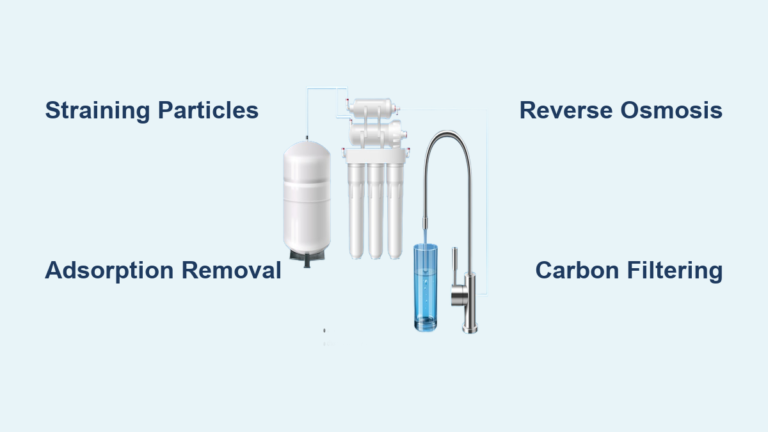
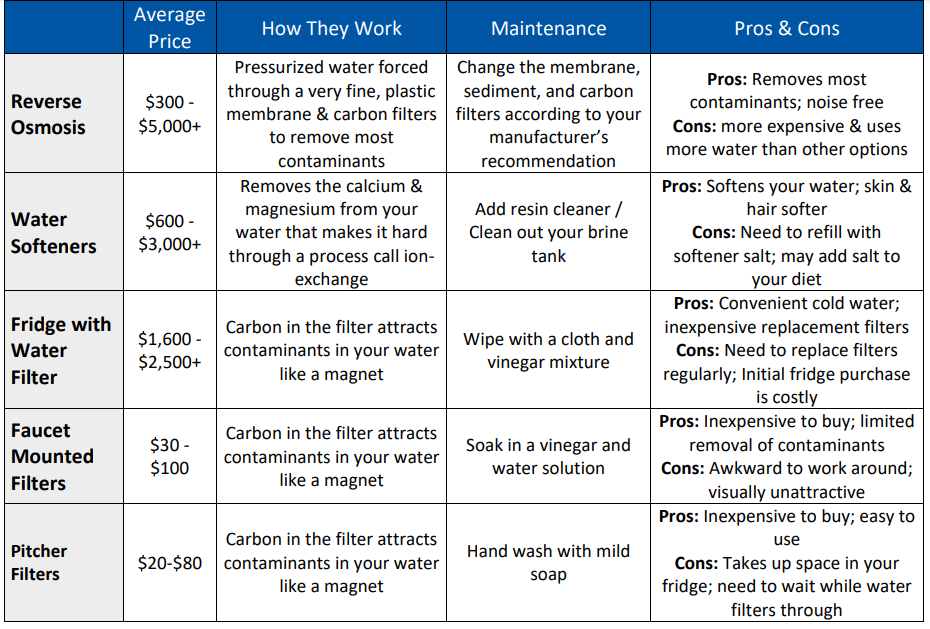
Activated carbon pitchers (like Brita) remove chlorine and some metals while retaining healthy minerals that reverse osmosis systems strip away.
Comparing Filtration Methods
| Method | Removes Bacteria | Removes Chemicals | Improves Taste | Clears Cloudiness |
|---|---|---|---|---|
| Boiling | Yes | No | No | No |
| Charcoal Only | No | Yes | Yes | Partial |
| UV Light | Yes | No | No | No |
| Hollow Fiber | Yes | No | No | Yes |
| Charcoal + Fiber | Yes | Yes | Yes | Yes |
| Sand Biofilter | Yes (mature) | Limited | Limited | Yes |
A combined system that filters mechanically, chemically, and biologically provides the safest water.
Frequently Asked Questions About Charcoal Water Filtration
Does charcoal kill bacteria in water?
No. Charcoal removes chemicals and improves taste through adsorption, but it cannot kill bacteria, viruses, or protozoa. You must boil water or use UV treatment after charcoal filtration to eliminate biological pathogens.
Can I use regular campfire charcoal for water filtration?
Yes, but with limitations. Regular charcoal works in emergencies but is far less effective than activated charcoal because many pores remain clogged with tars. Crush it finely, rinse thoroughly, and always follow with boiling or UV disinfection.
How long does a charcoal water filter last?
DIY filters should have their charcoal replaced after each use in high-risk environments. Commercial carbon filters typically last 12 months or 25–50 gallons. Replace the carbon when water taste changes or odors return, even if flow rate seems normal.
Is charcoal-filtered water safe to drink without boiling?
No. Charcoal removes chemicals and improves clarity but does not eliminate pathogens. Clear, good-tasting water can still contain harmful bacteria or protozoa. Always disinfect filtered water by boiling for 1 minute or using UV sunlight exposure for 6–8 hours.
What contaminants does activated charcoal remove from water?
Activated charcoal effectively removes chlorine, chloramines, pesticides, herbicides, and volatile organic compounds (VOCs). It does not remove heavy metals, dissolved salts, fluoride, or biological pathogens. It also does not significantly change water pH.
Can I make activated charcoal at home?
True activation requires industrial equipment with precise temperature and pressure control. A survival workaround involves soaking crushed hardwood charcoal in lemon juice or diluted vinegar to partially open pores, but this produces inferior results compared to commercial activated carbon.
Key Takeaways for Purifying Water with Charcoal
Charcoal filtration is a proven method for removing chemicals, improving taste, and reducing turbidity in emergency and outdoor settings. Build your filter with crushed hardwood charcoal layered between fine sand, use slow gravity flow, and always discard the first batches to flush carbon dust.
Most importantly, never rely on charcoal alone for safe drinking water. Pair filtration with boiling for 1 minute or UV sunlight exposure for 6–8 hours to eliminate pathogens. Replace charcoal when taste changes or after recommended usage limits, and store all components dry to prevent bacterial growth.
Your next step: gather the materials listed above and build a practice filter before you actually need it. Testing your setup at home ensures you can deploy it confidently when an emergency arises.