How Water Treatment Plants Work: Step by Step
Every time you turn on the tap, clean water flows out—safe for drinking, cooking, and bathing. But getting water to that point is a complex, carefully engineered process. Behind the scenes, water treatment plants perform a remarkable transformation, turning raw, often contaminated water into a life-sustaining resource. Whether purifying river water for drinking or cleaning sewage before returning it to nature, these facilities use a sequence of physical, chemical, and biological steps to ensure water safety.
The journey from dirty to drinkable typically takes 24 to 36 hours, though some stages happen in minutes. In the U.S. alone, over 14,000 treatment plants serve millions daily, processing everything from household sewage to industrial runoff. The process varies depending on whether the goal is to produce drinking water or to treat wastewater, but both follow a carefully designed path of purification.
In this guide, you’ll walk through exactly how water treatment plants work step by step, breaking down each stage from intake to distribution or discharge so you understand what happens before water reaches your glass or returns to the environment.
Drinking Water Treatment: From Source to Tap
Drinking water treatment plants take raw water from rivers, lakes, or underground sources and purify it to meet strict health standards. The process involves multiple stages that remove particles, chemicals, and harmful microorganisms.
How Intake and Screening Remove Large Debris
Before treatment begins, water is drawn from a natural source through intake systems, often screened tunnels or pipes submerged in lakes or rivers. In large cities like New York, these intakes can pull in over 1 billion gallons per day.
The first defense is screening, which removes large debris:
– Coarse screens with bars spaced 5–15 cm apart catch logs, trash, and even construction materials
– Fine screens with 5–20 mm gaps filter out smaller solids like leaves and twigs
These screens prevent damage to pumps and downstream equipment. Collected debris is usually sent to landfills, though unusual finds like weapons are reported to authorities.
Why Coagulation and Flocculation Matter for Clean Water
Raw water contains tiny, negatively charged particles like clay and organic matter that repel each other and won’t settle naturally. To remove them, plants use coagulation.
Chemicals like aluminum sulfate (alum) or ferric chloride are added. These positively charged coagulants neutralize the particles, allowing them to clump together.
Then comes flocculation:
– Water flows into slow-mixing tanks with paddles or baffles
– Polymers help particles bind into larger, heavier clusters called floc
– This stage lasts 20–45 minutes, creating visible floc that will settle easily
How Sedimentation Basins Clarify Water
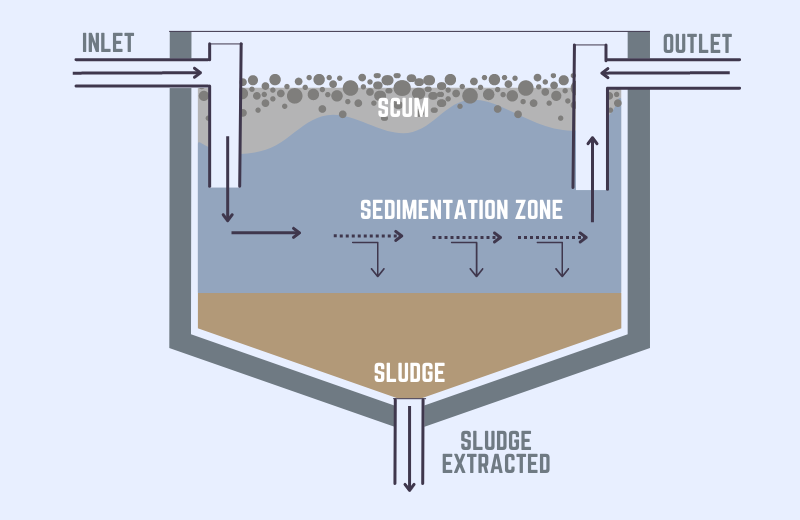
After flocculation, water enters sedimentation basins, which are large, quiet tanks where flow slows dramatically.
Here, gravity pulls the heavy floc to the bottom, forming a layer of sludge. Mechanical scrapers slowly push this sludge to collection points for disposal.
The water above becomes much clearer, with most suspended solids removed. This step is crucial because it reduces the load on filters and improves overall efficiency.
Filtration Methods That Trap Remaining Particles

Even after sedimentation, fine particles remain. Filtration removes them using layered media:
– Top layer: Anthracite coal
– Middle layer: Sand
– Bottom layer: Gravel
– Some systems add granular activated carbon (GAC) to absorb chemicals that cause bad tastes and odors
Water trickles down through the layers, trapping remaining particles, bacteria, and some viruses.
Advanced options include:
– Ultrafiltration: Membranes with tiny pores block larger contaminants
– Reverse osmosis (RO): Forces water through a semi-permeable membrane, removing salts and dissolved chemicals, common in desalination or reuse systems
Filters are cleaned periodically by backwashing, where water is flushed upward to remove trapped debris.
Disinfection Methods That Kill Harmful Pathogens
Filtration reduces pathogens, but disinfection is the final kill step. Common methods include:
- Chlorination: Most widely used. Chlorine or chloramine kills bacteria and viruses. It also leaves a residual (0.5–5 mg/L) that protects water as it travels through pipes
- Ultraviolet (UV) light: Damages microbial DNA, making organisms harmless. Effective but provides no residual protection
- Ozone (O₃): A powerful oxidant that destroys pathogens quickly. Like UV, it doesn’t last in the distribution system, so it’s often paired with chlorine
For wastewater, dechlorination is required before release to protect aquatic life.
pH Adjustment and Fluoridation Before Distribution
Before distribution, water undergoes final tweaks:
– pH adjustment with lime or soda ash prevents pipe corrosion and improves taste
– Fluoridation adds fluoride to help prevent tooth decay, a public health measure in many communities
These steps ensure water is not only safe but also stable and beneficial during its journey to homes.
Storage and Distribution to Homes and Businesses
Treated water flows into finished water tanks or reservoirs, which are closed structures that prevent contamination and maintain pressure.
From here, pumps push water through a network of pipes to homes, schools, and businesses. Throughout the system, operators monitor for turbidity, chlorine levels, and pressure to ensure safety and consistency.
Water must meet EPA’s National Primary Drinking Water Regulations before it reaches your tap.
Wastewater Treatment: Cleaning Used Water for Reuse
Wastewater treatment plants handle used water from homes, industries, and storm drains. Their job is to clean it before returning it to rivers, lakes, or reuse systems. The process is more complex than drinking water treatment due to high levels of organic matter and pathogens.
Preliminary Treatment That Protects Equipment
This phase protects equipment and prepares water for deeper cleaning.
- Bar screens remove large debris like rags, plastics, and sticks
- Grit chambers eliminate sand, gravel, and coffee grounds that could wear down machinery
Two common grit removal systems:
– Aerated chambers: Use air to swirl water, separating grit from organic matter
– Vortex chambers: Rely on centrifugal force to push solids to the center
The cleaned water moves forward; grit is washed and landfilled.
Primary Treatment and the Role of Clarifiers
In primary clarifiers, wastewater sits for 1–2 hours, allowing solids to settle and floatables to rise.
- Primary sludge (organic solids) sinks and is scraped to digesters
- Scum (oils, grease, plastics) floats and is skimmed off
This stage removes 50–70% of suspended solids and some organic matter. The remaining liquid, called effluent, moves to biological treatment.
Secondary Treatment Using Activated Sludge
This is where biology takes over. The goal is to break down dissolved and suspended organic matter using microorganisms.
The Activated Sludge Process (Most Common)
- Effluent enters aeration basins
- Return Activated Sludge (RAS), a culture of aerobic bacteria, is added
- Air blowers inject oxygen, fueling bacterial digestion
- Bacteria consume organic pollutants, converting them into CO₂, water, and new cells
This process removes up to 85% of organic matter and drastically lowers Biochemical Oxygen Demand (BOD).
Alternative Biological Methods
- Trickling filters: Water drips over a media bed coated with biofilm. Less efficient, mostly used in smaller plants
- Sequencing Batch Reactors (SBR): Treat water in batches using timed cycles of aeration and settling
After aeration, the mix goes to secondary clarifiers:
– Bacteria-rich sludge settles
– Most is recycled as RAS; excess becomes waste activated sludge (WAS)
– Clear effluent moves to final polishing
Tertiary Treatment for Higher Purity Standards
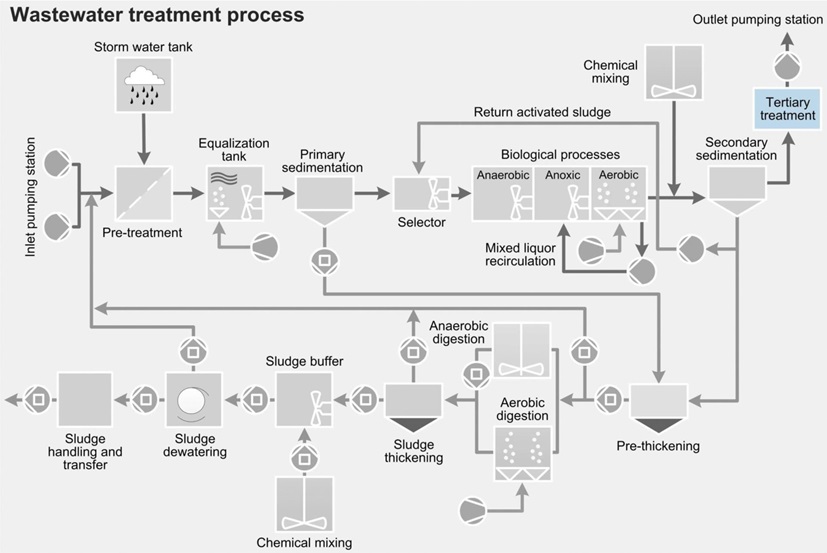
Also called advanced or polishing treatment, this optional stage is used when higher purity is needed for reuse or sensitive environments.
Key processes:
– Nutrient removal: Biological or chemical methods strip out nitrogen and phosphorus to prevent algal blooms
– Advanced filtration: Sand filters or membranes remove fine particles
– Disinfection: UV, ozone, or chlorine eliminates remaining pathogens
The result is water so clean it can be used for irrigation, industrial cooling, or even indirect drinking water supply.
Sludge Management and By-Product Handling
Both drinking and wastewater plants produce sludge, a thick, semi-solid waste. How it’s handled matters for health, cost, and sustainability.
Sludge Processing Steps
- Thickening: Reduces water content, shrinking volume
- Digestion:
– Anaerobic digestion (no oxygen) breaks down organics and produces biogas (methane), which can power the plant
– Aerobic digestion uses oxygen; faster but more energy-intensive - Dewatering: Centrifuges or filter presses squeeze out more water, producing a sludge cake
Disposal and Reuse Options
- Landfill or incineration: For sludge that doesn’t meet safety standards
- Biosolids: If low in toxins and pathogens, dried sludge can be used as fertilizer or soil conditioner. This practice is common in the U.S. and Spain
Proper sludge management turns waste into a resource, supporting circular economy goals.
Testing, Maintenance, and Safety Checks
Water plants don’t run on autopilot. They require constant monitoring and upkeep to stay compliant and efficient.
Continuous Monitoring Systems
Operators track key parameters 24/7:
– Turbidity (cloudiness)
– pH and chlorine levels
– Dissolved oxygen, ammonia, nitrate
Sensors and automated systems adjust chemical doses and flow rates in real time.
Sampling and Regulatory Compliance
- Water is tested multiple times daily at intake, mid-process, and final discharge
- Labs check for coliform bacteria, heavy metals, and organic contaminants
- In the U.S., plants must follow EPA’s National Primary Drinking Water Regulations (NPDWR) and NPDES permits for wastewater discharge
Inspection and Cleaning Protocols
- Submerged tanks and filters are inspected regularly using divers or ROVs (Remote Operated Vehicles)
- Biofouling (algae, slime) and sediment buildup reduce efficiency
- Example: In Regina, Canada, algae clogged filters, cutting capacity by 50%, prompting urgent cleaning
- Plants should be cleaned and emptied 1–2 times a year to maintain performance
Environmental Impact and Future Trends
Despite progress, nearly 80% of global wastewater is still released untreated, harming ecosystems and human health. But innovation is changing the game.
Water Reuse and Sustainability Solutions
With freshwater scarcity rising, treated wastewater is now seen as a valuable resource.
- Indirect potable reuse: Treated water enters rivers or aquifers, mixes with natural flows, and is later re-treated for drinking
- Direct reuse: In places like California and Singapore, advanced systems produce “toilet-to-tap” water safe enough for immediate use
Energy and Digital Innovation
- Anaerobic digesters produce biogas, making some plants energy-neutral or even energy-positive
- Digital twins and AI platforms like GoAigua use real-time data to optimize operations, reduce energy use, and predict maintenance
These advances support UN Sustainable Development Goal 6: Clean Water and Sanitation for all.
Frequently Asked Questions About Water Treatment
How long does the water treatment process take?
The complete water treatment process typically takes 24 to 36 hours, though some individual stages like filtration can happen much faster. The exact duration depends on the plant size, water quality, and the specific treatment goals.
What chemicals are used to purify drinking water?
Common chemicals include aluminum sulfate (alum) and ferric chloride for coagulation, chlorine or chloramine for disinfection, and lime or soda ash for pH adjustment. Fluoride is also added in many communities for dental health.
What is the difference between screening and filtration?
Screening removes large debris like logs, trash, and sticks at the beginning of treatment. Filtration happens later in the process and removes fine particles, bacteria, and some viruses using layers of sand, gravel, and activated carbon.
Why is activated sludge important in wastewater treatment?
Activated sludge contains aerobic bacteria that consume organic pollutants in wastewater. This biological process removes up to 85% of organic matter and significantly reduces Biochemical Oxygen Demand, making it the heart of most wastewater treatment systems.
Can treated wastewater be used for drinking?
Yes, through indirect potable reuse, treated wastewater enters rivers or aquifers, mixes with natural water, and is later re-treated for drinking. Some advanced systems in California and Singapore even use direct potable reuse with extensive treatment.
How often do water treatment plants need cleaning?
Plants should be cleaned and emptied 1–2 times per year to prevent buildup of sludge, sediment, and biofouling. Regular inspections using divers or ROVs help identify when cleaning is needed.
Final Takeaways on How Water Treatment Plants Work
Water treatment plants are engineering marvels that silently protect public health. Whether producing drinking water or cleaning sewage, they follow a step-by-step process that combines physics, chemistry, and biology.
Drinking Water Process Summary:
1. Screen out debris
2. Coagulate and flocculate particles
3. Settle floc in basins
4. Filter through sand and carbon
5. Disinfect with chlorine, UV, or ozone
6. Adjust pH and add fluoride
7. Store and distribute safely
Wastewater Process Summary:
1. Remove large trash and grit
2. Settle solids and skim scum
3. Digest organics with bacteria
4. Polish with advanced filtration and disinfection
5. Return clean water to nature or reuse
These systems take 24–36 hours to complete, turning hazardous water into a safe, sustainable resource. You can help by not flushing wipes, grease, or chemicals that clog systems, supporting infrastructure upgrades in your community, and conserving water to reduce treatment loads.
Next time you turn on the faucet, remember that a complex, invisible system made that clean water possible.