Reverse Osmosis Explained: How It Works
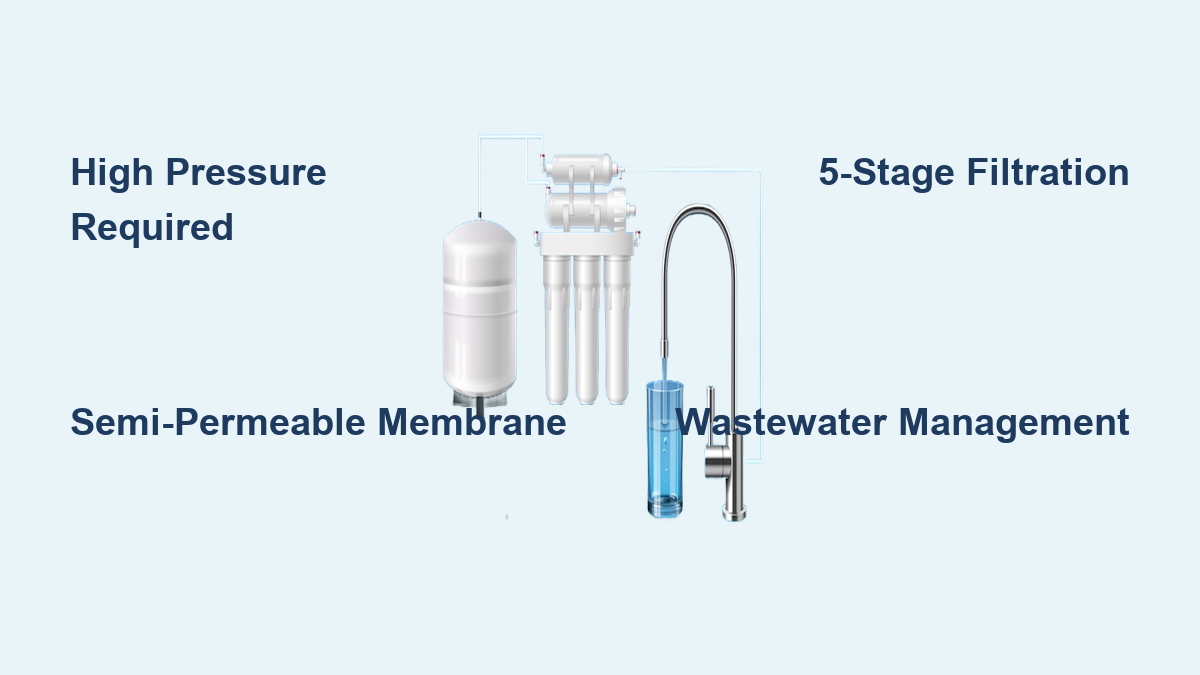
Imagine turning dirty, salty, or contaminated water into clean, safe drinking water, molecule by molecule. That is exactly what reverse osmosis (RO) does. Reverse osmosis is a powerful water purification technology that removes up to 99% of dissolved salts, heavy metals, microorganisms, and chemicals from water using a semi-permeable membrane and pressure. Unlike basic filters that trap dirt, RO works at the molecular level, making it one of the most effective methods for producing clean drinking water in homes, hospitals, labs, and even massive industrial plants.
You have probably seen RO systems under kitchen sinks or heard about them in bottled water plants. But how does reverse osmosis actually work? It all starts by reversing a natural process called osmosis. Normally, water moves from a less concentrated solution to a more concentrated one, like roots absorbing water from soil. Reverse osmosis flips this. We force water against that natural flow using high pressure, pushing it through a microscopic membrane that blocks nearly every contaminant. The result is crystal-clear purified water on one side, and a concentrated waste stream on the other.
In this guide, you will learn the science behind RO, how it is built, what it removes, where it is used, and how to keep it running efficiently. Whether you are considering a home system or just curious about how your drinking water gets so clean, here is everything you need to know about reverse osmosis.
How Reverse Osmosis Reverses Nature

Osmosis vs. Reverse Osmosis Explained
Osmosis is a natural process. Picture two water solutions separated by a semi-permeable membrane, one pure and the other salty. Water naturally flows into the saltier side to balance the concentration. No energy is needed. That is osmosis.
Reverse osmosis stops that flow and reverses it. By applying high pressure (typically 40–100 psi for home systems), we push the salty water against its natural tendency. Only pure water molecules can pass through the ultra-fine membrane. Salts, metals, and contaminants are left behind in the concentrate stream.
This requires external energy, usually a pump in large systems or household water pressure in under-sink units. Without that pressure, RO would not work.
Why Pressure Matters
The amount of pressure required depends on the osmotic pressure of the feed water. For seawater, that can be over 600 psi. For municipal tap water, 50–80 psi is usually enough.
If applied pressure is too low, water will not move through the membrane efficiently. If too high, it can damage the membrane or waste energy. That is why modern RO systems use pressure-optimized designs and sometimes booster pumps to maintain ideal conditions.
Inside the RO Membrane

Membrane Pore Size and Rejection
The heart of any RO system is its semi-permeable membrane, with pores as small as 0.0001 microns, about 1/100,000 the width of a human hair. To put that in perspective:
- Bacteria: 0.2–5 microns → Blocked
- Viruses: 0.02–0.4 microns → Blocked
- Arsenic: 0.0004 microns → Blocked by charge
- Water molecule: 0.00028 microns → Passes through
Contaminants are rejected based on size and charge. Molecules larger than 200 Daltons are almost completely rejected. Ions with higher charge (like calcium, 2+) are rejected more than monovalent ions (like sodium, 1+).
This dual mechanism makes RO far more effective than standard filters.
Cross-Flow Filtration Design
Unlike a coffee filter that clogs quickly, RO uses cross-flow filtration. Water flows across the membrane surface, not just into it. Clean water (permeate) passes through. Contaminants are swept away in the concentrate stream, reducing buildup and prolonging membrane life.
This self-cleaning action is key to RO’s long-term performance.
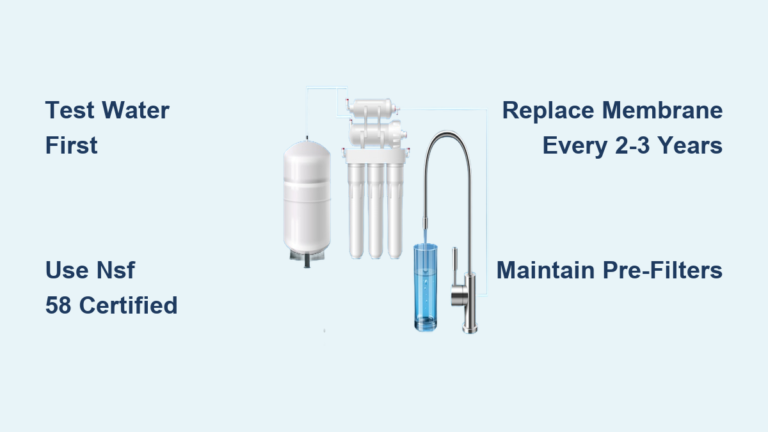
How a 5-Stage RO System Works
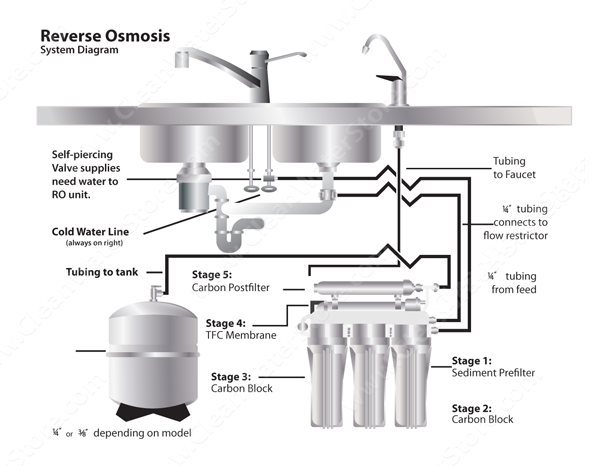
Stage 1: Sediment Pre-Filter (5 Micron)
Before water reaches the delicate membrane, it passes through a 5-micron sediment filter. This traps visible particles like:
- Sand
- Rust
- Silt
- Dirt
Without this stage, particles would clog the membrane and reduce flow. Think of it as a bouncer keeping the big, rough stuff out.
Stage 2 and 3: Carbon Block Filters
Next, water flows through two carbon block filters. These remove:
- Chlorine and chloramines
- Pesticides
- Herbicides
- VOCs (volatile organic compounds)
- Bad tastes and odors
Why two stages? More contact time means better removal. This is critical because chlorine damages RO membranes. Carbon filters protect the membrane from chemical attack.
Stage 4: Reverse Osmosis Membrane
Now comes the core stage. Water enters the RO membrane, usually a spiral-wound thin-film composite (TFC) element. Under pressure, water molecules pass through, and contaminants are rejected into the drain.
This stage removes:
- Lead, arsenic, chromium
- Nitrates, fluoride
- 95–99% of total dissolved solids (TDS)
- Microorganisms
The result is ultra-pure permeate water.
Stage 5: Post-Carbon Polishing Filter
After storage, water may pick up slight odors from the tank. The polishing filter ensures final taste quality by removing any residual flavors, delivering crisp, fresh-tasting water.
Optional: Remineralization Filter
Pure RO water can be slightly acidic due to mineral removal. A remineralization filter adds back calcium and magnesium to:
- Improve taste
- Raise pH
- Support hydration
This is common in high-end systems and health-focused setups.
What Reverse Osmosis Removes (and What It Doesn’t)

Contaminants Removed by RO
RO is one of the most comprehensive filtration methods. It effectively removes:
| Contaminant | Removal Rate | Examples |
|---|---|---|
| Heavy Metals | >95% | Lead, arsenic, mercury, cadmium |
| Dissolved Salts | 95–99% | Sodium, calcium, chloride |
| Microorganisms | >99% | Bacteria, viruses, cysts |
| Chemicals | >90% | Pesticides, PFAS, VOCs |
| Particulates | 100% | Rust, sediment, microplastics |
| Radionuclides | High | Radium, uranium |
RO is especially valuable for removing PFAS (“forever chemicals”) and arsenic in well water, contaminants often missed by basic filters.
What RO Can’t Remove
Despite its power, RO has limits:
- Dissolved Gases: CO₂ passes through, making permeate slightly acidic (pH ~6.5–7.0).
- Some Pesticides: Very small, non-polar molecules may slip through.
- Chloramines: While carbon reduces them, complete removal requires sufficient contact time.
RO water is not distilled. It may contain trace minerals, but it is far purer than tap water.
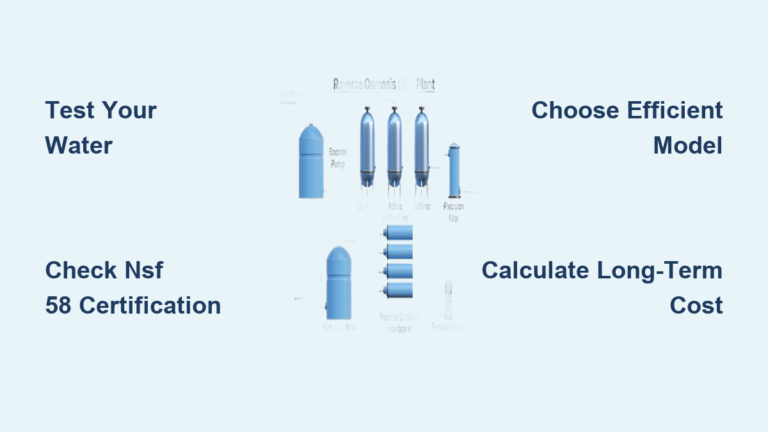
Industrial vs. Residential RO Systems
Residential RO: Compact and Efficient
Home systems are designed for drinking and cooking water. They typically produce 15–100 gallons per day and include:
- Pre-filters
- RO membrane
- Storage tank (2–4 gallons)
- ASO valve (stops flow when tank is full)
- Faucet
Most use 35–60 psi household pressure. Low water pressure systems may need a booster pump.
Industrial RO: High-Volume and High-Purity
Factories, power plants, and pharmaceutical labs use large-scale RO for:
- Boiler feed water
- Ultrapure water (WFI – Water for Injection)
- Seawater desalination
- Wastewater recycling
These systems use:
- Multiple stages to boost recovery (e.g., 80% water reuse)
- Double-pass RO for ultra-purity
- Antiscalants and softeners to prevent scaling
- CIP (Clean-in-Place) systems for maintenance
The St. Mary’s water recycling plant, for example, processes 58 million liters daily with 80% recovery using a 3-stage array.
RO Performance Metrics You Should Know
Salt Rejection Rate
Measures how well the membrane blocks contaminants:
Formula:
((Feed TDS – Permeate TDS) / Feed TDS) × 100
A healthy RO system rejects 95–99% of salts. Below 90%? Time to inspect or replace the membrane.
Water Recovery Rate
How much purified water you get versus waste:
Formula:
(Permeate Flow / Total Feed Flow) × 100
Typical recovery:
- Residential: 20–30%
- High-efficiency: 50–75%
- Industrial: Up to 85%
Higher recovery means less wastewater but increases scaling risk.
Flux Rate and Concentration Factor
Flux Rate measures water production per membrane area (GFD):
- Brackish water: 14–18 GFD
- Seawater: 8–12 GFD
Concentration Factor shows how much salts concentrate in the reject stream:
Formula:
1 / (1 – Recovery %)
High concentration means higher scaling risk.
Pre-Treatment: Protecting the Membrane
Why Pre-Filtration Is Non-Negotiable
RO membranes are sensitive. Without proper pre-treatment, they fail fast. Three main threats:
- Fouling (from particles, organics, biofilm)
- Scaling (from calcium, magnesium)
- Chemical damage (from chlorine)
Pre-treatment stops all three.
Key Pre-Treatment Methods
- Sediment Filters: 5-micron cartridges stop particles.
- Carbon Filters: Remove chlorine and chloramines.
- Water Softeners: Prevent scale in hard water areas.
- Antiscalants: Chemicals that keep minerals dissolved.
- MMF (Multi-Media Filters): Used in industrial systems for finer filtration.
If Silt Density Index (SDI) > 3, pre-filtration is required.
Maintenance: Keep RO Running Smoothly
Filter Replacement Schedule
- Sediment and Carbon Filters: Every 6–12 months
- RO Membrane: Every 2–5 years
- Polishing Filter: Every 12 months
- Remineralization Cartridge: Every 12–24 months
Smart systems send alerts when replacements are due.
When to Clean the Membrane (CIP)
Clean in place (CIP) when you see:
- 15% drop in permeate flow
- 15% increase in salt passage
- 15% rise in pressure drop
Use:
- Low-pH cleaners for scale
- High-pH cleaners for organics and biofouling
Always normalize data for temperature and pressure to avoid false alarms.
RO vs. Other Filtration Methods
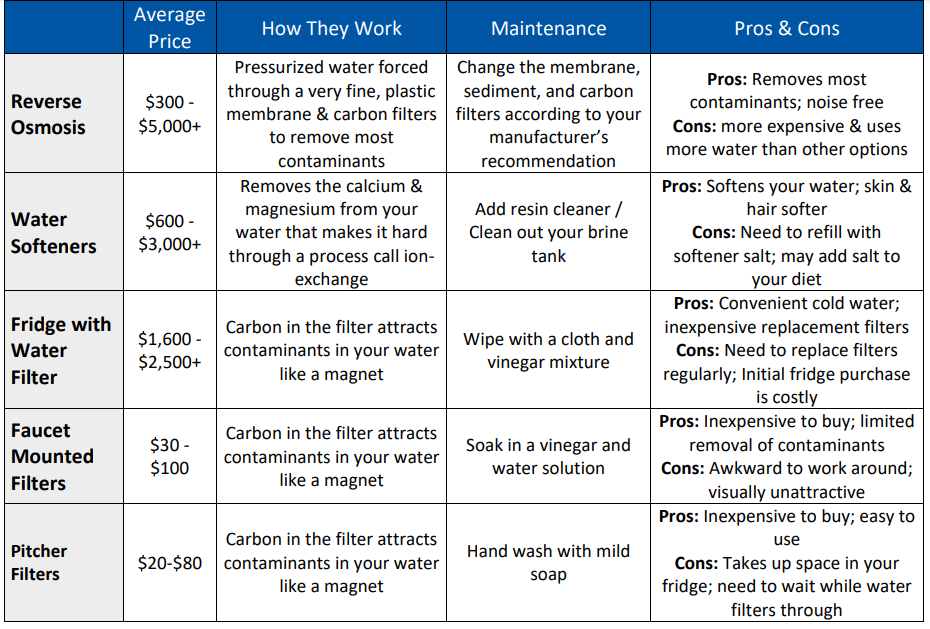
RO vs. Pitcher Filters
| Feature | RO System | Pitcher Filter |
|---|---|---|
| TDS Removal | 95–99% | Minimal |
| Contaminants Removed | Salts, metals, viruses | Chlorine, taste, some lead |
| Flow Rate | 1–2 gal/hour | Slow |
| Waste Water | Yes | No |
| Best For | High-purity drinking water | Aesthetic improvement |
RO wins for comprehensive purification.
RO vs. Distillation
- RO: Faster, lower energy, removes more chemicals.
- Distillation: Removes nearly 100% minerals, but uses more energy and may not remove VOCs without venting.
RO is more practical for homes.
RO vs. Water Softener
- Softener: Removes hardness (calcium, magnesium) via ion exchange. Does not purify.
- RO: Removes a wide range of contaminants, including heavy metals.
They work well together: softener protects plumbing, RO purifies drinking water.
Environmental and Health Considerations
Does RO Water Affect Health?
RO water is safe to drink. While it removes beneficial minerals, you get most of your calcium and magnesium from food, not water.
Slightly acidic pH (6.5–7.5) is not harmful. The EPA’s aesthetic range is 6.5–8.5.
For better taste and balance, use a remineralization filter.
Environmental Impact
- Plastic Reduction: One RO system can eliminate 2,700 plastic bottles per year.
- Wastewater: Traditional RO produces 3–5 gallons waste per 1 gallon purified. High-efficiency models reduce this to 1:1.
- Energy Use: Much lower than distillation.
Modern RO systems are becoming greener and smarter.
Choosing the Right RO System
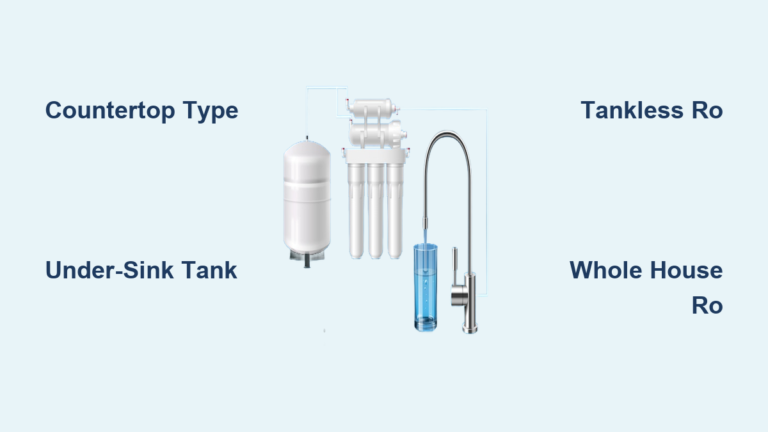
Tank vs. Tankless RO
| Feature | Tank System | Tankless System |
|---|---|---|
| Water Storage | 2–4 gallons | None |
| Flow Rate | High on demand | Limited by membrane output |
| Space Required | Larger | Compact |
| Risk of Stagnation | Possible | None |
| Best For | Families, high usage | Small kitchens, under-sink |
Tankless systems are growing in popularity for their space-saving design.
Look for These Certifications
Choose systems with:
- NSF/ANSI 58 – RO-specific performance
- NSF/ANSI 53 – Health contaminant removal (lead, cysts)
- NSF/ANSI 42 – Taste and odor
- NSF/ANSI 401 – Emerging contaminants (PFAS, pharmaceuticals)
- NSF Protocol P231 – Virus and bacteria reduction
Certifications prove the system does what it claims.
Frequently Asked Questions About Reverse Osmosis
How does reverse osmosis differ from regular filtration?
Regular filters use physical sieving to trap particles. Reverse osmosis uses a semi-permeable membrane and pressure to remove contaminants at the molecular level, blocking up to 99% of dissolved solids, heavy metals, and microorganisms that standard filters miss.
What contaminants does reverse osmosis remove from water?
RO removes heavy metals (lead, arsenic, mercury), dissolved salts, microorganisms (bacteria, viruses), chemicals like pesticides and PFAS, particulates, and radionuclides. It does not effectively remove dissolved gases such as CO₂.
How much pressure does a reverse osmosis system need?
Residential RO systems typically need 40–100 psi, with 50–80 psi being common for municipal tap water. Seawater desalination may require over 600 psi due to higher osmotic pressure.
How often should you change RO filters and membranes?
Sediment and carbon pre-filters should be replaced every 6–12 months. The RO membrane lasts 2–5 years. Polishing filters and remineralization cartridges are typically replaced every 12–24 months.
Is reverse osmosis water safe to drink long-term?
Yes, RO water is safe to drink. While it removes some minerals, most of your calcium and magnesium come from food. Adding a remineralization filter can improve taste and pH balance if desired.
What is the wastewater ratio of a reverse osmosis system?
Traditional RO systems produce 3–5 gallons of wastewater per gallon of purified water. High-efficiency models can achieve a 1:1 ratio, significantly reducing waste.
Key Takeaways for Understanding Reverse Osmosis

Reverse osmosis is a molecular-level purification process that uses pressure and a semi-permeable membrane to remove up to 99% of contaminants from water. It works by reversing natural osmosis, forcing water through microscopic pores while leaving salts, metals, and microorganisms behind.
A standard 5-stage RO system combines sediment pre-filtration, carbon filtration, the RO membrane, and a polishing filter to deliver clean, great-tasting water. Proper pre-treatment and regular maintenance are essential for long-term performance.
Your next step: if you are considering an RO system for your home, look for NSF/ANSI 58 certification, decide between tank and tankless designs, and factor in your household’s water usage to choose the right capacity.