Does Reverse Osmosis Remove Fluoride?

If you have ever wondered whether your home water filter actually strips out fluoride, you are asking the right question. Most pitcher and faucet filters leave fluoride untouched, which frustrates anyone trying to control their daily intake. The short answer to does reverse osmosis remove fluoride is yes, and it does so far more effectively than nearly any other residential option.
Reverse osmosis systems typically eliminate 85% to 99% of fluoride, depending on system quality, water pressure, and membrane condition. In this guide, you will learn exactly how the process works, what affects performance, how RO compares to other filters, and what to look for when buying a system that delivers on its fluoride removal claims.
How Reverse Osmosis Blocks Fluoride at the Membrane

Reverse osmosis relies on physical filtration, not chemical treatment. Water is forced through a semi-permeable membrane with microscopic pores roughly 0.0001 microns wide. Fluoride ions, though small, are larger than water molecules and carry a negative charge that the membrane repels.
Why Fluoride Ions Get Trapped
Fluoride enters tap water either through added compounds like hydrofluosilicic acid or natural mineral leaching. Once dissolved, it exists as negatively charged ions. The RO membrane rejects these ions through two mechanisms working together:
- Size exclusion keeps ions physically larger than water molecules from passing
- Charge repulsion pushes back negatively charged contaminants
Pressurized feed water flows across the membrane surface. Water molecules squeeze through to the clean side, while fluoride, heavy metals, and other dissolved solids get flushed away as wastewater.
Fluoride Removal Rates You Can Expect

Performance varies across systems, but high-quality units consistently remove 90% or more of fluoride under normal household conditions.
Typical Performance by System Type
| System Type | Fluoride Removal Rate |
|---|---|
| Standard RO | 85% to 92% |
| Multi-stage RO | 90% to 95% |
| Premium RO (e.g., SmartFlow®) | Up to 90% certified |
| Well-maintained RO | Up to 99% |
Some user TDS measurements and lab tests show removal rates exceeding 95%, especially when feed water starts with high fluoride concentrations and pH sits between 6.5 and 7.5.
Pro Tip: Always review the manufacturer’s performance data sheet. Look for “fluoride reduction” listed under NSF/ANSI Standard 58 certification to confirm real-world effectiveness.
Key Factors That Affect Fluoride Removal
Even the best RO system underperforms when conditions slip. Several variables directly influence how much fluoride ends up in your glass.
Water Pressure Requirements
RO membranes need adequate pressure, typically 40 to 80 psi, to push water through efficiently. Low pressure reduces both flow rate and rejection efficiency. If your home runs below 40 psi, a booster pump restores performance.
pH and Ion Rejection
Fluoride rejection drops slightly in highly alkaline water above pH 8.5. Most municipal supplies fall between pH 6.5 and 8.5, so standard RO handles them well. Extreme pH can reduce removal by 5% to 10%.
Membrane Age and Condition
A worn, scaled, or fouled membrane loses its ability to reject ions. Over time, chlorine damage, mineral scale, and biofilm create micro-channels that let contaminants slip through. This is why membrane replacement every 2 to 3 years is critical.
Pre-Filtration Protects the Membrane
Pre-filters catch sediment and chlorine before water reaches the membrane. Without them:
- Sediment clogs the membrane surface
- Chlorine degrades the thin-film composite
- Membrane life shortens dramatically
A full 4- or 5-stage system keeps fluoride removal consistent over the membrane’s lifespan.
Why NSF/ANSI Standard 58 Certification Matters
Not every system labeled “reverse osmosis” actually removes fluoride effectively. Certification is the only reliable proof.
What NSF 58 Guarantees
NSF/ANSI Standard 58 is the specific benchmark for RO drinking water systems. Certification confirms:
- Independent lab testing was performed
- Fluoride reduction claims are verified
- Contaminant removal meets strict thresholds
Never buy an RO system for fluoride removal without NSF 58 certification.
Other Certifications Worth Knowing
Multi-certified systems offer broader contaminant protection:
- NSF 42: Chlorine, taste, and odor
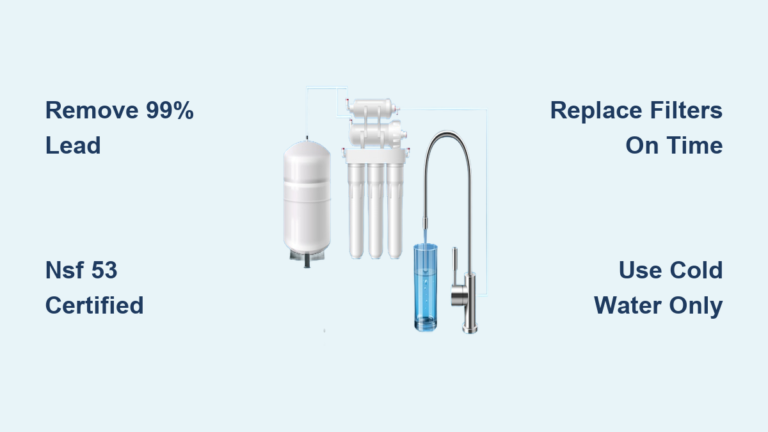
- NSF 53: Lead, cysts, and VOCs
- NSF 401: Pharmaceuticals and hormones
- P473: PFAS (forever chemicals)
A system with several certifications handles more than just fluoride.
RO vs. Other Fluoride Removal Methods
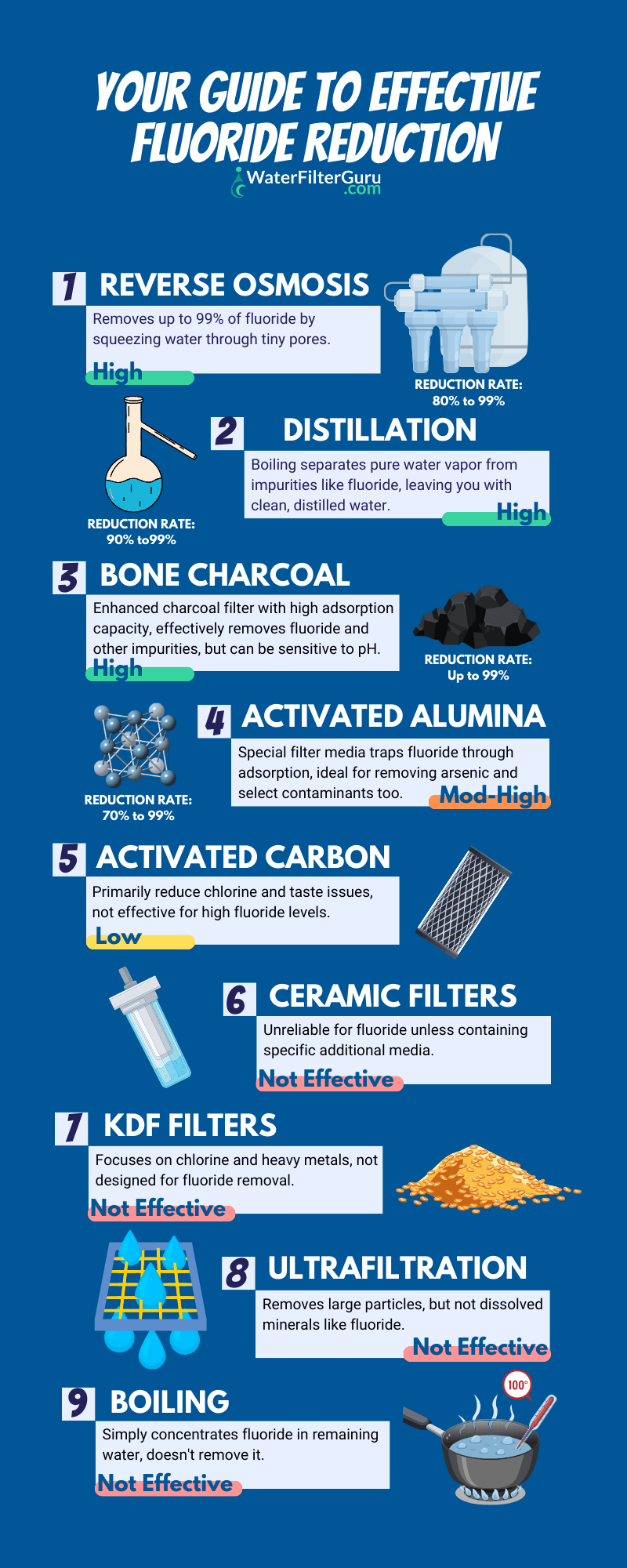
Several technologies claim to remove fluoride. Here is how they stack up against reverse osmosis.
RO vs. Distillation
Distillation boils water, captures steam, and condenses it back to liquid. It removes about 99.9% of fluoride but is slow and energy-hungry.
| Feature | Reverse Osmosis | Distillation |
|---|---|---|
| Fluoride Removal | 90% to 99% | ~99.9% |
| Speed | Continuous flow | 1 to 2 gallons per hour |
| Energy Use | Low (uses water pressure) | High (boils water) |
| Wastewater | 2 to 5 gallons per gallon purified | Minimal |
| Practicality | Under-sink, automatic | Countertop, batch process |
Distillation wins slightly on removal rate, but RO wins on convenience and daily usability.
RO vs. Activated Alumina
Activated alumina adsorbs fluoride but only under narrow conditions:
- Effective only below pH 8.5
- Peak performance at pH 5.5 to 6.0 (rare in tap water)
- Requires frequent media replacement
RO is less finicky and removes a broader range of contaminants.
RO vs. Bone Char Carbon
Bone char is made from heated animal bones and can adsorb fluoride effectively. However:
- It is not found in standard carbon filters
- Requires specific pH and contact time
- May raise ethical or dietary concerns
RO remains more practical and widely available.
RO vs. Pitcher and Faucet Filters
Standard carbon filters like Brita or PUR do not remove fluoride. They improve taste and strip chlorine but leave dissolved minerals, including fluoride, untouched. Ultrafiltration and ion exchange water softeners also fail to remove fluoride. Only RO and distillation offer reliable home reduction.
What Else Reverse Osmosis Removes
Fluoride is just one of many contaminants RO eliminates. A certified system also reduces:
Heavy Metals
- Lead (up to 99%)
- Arsenic (up to 98%)
- Mercury, cadmium, and chromium-6
Chemicals
- Chlorine and chloramines
- Pesticides and herbicides
- VOCs (volatile organic compounds)
- PFAS (PFOA and PFOS)
Other Contaminants
- Nitrates
- Pharmaceuticals
- Microplastics
- Bacteria and viruses (via size exclusion)
RO also drops Total Dissolved Solids (TDS) significantly, often from 300+ ppm down to under 20 ppm, giving you cleaner-tasting water.
The Trade-Offs: Mineral Loss and Wastewater
RO is not perfect. Two main drawbacks come with high-purity water.
Demineralized Water Tastes Flat
RO strips beneficial minerals like calcium and magnesium along with contaminants. This can lead to:
- A flat or bland taste
- Reduced dietary mineral intake
- Slightly acidic pH in purified water
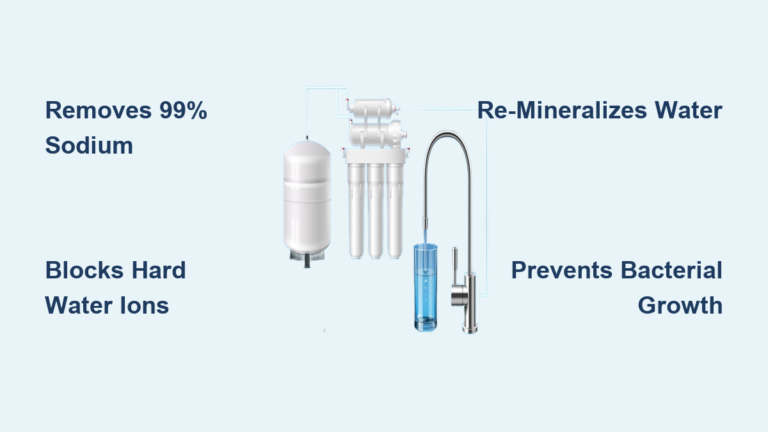
Solution: Choose an RO system with a remineralization stage. These add calcium, magnesium, or alkaline minerals back after filtration, improving taste and health value without reintroducing fluoride.
Wastewater: 2 to 5 Gallons Per Gallon Purified
For every gallon of clean water, RO systems discharge 2 to 5 gallons as concentrate. This matters in drought-prone regions.
Ways to reduce waste:
– Reuse wastewater for mopping, toilet flushing, or outdoor cleaning
– Install a permeate pump to cut waste by up to 80%
– Choose zero-waste RO systems (slower, more expensive)
Despite the waste, RO still beats distillation on overall efficiency.
Maintenance: Keeping Fluoride Removal Near 99%
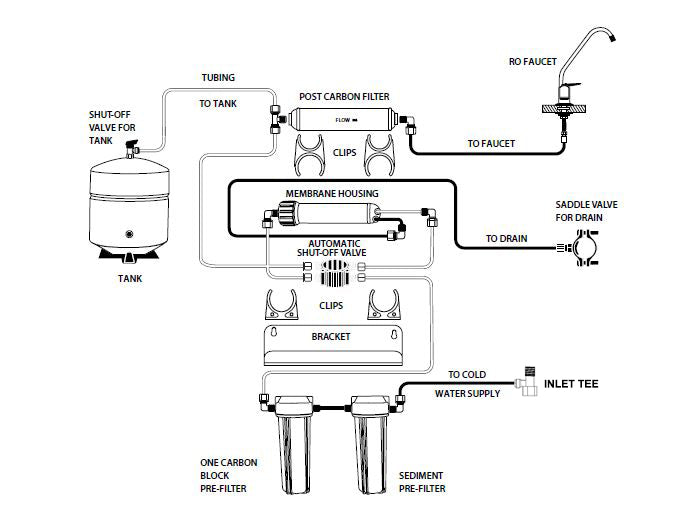
An unmaintained RO system gradually loses effectiveness. Here is how to keep yours performing.
Replace Filters on Schedule
| Component | Replacement Interval | Purpose |
|---|---|---|
| Sediment pre-filter | Every 6 to 12 months | Blocks dirt and sand |
| Carbon pre-filter | Every 6 to 12 months | Removes chlorine |
| RO membrane | Every 2 to 3 years | Removes fluoride and TDS |
| Post-carbon filter | Every 6 to 12 months | Polishes taste |
| Remineralization filter | Every 6 to 12 months | Adds minerals back |
Skipping pre-filter changes is the #1 cause of early membrane failure.
Monitor Performance with a TDS Meter
A $15 TDS meter tracks fluoride removal indirectly through total dissolved solids.
How to test:
1. Measure tap water TDS (e.g., 250 ppm)
2. Measure RO water TDS (e.g., 25 ppm)
3. Calculate reduction: (250 minus 25) divided by 250 equals 90%
If RO water climbs above 50 ppm or trends upward over time, the membrane likely needs replacement.
Warning: Never assume your system is working. Test every few months.
Who Benefits Most from RO Fluoride Removal
RO is ideal for specific groups concerned about fluoride exposure.
Families with Young Children
Infants and toddlers are more sensitive to fluoride. Excess intake during tooth development can cause dental fluorosis (white spots on teeth). Using RO water for formula mixing helps control exposure precisely.
People in Highly Fluoridated Regions
Some areas naturally have fluoride levels above 2.0 mg/L. The EPA limit is 4.0 mg/L, but health advocates recommend staying below 0.7 mg/L. RO brings levels down to near zero.
Individuals with Fluoride Sensitivity
Some people report headaches, joint pain, or digestive issues linked to fluoride. While research continues, RO offers peace of mind for those seeking elimination.
Health-Conscious Homeowners
If you already filter for lead, PFAS, or chlorine, adding fluoride removal completes the picture. RO delivers the most thorough purification in a single system.
How to Choose the Right RO System for Fluoride Removal
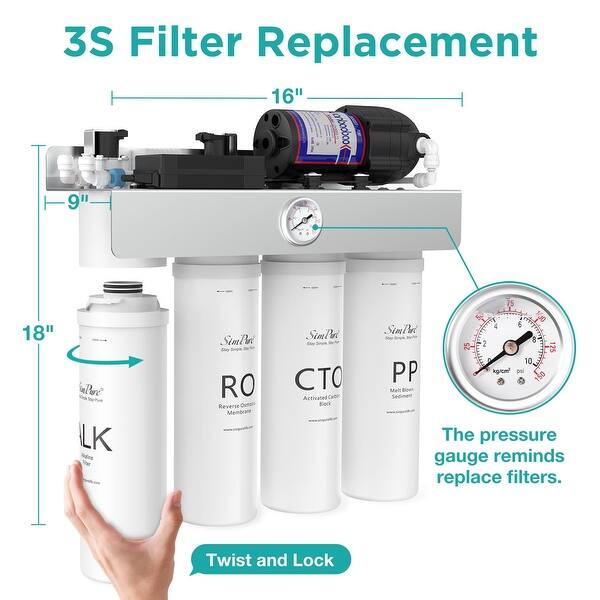
Not all RO systems are equal. Use these criteria to pick one that delivers.
1. Require NSF 58 Certification
This is non-negotiable. Check the product listing or manual for NSF/ANSI Standard 58 with fluoride reduction explicitly listed.
2. Look for Multi-Stage Filtration
A quality system includes at least 4 stages:
1. Sediment filter
2. Carbon block filter
3. RO membrane
4. Post-carbon filter
A 5th stage with remineralization improves taste and mineral content.
3. Prioritize Easy Filter Replacement
Choose models with quick-change filters and widely available parts. No tools should be required.
4. Check Flow Rate and Storage
Standard RO produces water slowly. A 4-gallon tank ensures purified water on demand. Look for flow rates of 50 to 100 GPD (gallons per day).
Frequently Asked Questions About Reverse Osmosis and Fluoride
Does reverse osmosis remove 100% of fluoride?
No system removes 100%, but high-quality RO eliminates 85% to 99% of fluoride. Well-maintained systems with intact membranes can reach 99% under optimal conditions.
How often should I replace the RO membrane to keep fluoride removal high?
Replace the membrane every 2 to 3 years under normal household use. If TDS readings in your purified water climb above 50 ppm or rise steadily, replace it sooner.
Can I add fluoride back to RO water if I want it?
Yes. Some people use remineralization cartridges that add calcium and magnesium but not fluoride. If you want fluoride specifically, you would need to add it manually, though most RO users prefer to keep it out.
Is RO water safe for babies and infant formula?
Yes. RO water is among the safest options for mixing infant formula because it provides near-zero fluoride, reducing the risk of dental fluorosis during tooth development.
Do refrigerator filters or pitcher filters remove fluoride?
No. Standard refrigerator filters, Brita pitchers, PUR faucets, and most ultrafiltration units do not remove fluoride. Only RO and distillation reliably reduce it at home.
Does boiling water remove fluoride?
No. Boiling actually concentrates fluoride as water evaporates. It is not a removal method.
Key Takeaways on Reverse Osmosis and Fluoride Removal
Reverse osmosis remains the most practical and effective residential method for fluoride reduction. It outperforms carbon filters, ultrafiltration, and water softeners, and it beats distillation on speed and energy efficiency.
- RO removes 85% to 99% of fluoride when properly maintained
- Only NSF 58-certified systems deliver verified fluoride reduction
- Regular filter and membrane replacement keeps performance near peak
- Remineralization stages restore taste and mineral content
- Wastewater can be reused to reduce environmental impact
Next step: Test your tap water’s TDS and fluoride level, then choose an NSF 58-certified RO system with remineralization. Replace filters on schedule and test RO output every 3 to 6 months. With the right system and care, you can enjoy fluoride-free, great-tasting water every day.