Does Reverse Osmosis Remove Forever Chemicals?

If you’re worried about “forever chemicals” lurking in your tap water, you’re not alone. Per- and polyfluoroalkyl substances (PFAS) are now detectable in the blood of 97% of Americans. These synthetic compounds, found in non-stick cookware, firefighting foams, and food packaging, resist natural breakdown and have been linked to cancer, immune dysfunction, and developmental issues. The critical question is: does reverse osmosis remove forever chemicals? The answer is a clear yes—reverse osmosis (RO) is the most effective residential filtration method available, consistently removing 90–99% of PFAS, including hard-to-capture short-chain variants like GenX and PFBS.
Unlike standard pitcher or faucet filters, RO systems use a dual-mechanism approach combining physical size exclusion and electrostatic repulsion to block PFAS at the molecular level. With pore sizes as small as 0.0001 microns, RO membranes physically trap PFAS molecules that are 5 to 15 times larger. This makes RO the only point-of-use technology capable of reliably reducing PFAS levels below the U.S. EPA’s enforceable limit of 4 parts per trillion (ppt) for PFOA and PFOS. In this guide, you’ll learn exactly how RO works against forever chemicals, how it compares to other filters, and what to look for when choosing a system that delivers real protection.
How RO Blocks Forever Chemicals

Reverse osmosis doesn’t just reduce PFAS—it stops them cold. The technology relies on a multi-stage process centered around a semi-permeable membrane that acts as a molecular gatekeeper. Two key mechanisms work in tandem: physical blockage and chemical repulsion.
Physical Size Exclusion
PFAS molecules range from 0.5 to 1.5 nanometers in size. In contrast, the pores in a high-quality thin-film composite (TFC) RO membrane are about 0.1 nanometers (0.0001 microns)—small enough to block nearly all dissolved contaminants. Because PFAS are significantly larger than these pores, they cannot pass through. This is steric hindrance in action: a physical barrier that works regardless of chemical charge or structure.
To visualize this, imagine trying to push a basketball through a chain-link fence. The ball is simply too big. Similarly, PFAS are too large to fit through the membrane’s microscopic pores. This mechanism is especially effective for long-chain PFAS like PFOA and PFOS, but it also applies to emerging short-chain replacements like GenX, which still exceed the pore size threshold.
Electrostatic Charge Repulsion
Even if a PFAS molecule were small enough to approach the membrane, it faces a second line of defense: electrostatic repulsion. In water, most PFAS carry a negative charge. The surface of a TFC polyamide membrane also carries a slight negative charge. Like two magnets with the same polarity, they repel each other.
This charge-based rejection is crucial for short-chain PFAS, which are smaller and more soluble than their long-chain counterparts. Without electrostatic repulsion, some of these molecules might slip through. But because of this dual-barrier system combining size plus charge, RO maintains removal rates above 90% across all regulated PFAS compounds.
RO vs. Other PFAS Filters
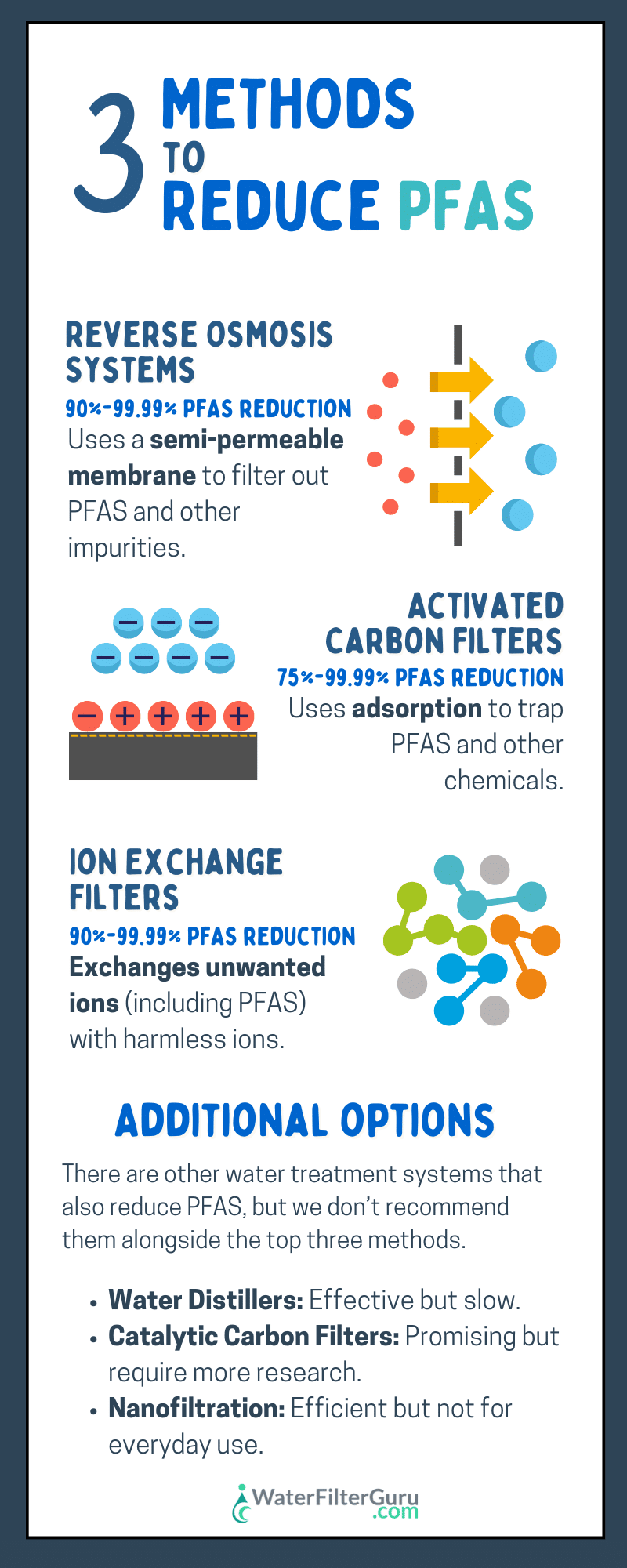
Not all water filters are created equal when it comes to PFAS. While reverse osmosis leads the field, other technologies like activated carbon and ion exchange vary widely in performance—especially against modern short-chain chemicals.
Activated Carbon: Limited and Unpredictable
Granular activated carbon (GAC) filters work by adsorption, trapping contaminants in their porous structure. While effective for long-chain PFAS (90–95% removal), GAC struggles with short-chain variants like PFBS and GenX, achieving only 50–70% removal.
A landmark Duke University and NC State study tested 76 residential filters and found GAC systems delivered inconsistent results—some removed nearly all PFAS, while others provided zero reduction. In some cases, filters even released trapped chemicals back into the water after saturation. This unpredictability makes GAC a risky choice for homes in high-risk areas.
Ion Exchange Resins: Effective but Costly
Anion exchange systems use charged resin beads to attract and bind PFAS ions. They offer high removal rates (95–99% for long-chain and 85–95% for short-chain PFAS) but come with trade-offs. These systems are more expensive, require regular regeneration or replacement, and are typically used in whole-house setups.
While effective, ion exchange is often overkill for most households. Since drinking and cooking are the primary exposure routes, a point-of-use RO system at the kitchen sink provides targeted, cost-effective protection without the complexity of whole-home treatment.
Standard Carbon Filters: Not Reliable
Pitcher, faucet, and refrigerator filters using basic activated carbon offer minimal PFAS protection, removing only 10–60% of contaminants. These filters are designed for taste and odor improvement, not health-threatening chemicals. Relying on them for PFAS removal is like using a screen door to keep out mosquitoes—some may be blocked, but many get through.
Proven PFAS Removal Rates by RO

Reverse osmosis doesn’t just claim to remove PFAS—it delivers measurable results. Peer-reviewed studies and EPA data confirm that high-quality RO systems consistently reduce PFAS to safe levels.
RO Removal by PFAS Type
| PFAS Compound | RO Removal Rate | EPA MCL (ppt) |
|---|---|---|
| PFOA | 96–99% | 4 |
| PFOS | 97–99% | 4 |
| PFNA | 94–98% | 10 |
| PFHxS | 93–97% | 10 |
| PFBS | 90–95% | 2,000 (mixture) |
| GenX | 91–96% | 10 |
Source: EPA PFAS Treatment Guide, Duke/NC State Study (2023)
RO systems reliably bring PFOA and PFOS levels below the EPA’s 4 ppt enforceable limit, even when source water exceeds 100 ppt. This kind of precision is critical—1 ppt is equivalent to half a drop of ink in an Olympic-sized pool.
Why RO Wins Against Short-Chain PFAS
As regulators crack down on PFOA and PFOS, industries are shifting to short-chain alternatives like GenX and PFBS. These newer chemicals are more water-soluble and harder to remove. Standard carbon filters fail to capture them effectively, but RO maintains over 90% removal due to its dual-mechanism design.
This makes RO the only single-step residential solution capable of handling mixed PFAS contamination—long-chain, short-chain, and everything in between.
Real-World RO Performance Data
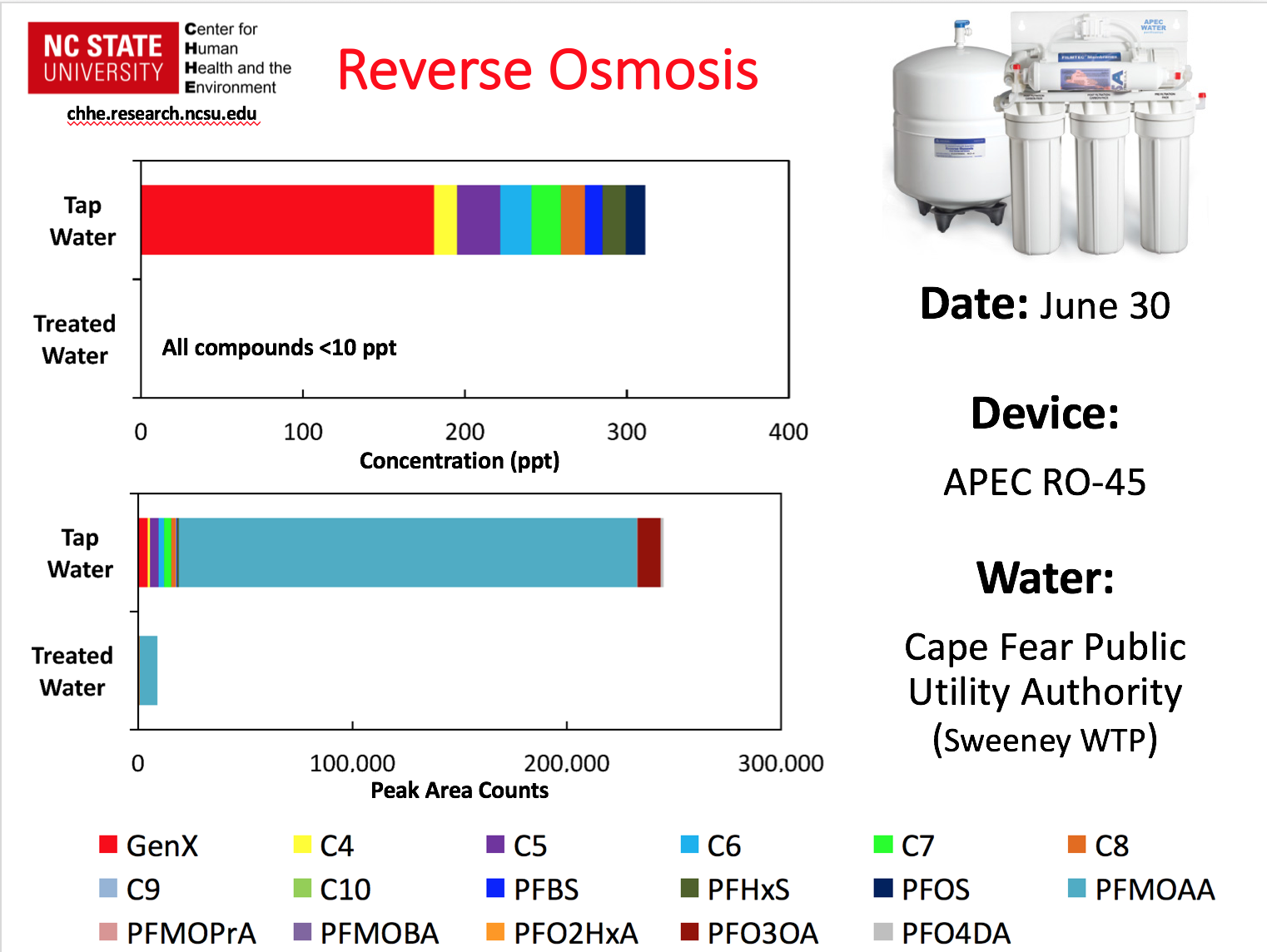
Laboratory results are one thing—real-world performance is another. A comprehensive study by Duke University and North Carolina State University tested residential filters in PFAS-impacted areas, delivering clear, actionable insights.
Duke/NC State Study Findings
- RO filters removed 94% or more of GenX and other PFAS.
- Two-stage filters also performed well, but sample size was small.
- Activated carbon filters averaged only 73% removal, with wildly unpredictable results.
- In four out of six whole-house carbon systems, PFAS levels increased after filtration, likely due to contaminant release or channeling.
The study concluded: under-sink RO is the most efficient and reliable system for home PFAS removal.
Whole-House Systems: Proceed with Caution
While appealing, whole-house activated carbon systems pose risks. They remove chlorine, which can lead to bacterial growth in plumbing. They also require frequent maintenance and may leach captured PFAS if not properly managed. For most homes, treating only drinking and cooking water with an under-sink RO system is safer, more effective, and far more economical.
Choosing a PFAS-Effective RO System
Not all reverse osmosis systems are built to handle PFAS. To ensure maximum protection, focus on three key factors: membrane type, certification, and system design.
Use TFC Polyamide Membranes
Only thin-film composite (TFC) polyamide membranes deliver the tight pore structure and negative surface charge needed for 90–99% PFAS rejection. Avoid older cellulose triacetate (CTA) membranes—they’re chlorine-resistant but less effective, removing only 80–90% of PFAS.
Look for NSF/ANSI Certification
Certification ensures your system performs as advertised:
– NSF/ANSI 58: Covers RO systems and verifies TDS reduction.
– NSF/ANSI 53: Confirms reduction of specific health contaminants, including PFAS.
As of 2024, standards are being updated to reflect the new 4 ppt MCL. Ask manufacturers: Does your system reduce PFAS below 4 ppt? Don’t settle for vague “PFAS reduction” claims.
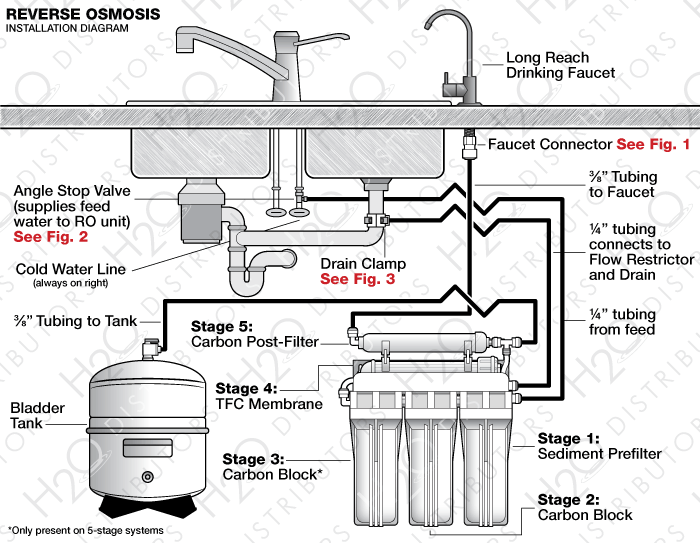
Multi-Stage Filtration Is Key
A high-performance RO system includes:
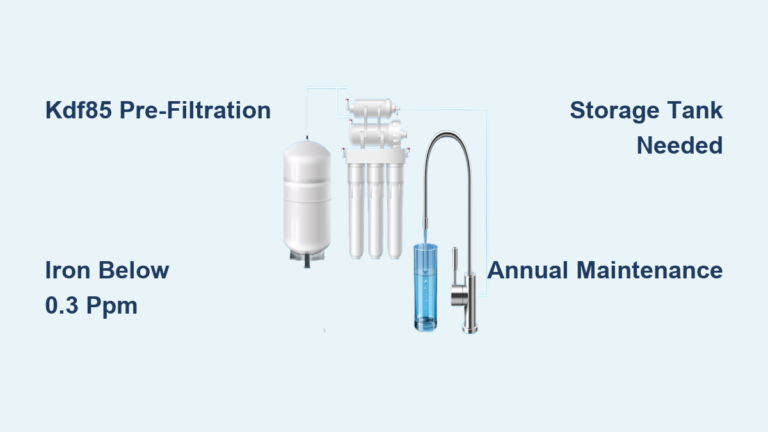
1. Sediment pre-filter – Removes rust and particles.
2. Carbon pre-filter – Removes chlorine (protects TFC membrane).
3. RO membrane – Removes PFAS, heavy metals, microplastics.
4. Post-filter – Polishes taste and removes VOCs.
This multi-stage design ensures long membrane life and maximum contaminant removal.
Installation and Maintenance Tips
Even the best RO system fails without proper care. Follow these steps to maintain peak performance.
Best Installation Options
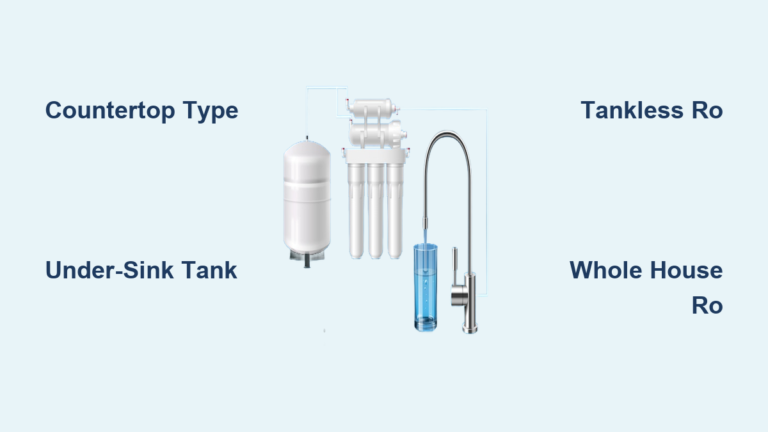
- Under-sink RO: Most popular and effective. Treats drinking and cooking water directly.
- Countertop RO: Ideal for renters. No plumbing required.
- Whole-house RO: Expensive and wasteful. Only consider for severe contamination.
For most households, under-sink RO strikes the best balance of performance, cost, and convenience.
Maintenance Schedule
- Pre- and post-filters: Replace every 6–12 months.
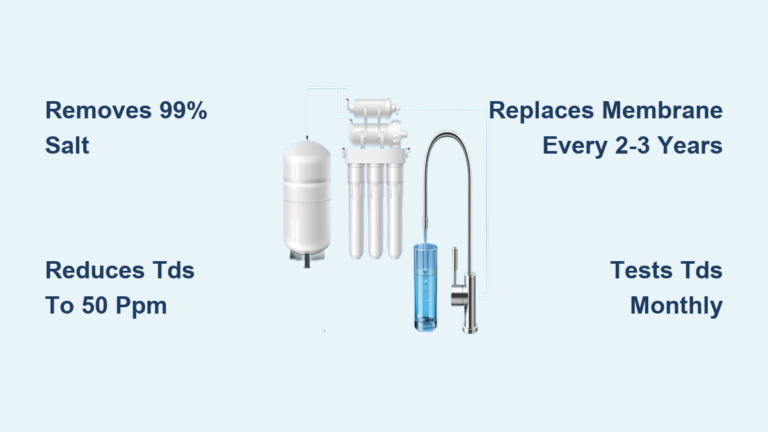
- RO membrane: Replace every 2–3 years (or when TDS rejection drops below 90%).
- Sanitize annually: Prevents bacterial growth in the storage tank.
Neglecting maintenance can lead to reduced flow, poor taste, or even contamination.
Test Your Water First
Before investing in a system, know what you’re facing.
How to Test for PFAS
- Check your CCR: Public water users should review their annual Consumer Confidence Report, which will include PFAS data starting in 2025.
- Use a certified lab: For private wells or independent verification, use labs certified for EPA Method 533 or 537.1. Cost: $200–$400 per test.
- Check contamination maps: The Environmental Working Group (EWG) offers a map of known PFAS sites. Proximity to military bases, airports, or industrial zones increases risk.
Testing confirms whether you need treatment and helps you choose the right system.
Debunking PFAS Myths
Misinformation can lead to false confidence. Here’s what doesn’t work—and what does.
Boiling Water: Makes It Worse
Boiling does not remove PFAS. In fact, it concentrates them by evaporating water. Never boil PFAS-contaminated water.
Bottled Water: Not a Guarantee
The FDA has no enforceable PFAS limit for bottled water. Consumer Reports has found PFAS in multiple brands. Bottled water is not a reliable solution.
Showering: Low Risk, But Not Zero
Dermal absorption of PFAS is minimal. Ingestion is the main concern. While whole-house RO can reduce exposure, focusing on drinking water is usually sufficient.
Frequently Asked Questions About Reverse Osmosis and PFAS
Does reverse osmosis remove all types of forever chemicals?
Reverse osmosis removes 90–99% of PFAS, including long-chain compounds like PFOA and PFOS, as well as short-chain variants like GenX and PFBS. No residential filter removes 100% of contaminants, but RO comes closest to meeting the EPA’s 4 ppt limit for the most dangerous compounds.
How often do I need to replace the RO membrane to maintain PFAS removal?
Replace your RO membrane every 2–3 years under normal household use. If TDS rejection drops below 90% of the original performance, replace it sooner. Pre- and post-filters should be changed every 6–12 months to protect membrane integrity.
Can a pitcher filter remove PFAS as effectively as reverse osmosis?
No. Standard pitcher and faucet filters remove only 10–60% of PFAS and perform especially poorly against short-chain chemicals. The Duke/NC State study found activated carbon filters averaged just 73% removal with wildly unpredictable results, while RO consistently achieved 94% or higher.
Is boiling water an effective way to remove forever chemicals?
Boiling water does not remove PFAS and actually concentrates them by evaporating clean water while leaving the chemicals behind. This method should be avoided if you suspect PFAS contamination.
Does reverse osmosis also remove microplastics?
Yes. RO membranes with 0.0001-micron pore sizes remove over 99% of microplastics, including submicron fragments. This makes RO a dual-purpose solution for two of the most pressing modern water contaminants.
What certification should I look for in a PFAS-effective RO system?
Look for NSF/ANSI 58 certification for RO systems and NSF/ANSI 53 for verified health-contaminant reduction, including PFAS. As of 2024, these standards are being updated to reflect the new 4 ppt MCL, so verify the product specifically claims reduction below 4 ppt.
Final Verdict on Reverse Osmosis for Forever Chemicals
When it comes to removing forever chemicals from your water, reverse osmosis is the only proven, reliable solution for home use. With 90–99% removal rates, third-party certification, and real-world validation, RO outperforms carbon filters, ion exchange, and all other point-of-use technologies.
While the upfront cost ($200–$1,000) and maintenance needs are higher than basic filters, the health protection is unmatched. For households in PFAS-impacted areas—or anyone seeking the highest standard of water safety—an NSF-certified, TFC-membrane RO system is the most effective step you can take.
Bottom line: Yes, reverse osmosis removes forever chemicals. And for those serious about clean, safe drinking water, it’s not just an option—it’s the standard. Start by testing your water, then choose a certified under-sink RO system to protect your household today.