Why Reverse Osmosis Wastes Water

You turn on the tap for a glass of crisp, purified water, and somewhere behind the scenes, your reverse osmosis system is sending several gallons down the drain. For homeowners who care about conservation, this feels contradictory. Why does reverse osmosis waste water when its purpose is to deliver clean drinking water?
The short answer is physics. Reverse osmosis forces water through a membrane so dense it blocks individual ions, and that process requires a constant flushing stream to carry contaminants away. In this guide, you will learn exactly how RO systems generate wastewater, what factors increase waste, how modern designs cut it dramatically, and practical ways to reuse the rejected water around your home.
How RO Membranes Force Out Impurities
Water Is Pushed Through Microscopic Pores
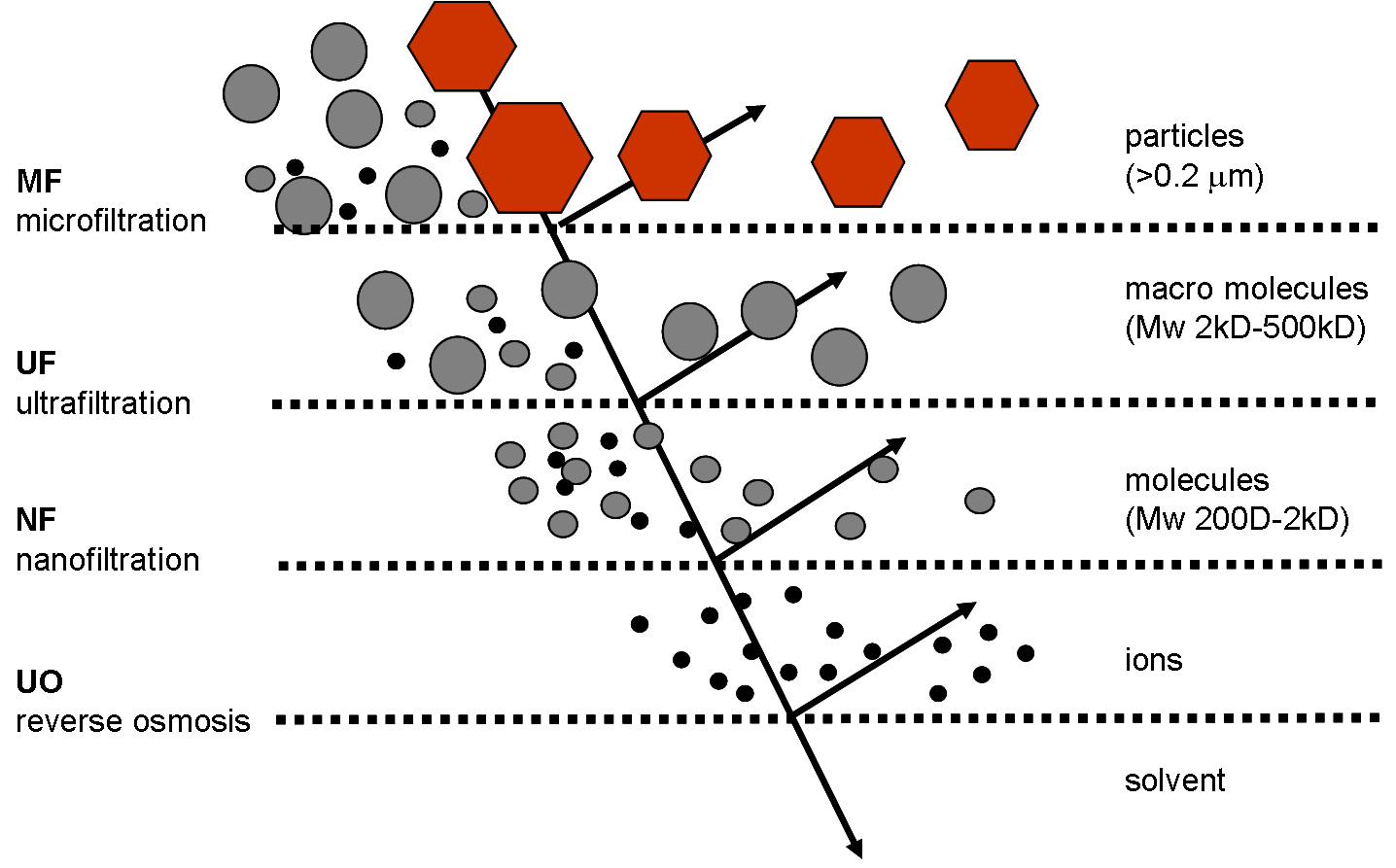
Reverse osmosis does not simply filter water. It reverses the natural osmotic process by applying pressure to push water molecules through a semi-permeable membrane. The membrane’s pores measure just 0.0001 microns, small enough to block heavy metals, dissolved salts, fluoride, nitrates, and most microbes.
Because the membrane cannot absorb or store these contaminants, they must be continuously swept away. A portion of the incoming water flows across the membrane surface, flushing the concentrated impurities to the drain. This method is called cross-flow filtration, and it is the reason RO inherently produces wastewater.
Why Other Filters Do Not Need a Waste Stream
Sediment and carbon filters work differently. A polypropylene filter traps particles like rust and sand down to 5 microns within its fibers, while an activated carbon filter adsorbs chlorine and organic chemicals on its surface. Neither requires a drain line because they capture contaminants rather than reject them.
But these filters cannot remove dissolved ions or microscopic pathogens. Only RO can, and doing so demands a way to dispose of what is captured. Without a waste stream, the membrane would foul, scale, and fail within days.
Typical RO Waste Ratios Explained

Standard Systems Waste 4 Gallons Per 1 Gallon Purified
Most traditional under-sink RO systems operate at a 4:1 waste ratio, meaning four gallons go to the drain for every one gallon stored. That equals a 25% recovery rate when measured without a tank.
In real-world use, the ratio is often worse. As the storage tank fills, compressed air inside creates backpressure against the membrane. By the time the tank is nearly full, the system may send 10 to 15 gallons down the drain for every additional gallon collected, dropping effective efficiency to just 10–15%.
Modern Systems Cut Waste Dramatically
Newer designs have transformed efficiency:
- Tankless RO systems with built-in booster pumps maintain 60+ PSI and achieve 1:1 to 2:1 ratios.
- Advanced units like the Waterdrop G2P600 produce 2 cups of purified water per 1 cup of waste, a 66% recovery rate.
- Countertop RO units often recycle pre-filtered water, achieving roughly 3:1 product-to-waste ratios.
These improvements mean today’s best systems waste 75% less water than older models while producing up to 800 gallons per day, compared to just 75 GPD for basic units.
Key Factors That Increase Water Waste
Low Water Pressure Slows Production
RO membranes need 35–40 PSI of incoming pressure to function efficiently. If your home falls below this range:
- The driving force through the membrane weakens.
- The system runs longer to produce the same amount of clean water.
- More water flows to the drain during each cycle.
Homes with well water or older plumbing often see waste ratios exceeding 6:1. Installing a booster pump or upgrading to a tankless RO system with an integrated pump solves this problem.
Full Storage Tanks Create Hidden Waste Spikes
When the storage tank fills, backpressure rises until it nearly matches incoming line pressure. At that point, very little water enters the tank, but the drain line keeps flowing. The system may cycle on repeatedly to maintain pressure, flushing gallons down the drain unnecessarily.
If your household uses little RO water, consider switching to a tankless model or installing a permeate pump to eliminate backpressure losses.
Old or Clogged Filters Increase Waste
Pre-filters protect the RO membrane from sediment and chlorine. If you do not replace them every 6–12 months, they become saturated. Chlorine then damages the membrane, reducing its ability to separate water from contaminants. A degraded membrane requires longer run times and more flushing, increasing waste.
Warning: Never skip filter changes. They are cheap insurance against costly waste and premature membrane failure.
How Permeate Pumps Slash Waste by 50%
They Use Waste Energy to Boost Efficiency
A permeate pump is the single most effective upgrade for tank-based RO systems. This mechanical device uses energy from the wastewater stream to push purified water into the storage tank.
Here is how it works:
- Concentrate flowing to the drain powers a hydraulic piston.
- That piston pressurizes the clean water side.
- This counteracts backpressure from the storage tank.
- The membrane sees less resistance and produces water faster.
With a permeate pump, recovery rates jump from 10–15% to 25–30%, and drain flow stops when tank pressure rises. Best of all, permeate pumps use no electricity and last for years with minimal maintenance.
Bottom Line: If you have a traditional RO system with a tank, adding a permeate pump can cut wastewater in half and pay for itself in water savings over time.
Reuse RO Wastewater: Smart Non-Potable Uses
It Is Not Sewage, It Is Recyclable Water
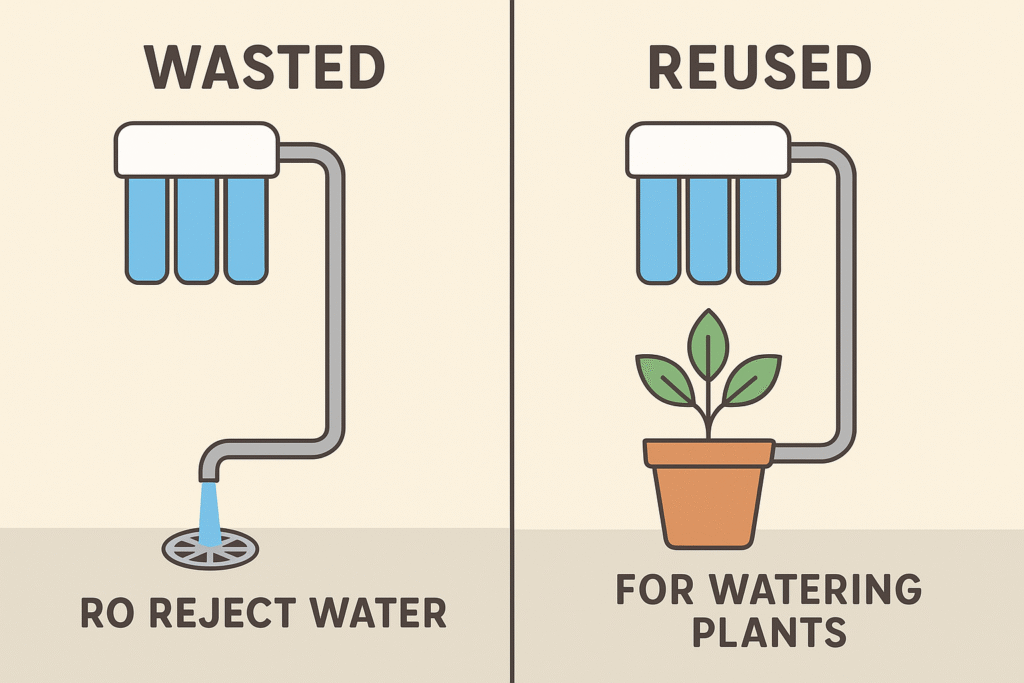
RO wastewater is often misunderstood. While unsafe to drink, it is not toxic. It has passed through sediment and carbon filters, so it is free of large particles, chlorine, and bad tastes. What remains are higher concentrations of calcium, magnesium, and dissolved salts.
This makes it suitable for many non-potable applications around your home.
Top Ways to Reuse RO Brine Water
- Water flower beds, trees, shrubs, and lawns. Avoid salt-sensitive plants like azaleas or blueberries if your source water is very hard.
- Mop tile and hardwood floors, scrub bathroom sinks, and clean outdoor patios without harsh chlorine residues.
- Collect RO waste in a bucket and pour it into the toilet bowl to save hundreds of gallons per year.
- Rinse cars, bikes, grills, and gardening tools before soaping. A typical car wash uses 40–75 liters.
Modern RO Designs That Waste Less Water
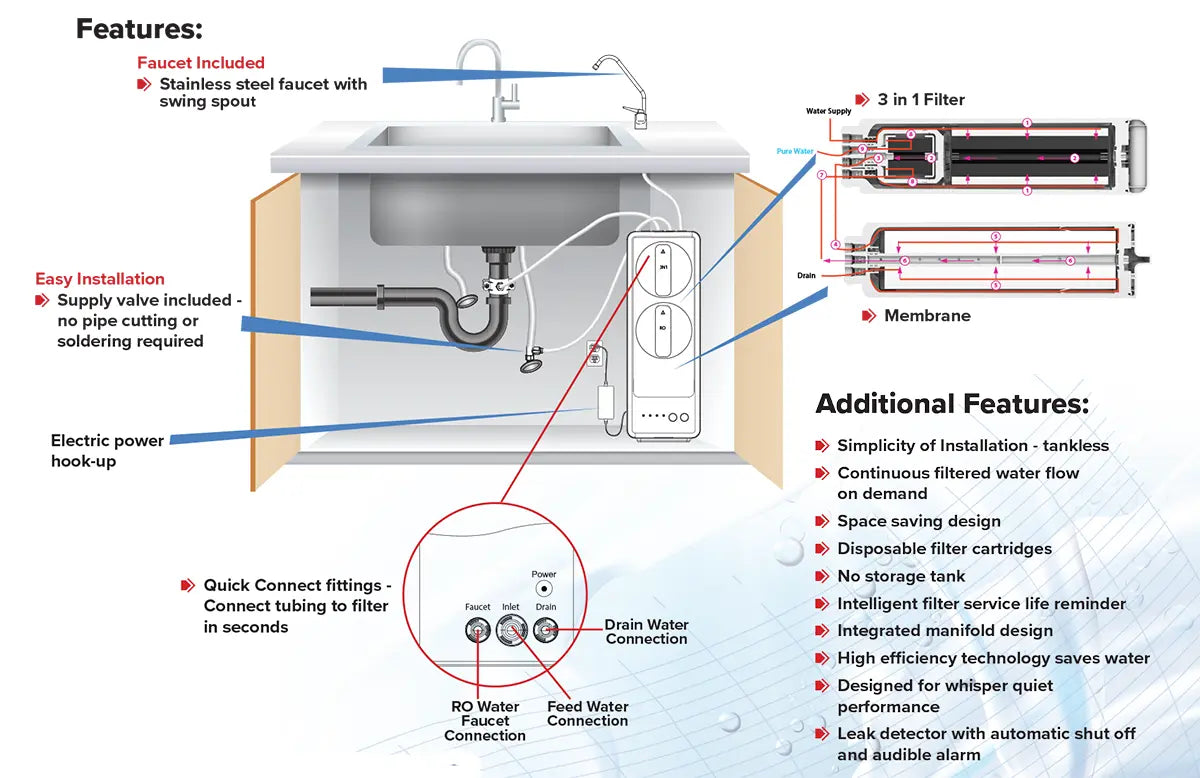
Tankless Systems Eliminate Backpressure
Traditional RO systems lose efficiency because of the storage tank. Tankless RO units solve this by using internal booster pumps to maintain 60+ PSI, delivering water on demand without a tank. Without backpressure, these systems achieve 1:1 to 2:1 waste ratios and produce up to 800 GPD, over 10x more than standard units.
Countertop RO Units Recycle Feed Water
Many countertop models use a closed-loop design that mixes pre-filtered water back with raw feed water. This dilutes the total dissolved solids entering the membrane, lowering osmotic resistance and boosting recovery to roughly 75%. These systems are excellent for renters who want high-efficiency RO without permanent installation.
Debunking RO Water Waste Myths
“RO Wastes More Water Than It Produces” Is Misleading
Traditional systems do waste 4x more water than they purify, but context matters. The average person uses only 5–10 gallons of RO water per week. Even at a 4:1 ratio, that equals just 20–40 gallons wasted monthly. Compare that to:
- A 10-minute shower: 50–70 gallons
- One load of laundry: 30–50 gallons
- One toilet flush: 1.6–3.5 gallons
RO waste is a drop in the bucket compared to other household uses. Plus, bottled water has a far worse footprint. Producing and transporting a single gallon of bottled water can require 3–5 gallons of water and more energy than running an RO system for months.
RO Water Costs Less Than Bottled
Even accounting for wastewater and filter replacements, RO water costs roughly 2 cents per gallon, compared to $1.22 for bulk bottled water and $7.50 for single-serve bottles. And unlike plastic bottles, RO systems generate no plastic waste.
Maximize Efficiency: Maintenance Checklist
Keep your RO system running at peak efficiency with regular care.
- Replace sediment and carbon filters every 6–12 months, the RO membrane every 2–3 years, and any post-carbon filter annually.
- Sanitize the system twice a year using 1 cup of food-grade hydrogen peroxide poured into the pre-filter housing, run for two full cycles, then flush thoroughly.
- Check monthly for leaks, faulty check valves, and worn flow restrictors that can cause continuous drain flow.
- Use a garden hose pressure gauge on an outdoor spigot to verify 35–40 PSI. Below 35 PSI requires a booster pump; above 80 PSI requires a pressure-reducing valve.
Frequently Asked Questions About RO Water Waste
Is RO wastewater safe for plants?
Yes, in most cases. RO concentrate contains calcium and magnesium that many plants tolerate well. However, avoid using it on salt-sensitive plants like azaleas or blueberries if your source water is very hard or high in sodium.
How much water does a typical RO system waste per day?
A traditional 4:1 system producing 5 gallons of drinking water per day wastes roughly 20 gallons. Modern tankless or permeate-pump systems can cut that to 5–10 gallons or less.
Can I send RO wastewater to a rain barrel or storage tank?
Yes, you can collect it in a bucket or divert it to an outdoor tank. Since the water lacks chlorine, use it relatively quickly to prevent bacterial growth, especially for indoor cleaning applications.
Do all RO systems waste the same amount of water?
No. Traditional under-sink systems waste the most, often at 4:1 ratios. Tankless systems with booster pumps achieve 1:1 to 2:1, and countertop recyclers can reach 3:1 or better.
Will a permeate pump really cut my waste in half?
In most tank-based systems, yes. Permeate pumps eliminate backpressure losses and boost recovery rates from 10–15% to 25–30%, effectively halving wastewater production.
Is RO water more expensive than tap water when you factor in waste?
Slightly, but not significantly. RO water costs about 2 cents per gallon including waste, compared to less than 1 cent for tap water. It is still far cheaper than bottled water and delivers far superior purification.
Final Thoughts on Reducing RO Water Waste
So why does reverse osmosis waste water? Because ultra-pure drinking water requires energy and flow to produce, and in RO systems, that flow carries away impurities. The wastewater is not inefficiency. It is how the membrane stays clean and functional.
Modern technology has dramatically reduced this waste. Permeate pumps double efficiency in tank systems, tankless designs eliminate backpressure entirely, and countertop recyclers boost recovery to 75%. Meanwhile, the rejected water is not trash. Use it to water plants, mop floors, or flush toilets, and you will minimize environmental impact while enjoying the safest drinking water available.
The bottom line: reverse osmosis does not waste water. It uses water wisely to deliver purity no other filter can match. Start by checking your home’s water pressure, replacing filters on schedule, and considering a permeate pump or tankless upgrade to maximize efficiency today.